
 Afiya Jafar
Fitness & Wellness Writer
Afiya Jafar is a fitness and wellness writer who focuses on making health, exercise, and healthy lifestyle information simple and practical.
Read Full Bio of Author →
Afiya Jafar
Fitness & Wellness Writer
Afiya Jafar is a fitness and wellness writer who focuses on making health, exercise, and healthy lifestyle information simple and practical.
Read Full Bio of Author →
 Sameena Begum
Health, Fitness & Digital Content Reviewer
Sameena reviews selected health, wellness, fitness, and digital content for clarity, factual presentation, and reader usefulness.
Read Full Bio of Reviewer →
Sameena Begum
Health, Fitness & Digital Content Reviewer
Sameena reviews selected health, wellness, fitness, and digital content for clarity, factual presentation, and reader usefulness.
Read Full Bio of Reviewer →
If you are seeking vegetarian protein foods for weight loss, you do not need to rely on meat or costly supplements. Indian vegetarian foods can all contain useful sources of protein including dal, paneer, tofu, soya chunks, chickpeas, rajma and curd – they just need to be worked into a calorie aware diet. Protein can also assist with satiety and the retention of lean muscle while losing weight – though total calories and overall diet quality influence this.
Why Protein Matters for Weight Loss
Protein is necessary for the preservation of muscle and other tissues in the body. During weight loss, a high protein diet may help prevent a significant lean mass loss. Studies examined in overweight and obese individuals reported that a high protein diet was associated with preserving lean weight during weight loss.
Higher-protein diets may also be associated with increased satiety. A systematic review of the evidence concluded that Higher protein intakes may be associated with increased satiety in overweight or obese individuals, though the evidence was inconsistent and varied according to the quality of the studies.
The key argument here is that protein alone is not a fat burning food. Regardless of the source, it is still the application of the right caloric deficit that really makes.
10 Protein-Rich Vegetarian Foods for Weight Loss
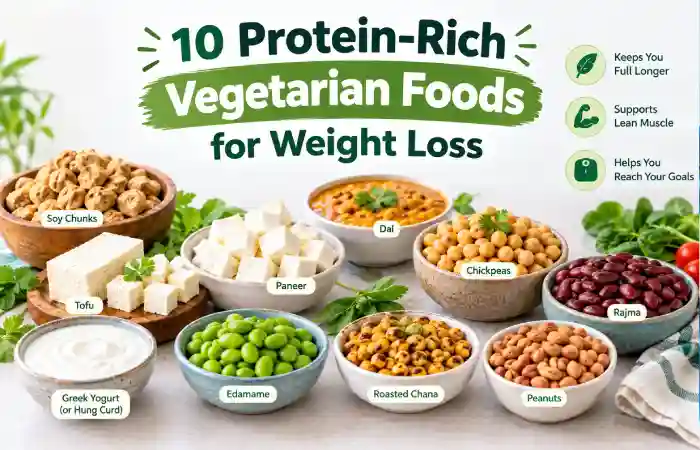
| Vegetarian food | Weight-loss-friendly use | Approx. protein |
| Soy chunks | Curry, pulao, bhurji | ~50–52 g/100 g dry |
| Low-fat paneer | Grilled, bhurji, salad | ~18 g/100 g |
| Tofu | Stir-fry, curry, scramble | ~8–15 g/100 g |
| Greek yogurt/hung curd | Breakfast or snack | ~9–10 g/100 g |
| Chickpeas/chana | Chaat, salad, curry | ~9 g/100 g cooked |
| Rajma | Rajma bowl or curry | ~9 g/100 g cooked |
| Moong dal | Dal, chilla, soup | ~7 g/100 g cooked |
| Edamame/soybeans | Salad or stir-fry | ~11 g/100 g cooked |
| Roasted chana | Controlled-portion snack | ~22 g/100 g |
| Peanuts | Small snack or topping | ~26 g/100 g |
Values are approximate as protein varies by variety, brand, preparation method and whether the food is weighed in cooked or uncooked form. Indian nutrition articles to date have also listed soy, paneer, tofu, dairy, dals and pulses as suitable vegetarian sources of protein.
Soy Chunks
Soy chunks are also among the highest-protein vegetarian foods available in India (a few references on current nutrition sources cite a protein content of about 50–52 g per 100 g of dry product).
Due to the high concentration of dry weight, one needs to use a reasonable cooked portion for comparison, not 100 g dry soy chunks as a true meal.
They made this by using; try: soy chunk curry with vegetables or soy bhurji.
Low-Fat Paneer
Paneer is easy to prepare, satisfying and ubiquitous. Low fat options can supply plenty of protein while conserving some of the calories derived from fat.
Have paneer with vegetables if you want to lose weight instead of just combining it with huge quantities of rice, naan or paratha.
Tofu
Tofu provides a convenient non-animal equivalent of paneer. Protein value differs significantly, so look for the nutrition information to compare ranges of brands. Typical Indian sources suggest around 8–15 g protein per 100 g from;
Consider: fried beans and eggs.
Greek Yogurt or Hung Curd
The strained curd contains more of the proteins in the individual servings than normal curd due to the removal of water. Unsweetened types should be used to eliminate any additional sugar added.
It does make a good breakfast, snack, raita or a foundation dish for a high protein dip.
Chickpeas
Chickpeas are high in both protein, and dietary fibre so are useful as a filling food. List as providing 8.9 g protein per 100 g cooked chickpeas (NDTV).
Have a try of chickpea salad with cucumber, tomato, onion, lemon and spices rather than a dressing which is heavy on calories
Rajma
Rajma contains protein and fibre and can be simply added to common Indian foods. To date nutrition references list the cooked form at about 9 g protein per 100 g.
The strategy for losing weight is moderation while rajma is healthy, the calorie count of the meal jumps greatly with the addition of generous portions of rice & oil.
Moong Dal
The moong dal is a good everyday source of protein. Cooked moong dal has about 7 g protein/ 100 g (based on today‘s food tables).
Use it to make daal, making as casserole, or in a moong-dal chilla. Add vegetables for extra bulk and fibres.
Edamame and Soybeans
Edamame provides plant protein and can be used in salads, bowls or stir-fries. Current Indian nutrition references list around 11 g protein per 100 g cooked edamame.
It is especially useful for people following vegetarian or vegan diets.
Roasted Chana
Roasted chana is an inexpensive snack option that combines protein and fibre. It can be more practical for weight management than frequently choosing fried snacks.
Keep the serving moderate because even nutritious foods contribute calories.
Peanuts
Peanuts contain significant protein, but they are also energy-dense because they contain considerable fat. Current references list approximately 26 g protein per 100 g roasted peanuts.
For weight loss, think of peanuts as a protein-containing addition, not an unlimited snack.
How Much Protein Do You Need?
The requirement for protein varies according to body weight, stage of life, physical activity, disease status and the diet. For Indian adults, under the standard reference assumptions stated earlier, the ICMR-NIN reference provides an RDA of 0.83 g/kg/day.
Diets used for weight-loss that provide a higher protein intake might target a different protein intake, especially in physically active individuals or individuals who want to maintain muscle. However, it is clear that there is no single protein intake target for all people.
For instance, if you weigh 60kg, you should not go away thinking that very high protein diet is required just because you want to lose weight.
How to Build a High-Protein Vegetarian Plate
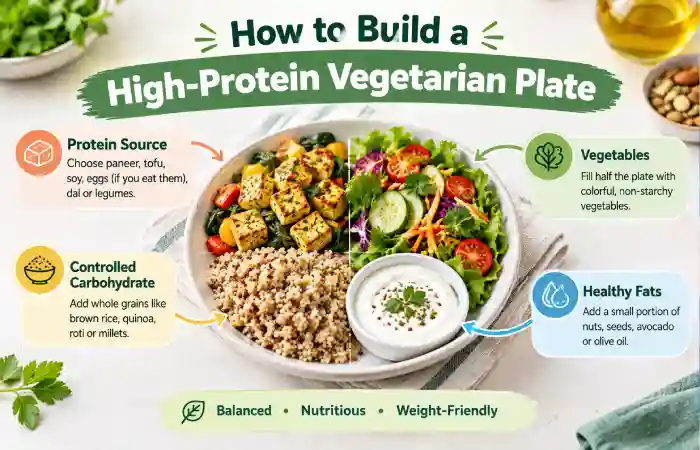
A simple approach is:
Protein source + vegetables + controlled carbohydrate + small amount of healthy fat
For example:
- Breakfast: Moong-dal chilla + unsweetened hung curd
- Lunch: Rajma + vegetables + a moderate portion of rice
- Snack: Roasted chana or curd
- Dinner: Tofu/paneer + mixed vegetables + roti
This approach makes protein part of normal meals rather than adding large amounts of protein on top of an already high-calorie diet.
Protein Comparison: Which Foods Are More Calorie-Dense?
It should be noted, however, that not all vegetharian foods that are high in protein are the same in regard to overall caloric content.
Other options higher in protein: m soy chunks, tofu, low-fat dairy and Greek yogurt. choices: müsli, chickpeas, renal beans and edamame.
More high calorie options : peanuts, almonds and seeds.
This difference is important because loss of weight does not depend on the amount of protein alone. These protein sources can be good foods, but still pack a lot of energy in a small amount.
Conclusion
There is no one best protein rich veg for weight loss. An assortment of soy, tofu, low fat paneer, curd, dals, chickpeas, rajma and otherlegumes can increase the satiety value and provide greater amount of protein for a vegetarian diet. Research has indicated that diets higher in protein can aid in modest weight and fat loss and help maintain lean body mass during energy restriction.
To achieve this goal sustainable results should be based upon reasonable protein intake, reasonable portions, vegetables and fibre, and conscious physical activity and overall calorie intake.
Afiya Jafar is a fitness and wellness writer who focuses on making health, exercise, and healthy lifestyle information simple and practical. Her work covers workouts, fitness motivation, strength training, nutrition, weight management, stress management, mindfulness, and everyday wellness.
Read full bio of Afiya Jafar
Sameena reviews selected health, wellness, fitness, and digital content for clarity, factual presentation, and reader usefulness.
Read full bio of Sameena Begum