

 Afiya Jafar
Fitness & Wellness Writer
Afiya Jafar is a fitness and wellness writer who focuses on making health, exercise, and healthy lifestyle information simple and practical.
Read Full Bio of Author →
Afiya Jafar
Fitness & Wellness Writer
Afiya Jafar is a fitness and wellness writer who focuses on making health, exercise, and healthy lifestyle information simple and practical.
Read Full Bio of Author →
 Sameena Begum
Health, Fitness & Digital Content Reviewer
Sameena reviews selected health, wellness, fitness, and digital content for clarity, factual presentation, and reader usefulness.
Read Full Bio of Reviewer →
Sameena Begum
Health, Fitness & Digital Content Reviewer
Sameena reviews selected health, wellness, fitness, and digital content for clarity, factual presentation, and reader usefulness.
Read Full Bio of Reviewer →
 Dr. Khizrana Begum
General Physician & Dermatologist
Dr. Khizrana Begum is a General Physician and Dermatologist with MBBS and MD qualifications and 5+ years of experience in the medical field.
Read Full Bio of Medical Reviewer →
Dr. Khizrana Begum
General Physician & Dermatologist
Dr. Khizrana Begum is a General Physician and Dermatologist with MBBS and MD qualifications and 5+ years of experience in the medical field.
Read Full Bio of Medical Reviewer →
In order to ensure that you sleep healthy, it’s necessary to get enough sleep. The CDC states that most adults ages 18-60 need at least 7 hours sleep per night. Adults 61 or over generally need 7 to 9 hours of sleep. The more older a person is, the fewer amount of hours he or she needs to sleep.
Better sleep is an important part of maintaining your overall health and well-being. To understand how sleep fits into physical, mental, emotional, and everyday self-care, explore this complete self care guide.
However, don’t stress over implementing and achieving the perfect sleep habits. Instead, work towards building an achievable daily schedule for yourself.
❝
This article is a part of
Self Care Hub
Why Self Care Matters for Sleep
They are mutually beneficial. If work-related stress, overstimulation or the need to be connected to others through various medias causes trouble getting the appropriate sleep in bed at the night, and then lack of good sleep the following day doesn’t aid dealing with potential daystress.
By practicing good self-care you create good circumstances that result in good sleep habits:
- Allocate yourself time for winding down at night.
- Don’t dwell in your problems in bed.
- Minimize the stimulation in the evenings.
- Allow light exposure and exercise during the day.
- Maintain a predictable schedule.
- Make sure the bedroom feels comfortable and is dark and quiet.
The term hygiene of sleep usually represents the sum of activities related to sleep and the conditions of the environment related to sleep, so solving sleep problems cannot be attained just by intervening in the activity sphere.
Creating a Relaxing Bedtime Routine
A bedtime routine gives your brain predictable signals that the day is ending.
You don’t need a complicated 20-step ritual. Try creating a 30–60 minute wind-down period.
For example:
60 minutes before bed: Finish demanding work and reduce bright lighting.
30 minutes before bed: Put your phone away, wash up and prepare your bedroom.
15 minutes before bed: Read, journal, stretch or practice slow breathing.
Bedtime: Go to bed when you’re ready to sleep.
The Better Sleep Council recommends using predictable calming activities to mentally and physically prepare for sleep.
A healthy bedtime routine can be easier to build when you have simple habits that fit your lifestyle. Explore these self care ideas for practical ways to relax, recharge, and support your well-being throughout the day.
Sleep-Friendly Evening Habits

Even small decisions in the evening can affect the time it takes for you to fall asleep. Focus on:
- The size of meals finished in the evening
- amount of caffeine consumed throughout the day
- consuming alcohol to help induce sleep
- doing gentle stretches over strenuous activity late at night
- dimming house lights an hour before bedtime
- no demanding conversations or complex work during the wind-down period
Habits performed throughout the day are equally important as both adequate activity as well as adequate daytime light may assist with your internal sleep-wake cycle.
Managing Stress Before Bed
Your own busy mind: Arguably, one of the most difficult issues to get over in terms of trying to sleep. Try and give your brain somewhere to express this busy mind rather than forcing you to stop thinking, and perhaps have a go at an easy “brain dump”:
- What is worrying you?
- What needs to be achieved tomorrow?
- Why could you potentially wait until another day?
- What was the greatest part of today?
Guided imagery, meditation, breathing, light stretching and relaxation are all good suggestions. According to Medical News Today they may help people unwind with breathing, meditation, stretching and other relaxation exercises, and guided imagery.
Screen Time and Sleep
Phones, tablets, computers and even the television can contribute to sleep problems as they emit light and they are also highly mentally stimulating.
An effective solution would be to create a no screen hour/half an hour before sleeping, so if bed time is at 10 p.m. stop using electronic devices or watching tv from 9 to 9:30 at least.
Instead of lying on the sofa scrolling through Social Media use these hour/s for:
Reading a printed book
Listening to calming music
Writing in a diary
A light stretch session
Preparing for the next day
A warm relaxing shower
Physical health and sleep are closely connected. Regular movement, nutritious food, hydration, and adequate rest can all be part of a balanced approach to caring for your body. Learn more about physical self care.
According to Health New Zealand, reducing stimulation is recommended as the lights that come off electronic devices in the evening may hinder natural sleep processes.
Try not to aim to be too strict; if an hour is too long try and start with just 15 or 30 minutes phone-free
Relaxation Techniques
There is no single relaxation technique that works for everyone. Experiment until you find one that feels natural.
| Technique | Best for | Time |
| Slow breathing | Racing thoughts | 2–5 min |
| Meditation | Mental stress | 5–10 min |
| Gentle stretching | Physical tension | 5–10 min |
| Reading | Mental transition | 10–20 min |
| Journaling | Worry/to-do thoughts | 5–10 min |
| Warm shower | Physical relaxation | 10–15 min |
A simple option is progressive muscle relaxation: gently tense and then relax different muscle groups, moving gradually from your feet toward your upper body.
Sleep Environment
In bed, you want something that should help you fall asleep- not something working against you. This means your bedroom should ideally be:
- Cool- comfortable, not too hot
- Dark- blackout curtains can help as can an eye mask
- Quiet- a sleep earplug, or steady white noise may help you sleep through external sound
- Comfortable- you need pillows as well as blankets that best complement the position in which you typically sleep
- Low stimulation- do not bring work stuff to bed, nor those unnecessary notifications that constantly buzz your phone or phone.
According to the CDC, “cool, dark, quiet” conditions are best when considering what habits promote sound sleep.
Sleep Product Comparison
| Product | Potential benefit | Best for |
| Eye mask | Blocks unwanted light | Light-sensitive sleepers |
| Blackout curtains | Darkens the room | Street/early-morning light |
| White-noise machine | Masks inconsistent sounds | Noisy environments |
| Comfortable pillow | Supports head and neck | Pillow discomfort |
| Sleep tracker | Helps observe patterns | Habit tracking |
Stress and unresolved emotions can sometimes make it harder to relax at night. Building healthy emotional habits, recognizing your feelings, and making time to unwind can support your overall well-being. Discover practical emotional self care practices.
Products should support good habits—not replace them.
Consistent Sleep Schedule
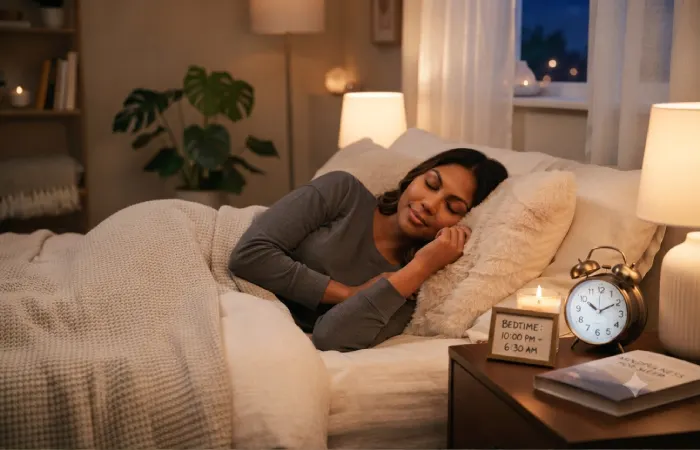
One of the most effective forms of sleep self-care is consistency.
Try to go to bed and wake up at approximately the same time every day, including weekends. Regular timing helps keep your body’s internal clock aligned with your daily routine.
If your schedule is currently inconsistent, don’t try to change everything overnight.
Instead:
1: Set a consistent wake-up time.
2: Move bedtime gradually toward your desired schedule.
3: Add a repeatable wind-down routine.
Consistency matters more than creating an elaborate routine that you abandon after a few days.
Common Sleep Habits to Avoid
Some habits can make sleep more difficult.
Avoid or reduce:
- Scrolling in bed for long periods
- Large meals immediately before bedtime
- Late caffeine
- Alcohol as a sleep strategy
- Intense exercise immediately before bed
- Working from your bed
- Frequently changing your sleep schedule
- Watching the clock when you’re unable to sleep
If you’re lying awake and becoming frustrated, getting out of bed and doing something quiet until you feel sleepy can be more helpful than forcing sleep.
Relaxing activities can help create a smoother transition from a busy day to bedtime. Whether you enjoy reading, gentle movement, journaling, or spending time outdoors, explore these self care activities for ideas you can add to your routine.
Building Better Sleep Habits
Don’t try to implement every sleep tip at once.
Start with these five:
- Choose a consistent wake-up time.
- Create a 30-minute wind-down routine.
- Put your phone away before getting into bed.
- Keep your bedroom dark, quiet and comfortable.
- Use one relaxation technique when your mind feels busy.
After these habits become routine, add another change if necessary.
Final Takeaway
Sleep self-care doesn’t have to be complicated, expensive or the ‘perfect’ thing. Most useful self care comes in fairly simple forms – it’s largely about preserving your schedule, easing your way into the evening, handling stress, minimizing stimulation in the hours leading up to bedtime, and making your sleep environment a sanctuary.
Managing stress and giving your mind time to recharge can make it easier to establish healthy sleep habits. Learn practical strategies for mental self care, including mindfulness, taking breaks, and setting healthy boundaries.
Begin with just one or two behaviors today. Once they feel like second nature, you can begin to layer others into the mix. Good sleep isn’t about finding the ‘perfect’ combination but providing conditions for rest.
Afiya Jafar is a fitness and wellness writer who focuses on making health, exercise, and healthy lifestyle information simple and practical. Her work covers workouts, fitness motivation, strength training, nutrition, weight management, stress management, mindfulness, and everyday wellness.
Read Full Bio of Afiya Jafar →
Sameena Begum reviews selected health, wellness, fitness, and digital content for clarity, factual presentation, consistency, and reader usefulness. Her review work helps maintain clear and responsible editorial standards across PhysicalFitt content.
Read Full Bio of Sameena Begum →
Dr. Khizrana Begum is a qualified medical professional with MBBS and MD qualifications and 5+ years of experience in the medical field. She works as a General Physician and Dermatologist, with expertise in general medicine, dermatology, preventive healthcare, and skin health.
Read Full Bio of Dr. Khizrana Begum →