
 Afiya Jafar
Fitness & Wellness Writer
Afiya Jafar is a fitness and wellness writer who focuses on making health, exercise, and healthy lifestyle information simple and practical.
Read Full Bio of Author →
Afiya Jafar
Fitness & Wellness Writer
Afiya Jafar is a fitness and wellness writer who focuses on making health, exercise, and healthy lifestyle information simple and practical.
Read Full Bio of Author →
 Sameena Begum
Health, Fitness & Digital Content Reviewer
Sameena reviews selected health, wellness, fitness, and digital content for clarity, factual presentation, and reader usefulness.
Read Full Bio of Reviewer →
Sameena Begum
Health, Fitness & Digital Content Reviewer
Sameena reviews selected health, wellness, fitness, and digital content for clarity, factual presentation, and reader usefulness.
Read Full Bio of Reviewer →
 Dr. Khizrana Begum
General Physician & Dermatologist
Dr. Khizrana Begum is a General Physician and Dermatologist with MBBS and MD qualifications and 5+ years of experience in the medical field.
Read Full Bio of Medical Reviewer →
Dr. Khizrana Begum
General Physician & Dermatologist
Dr. Khizrana Begum is a General Physician and Dermatologist with MBBS and MD qualifications and 5+ years of experience in the medical field.
Read Full Bio of Medical Reviewer →
Ways to cope effectively with normal pressure to help keep you calm, capable and healthy. It may be a complex technique which is not always the best approach; for many of us simple and combined efforts at controlling stress by being more aware, breathing, relaxing, keeping fit, planning your time more effectively and adopting a routine is effective.
When you want a broader overview of coping strategies, explore this guide to stress management and learn how different approaches can fit into your daily routine.
Stress is a normal reaction in response to pressure. It causes the stress response in the body which can be defined as the reaction the body has to a threat or demands made upon it; too much, or long-lasting stress, means the bodies’ own warning alarm becomes locked on.
❝
This article is a part of
Stress Management Hub
What Are Stress Management Techniques?
Stress management techniques are strategies which you can apply to cope with or prevent stress and it reduces its effect of the mind or body. They may cover some of the practices mentioned below:
- Breathing exercises
- Meditation and mindfulness practices
- Progressive muscle relaxation
- Mind-body practices such as yoga
- Exercise regimes- physical activities
- Time management skills
- Writing a journal and connection with others
- Good quality of sleep and life habits
It must be born in mind that there is no one practice which suits everyone so; you can consult with Mayo Clinic to understand your triggers and develop suitable coping skills and preferences.
Best Techniques for Managing Stress
| Technique | Difficulty | Best for | Time needed |
| Deep breathing | Easy | Immediate tension | 2–5 min |
| Mindfulness | Easy–Moderate | Repeated worrying | 5–15 min |
| Progressive muscle relaxation | Easy | Physical tension | 10–20 min |
| Exercise | Moderate | Ongoing stress | 20–30+ min |
| Yoga | Moderate | Mind + body tension | 15–30 min |
| Time management | Easy | Work/schedule stress | 10–20 min planning |
| Journaling | Easy | Racing thoughts | 5–10 min |
| Social connection | Easy | Emotional stress | Flexible |
Physical activity is another effective way to manage ongoing tension, and these stress relief exercises can help you incorporate movement into your stress-management routine.
The goal is not to practice every technique. Start with one or two that address your main source of stress.
Breathing Techniques for Stress
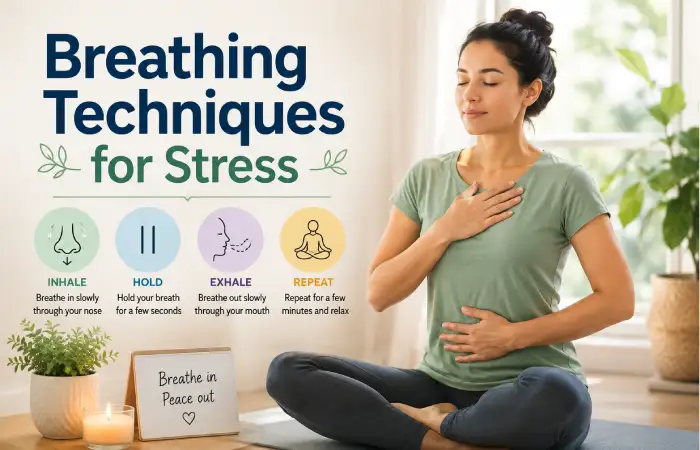
The basic breathing exercise is one of the easy stress-management techniques as one can practice it almost anywhere.
One simple exercise is given below to attempt:
- Sit calmly; ease your shoulders into an relaxed pose.
- Breathe in slowly and deeply through the nose.
- Allow your belly to rise slightly.
- Breathe out slowly; do not forcefully exhale the breath.
- Perform for several minutes.
Slow breathing exercise can be integrated into relaxation, meditation and yoga, respectively. Several studies that analyze single sessions of yoga, meditation, and breathing revealed that a majority of these studies included in the investigation demonstrated reduced acute stress responses.
Stop if breathing exercise creates dizziness or discomfort and resume normal breathing.
Mindfulness Techniques for Stress
Mindfulness is being present with yourself and a choice about your awareness that is not just taking things as they come and getting stuck on whatever worries about the present or future may present themselves.
Here is one practice of mindfulness:
notice / breathe / observe / return
notice what is. Bring attention to the breath and take it in nice and slow. Then notice what you notice, your thoughts and physical feelings; no judgment involved; and return to a conscious awareness of this moment.
What’s the most recent science?
A 2026 systematic review and meta-analysis of 17 randomized controlled trials (n=1641), using non-clinical adults, showed a statistically significantly smaller difference in mean stress scores between experimental and control conditions post-intervention with a standardized mean difference pooled post-intervention of 0.53.
2026 evidence snapshot
- 17 randomized controlled trials
- 1,641 participants
- 821 received mindfulness-based interventions
- 820 were controls
- Between-group effect: SMD −0.53
- 95% CI: −0.72 to −0.33
If your main source of pressure is your job, learning how to manage work stress can help you handle deadlines, workloads, and other workplace challenges more effectively.
This is encouraging evidence, although the researchers also reported substantial variation between studies.
Relaxation Techniques for Stress
Relaxation techniques aim to reduce physical tension and encourage a calmer state.
Popular options include:
- Progressive muscle relaxation
- Meditation
- Guided imagery
- Yoga
- Tai chi
- Deep breathing
- Walking outdoors
PMR, otherwise known as progressive muscle relaxation, includes intentionally contracting then releasing each set of muscles. It’s most helpful if stress manifests itself physically with muscle tension.
According to the Mayo Clinic, it can be part of your stress management plan and stresses the importance of finding the method that is right for you and practicing frequently.
Exercise and Stress Management
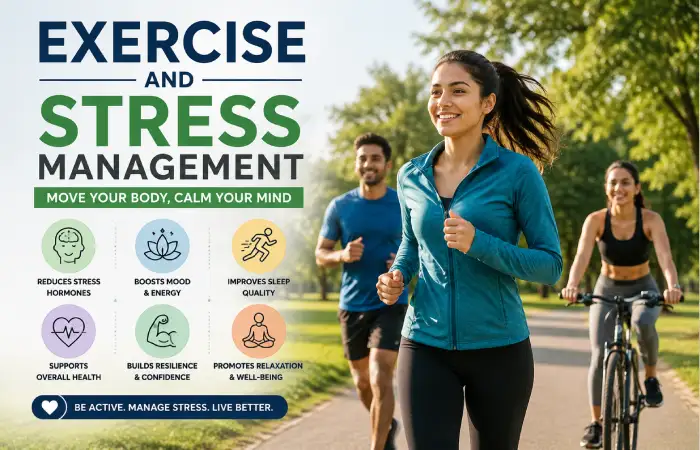
It’s a very common and useful tool for managing stress. Walking, swimming, cycling, dancing, running, yoga and other activity that you find enjoyable help you become more physically active and also give your mind time away from worried thoughts.
An intense workout is not needed. A manageable plan is often more helpful than overambitious goal setting that soon becomes another item for your stressed out agenda.
Current data also shows evidence for the utility of physical approaches as part of a comprehensive stress management plan. A 2025 review of workplace health promotion strategies concluded that cognitive-behavioral, stress-management and physical approaches achieved small results.
Time Management and Stress
When you manage time poorly, you are constantly hurried, miss deadlines, and can’t stop stressing in your head.
Here’s how to fix it:
- Write everything that has been assigned to you.
- Differentiate between your urgent tasks and your important tasks.
- Determine your top three tasks to concentrate on.
- Smaller tasks make huge assignments feel like smaller jobs.
- Make yourself take breaks instead of just pushing on for an unlimited length of time.
- Delegates or eliminates anything and anyone you do not want to accomplish with their commitment or a certain person.
- Assign practical due dates.
For a relaxation-focused approach, try incorporating meditation techniques for stress into your daily routine to encourage calmness and improve your ability to cope with everyday pressure.
Mayo Clinic suggests limiting what you commit to doing, and eliminating non-essential commitments, for example.
How to Choose the Right Stress Management Technique
The first thing you’ll want to ask yourself is how your stress is presenting.
- Is your body holding the stress? Try deep breathing, stretching or progressive muscle relaxation.
- Is your brain working at overdrive? Try mindfulness, meditation or journaling.
- Is work the source? Focus on time management, setting limits and picking your priorities.
- Is your body physically on edge? Go for a walk or some other exercise.
- Are you feeling lonely or excluded? Talk to someone you trust or be with people you feel cared by.
Simple lifestyle changes can also support natural stress relief by encouraging healthier habits that promote relaxation and overall well-being.
You can also practice multiple techniques! For instance, combine a mindful 10 minute walk.
An easier daily routine:
Morning: 2-5 minutes of controlled slow breathing
Work day: list and work on 2-3 things, take short movement breaks.
Evening: 5-10 minutes journaling, meditation, or relaxing activity.
Weekly: one activity with other people and one good physical exercise class or activity you enjoy.
Mindfulness can be particularly useful when stressful thoughts become overwhelming, so practicing mindfulness for stress may help you stay focused on the present moment.
The most important aspect to remember is consistency-not trying to execute it flawlessly.
If your symptoms have reached an all-time high, and are interfering negatively in your work, social life, personal relationships, and/or physical health, you’ll want to find a caring licensed psychologist or physician to discuss managing these symptoms further. These management techniques should not replace professional treatment-just enhance it.
The Bottom Line
Managing stress doesn’t need to be complicated. First find your stress triggers, then decide upon and implement a strategy to address them appropriately. Breathing may be useful for in-the-moment reset, mindfulness for reoccurring anxiety, relaxation for physical release, exercise for long term benefits and time management to prevent preventable stress. The optimal technique is one which is achievable.
Afiya Jafar is a fitness and wellness writer who focuses on making health, exercise, and healthy lifestyle information simple and practical. Her work covers workouts, fitness motivation, strength training, nutrition, weight management, stress management, mindfulness, and everyday wellness.
Read Full Bio of Afiya Jafar →
Sameena Begum reviews selected health, wellness, fitness, and digital content for clarity, factual presentation, consistency, and reader usefulness. Her review work helps maintain clear and responsible editorial standards across PhysicalFitt content.
Read Full Bio of Sameena Begum →
Dr. Khizrana Begum is a qualified medical professional with MBBS and MD qualifications and 5+ years of experience in the medical field. She works as a General Physician and Dermatologist, with expertise in general medicine, dermatology, preventive healthcare, and skin health.
Read Full Bio of Dr. Khizrana Begum →