
Last Updated: September 10, 2026
How to Motivate Yourself to Workout
The desire to get motivated for working out, you’re definitely not alone! Fitness enthusiasts sign up for a brand new year’s motivation session millions of times over every year, yet almost no one is working out 3 weeks later.
In short, motivation is temporary. Systems, habits, and psychology, is what keep’s people moving!
Workouts motivation is one of the key issues faced by people starting out a new fitness journey, you probably believe you do not have enough self control when you are just starting out, yet what many people do not understand is workout motivation is related with psychology, routines, energy levels and lifestyle pattern of people, in 2026, fitness experts focus less on ‘willpower’, yet more on..f
- identity-based habits,
- dopamine-driven routines,
- realistic scheduling,
- and sustainable exercise systems.
Whether you want to:
- lose weight,
- gain muscle,
- improve mental health,
- or simply feel healthier,
Establishing a consistent morning workout routine can help build discipline and make exercise a natural part of your day.
this guide will show you exactly how to stay motivated to work out consistently — even on difficult days.
❝
This article is a part of
Workout Motivation Hub
Why Workout Motivation Is Hard
Motivation is really simple to put in theory, but a really hard concept to keep up in practice. Every human wants to be energized and be comfortable, and the human brain is designed to think comfort first and preserve energy at all costs.
As exercises requires physical effort while watching videos, social media or taking a nap require no effort but provide a burst of dopamine; humans often get caught in a mental war between the need for instant comfort and the reward of exercising and having better health.
Psychology research of workout motivation that was conducted and published in recent years, people who have:
- feel stressed,
- lack sleep,
- set unrealistic goals,
- or do not enjoy their exercise routine.
Are more likely to skip working out sessions. Lifestyle related issues have become a really huge reason why we find it hard to work out. We all know that long hours of work, endless screen time and mental tiredness lead to low energy and our body perceives workout sessions much harder than they actually are.
Common Psychological Barriers to Exercise
| Barrier | How It Affects Motivation |
| Fear of Failure | People quit after missing a few workouts |
| Lack of Immediate Results | Progress feels slow |
| Gym Anxiety | Fear of judgment reduces confidence |
| Mental Fatigue | Stress lowers physical motivation |
Another important factor is the misunderstanding of motivation itself. Many beginners believe motivated people always “feel like” exercising. In reality, fitness experts explain that consistency usually comes from habits and routines, not daily excitement.
Studies of behavior science show that actions will lead to motivation and vice versa. As people start to be used to the exercises they do:
- improved mood,
- better sleep,
- increased energy,
- and reduced stress.
What Research Says About Workout Motivation
| Research Finding | Impact |
| Small habits increase consistency | Easier long-term adherence |
| Enjoyable workouts improve retention | People stick with fitness longer |
| Sleep quality affects motivation | Poor sleep reduces workout energy |
| Tracking progress improves commitment | Visible progress boosts consistency |
Many people stay committed to their fitness goals by participating in fitness motivation challenges that provide structure and accountability.
However, on a brighter side, workout motivation can actually be built, and instead of a temporary boost in workout motivation, the use of habits and psychology leads to better sustained results.
Common Reasons People Skip Workouts
Skipping a workout is something people seem to struggle a lot, especially when starting a workout plan. Most people find that it’s not their lack of motivation but a bunch of other reasons like mental habits, wrong expectations, stress levels and bad planning. Understanding these issues is the first step towards a long term consistent fitness journey.
One of the most common mistake we make is to work out way too hard. This is usually caused by overly ambitious plans, not taking our physical body’s limits into account. This overexertion leads to muscle damage, pain and in most cases to burn out in a few weeks, making us want to quit completely.
Another major issue is lack of immediate results. Fitness does take time, it is slower than most people expect, which is why many people will lose motivation when they do not get instant results. When it comes to body transformation or even building a certain fitness level it often takes several weeks, months, and years of effort to achieve those goals.
Also, there are lifestyle factors which lead to lack of motivation and also decrease workout motivation. Long work hours, stress levels, screen fatigue, lack of sleep etc. All take their toll, which make workouts appear much harder. Research published in sports psychology actually shows that people under a higher amount of stress and have lower physical energy levels are also more prone to skip their workouts.
Most Common Reasons People Avoid Exercise
| Reason | Effect on Consistency |
| Unrealistic Goals | Leads to burnout and frustration |
| Lack of Time | Busy schedules reduce routine building |
| Poor Sleep | Lowers physical energy |
| Gym Anxiety | Fear of judgment reduces confidence |
| No Visible Results | Causes loss of motivation |
| Boring Workouts | Reduces enjoyment and interest |
| Stress & Mental Fatigue | Makes exercise feel overwhelming |
When motivation starts to fade, reading inspiring stories and exploring workout inspiration ideas can help you regain focus.
Another issue for people is also gym anxiety, especially for people starting off in the year 2026. Most people fear working out in front of other gym goers and may feel inadequate, anxious or fear being judged which is what puts them off from working out in the first place.
For those who prefer structured fitness environments, learning how to stay motivated to go to the gym can improve workout consistency and long-term results.
Workout motivation is really helped by having a routine. You see research says that having a system and habits is much better than relying on motivation. The thing is, motivation can be really unstable.. Systems and habits are always there for you. So if you work out at the time every day that is a great system. You will not need to feel motivated to go and work out. You will just do it because it is what you do at that time.
Workout motivation is built by doing this every day. Having a system like this is really good because it helps you to not give up on working out. Workout motivation is important. It is not as important, as having a good system and habits. For example; scheduling your work out session at a particular time will ensure consistency at large.
Research-Based Factors That Improve Workout Consistency
| Habit Strategy | Benefit |
| Starting with short workouts | Reduces mental resistance |
| Exercising with friends | Improves accountability |
| Tracking progress | Increases motivation |
| Choosing enjoyable activities | Builds long-term consistency |
| Setting realistic goals | Prevents burnout |
Ultimately, consistency in workout is built around making workout more easier, manageable and enjoyable for the users. Consistent little steps bring greater rewards in the long term rather than quick, immense burst of motivation.
How to Build Exercise Habits
Generally it is believed that making your exercise habits is one of the best ways to achieve long-term exercise adherence. Because every person has a different motivation from one day to another; hence, one can’t rely on motivation for exercise adherence. In contrast, an exercise routine can make it easier to meet your goals because exercise habit is independent on whether you are motivated.
The biggest mistake many fitness newcomers make is trying to alter too many habits or fitness principles at once. Studies from psychology prove that slow and repetitive action is much more easier and is sustainable than sudden and intense workouts. Starting with a 10 or 15 minute session of working out will make the transition smooth and will not put too much pressure on you.
Also, for new fitness enthusiasts, it is highly advised that consistency beats intensity. Building a good routine such as walking is much better than doing some sort of workout for a brief period and then resting for days.
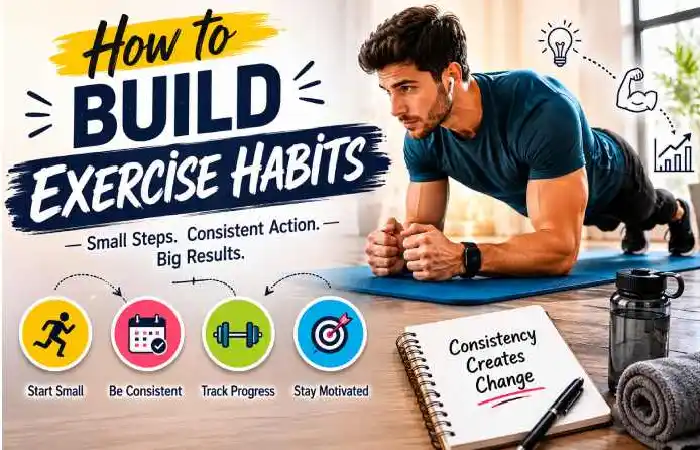
Habit stacking another useful idea will ensure that you don’t break any new habits you have already formed. It involves adding a new habit that you have recently formed to an already established daily routine. For instance:
- stretching after brushing your teeth,
- walking after lunch,
- or doing a quick workout after morning coffee.
This method advantages your brain couple workouts with existing routines, making them anxious to recall and maintain.
Understanding the connection between exercise and well-being can strengthen motivation, which is why exploring mental health and fitness motivation is beneficial for many people.
Simple Habit-Building Strategies for Fitness
| Strategy | How It Helps |
| Start Small | Reduces mental resistance |
| Schedule Workouts | Builds consistency |
| Habit Stacking | Makes routines easier to remember |
| Prepare Clothes Early | Removes excuses |
| Track Progress | Creates motivation through visible improvement |
| Choose Enjoyable Workouts | Increases long-term consistency |
Research also suggests that environment acting a major role in exercise habits. Humans are more liable to work out when:
- gym clothes are visible,
- workout equipment is accessible,
- and distractions are reduced.
Developing stronger habits often involves improving time management through fitness productivity strategies that keep your workouts a priority.
Having a place at home for working out even if it is small can help you stick to your routine. This is because it helps you remember that you need to do your workout every day. Having a workout space at home can really make a big difference in how consistent you are, with your workout routine.
Research-Based Factors That Improve Exercise Habits
| Research Insight | Benefit |
| Small goals improve adherence | Easier long-term commitment |
| Consistent timing builds routine | Workouts feel automatic |
| Tracking habits increases success rates | Encourages accountability |
| Enjoyable exercise improves retention | Reduces quitting |
Another important factor is identity-based thinking. Instead of saying:
“I’m trying to work out,”
think:
“I’m becoming a healthy and active person.”
It can provide to feeling like the routine is part of your lifestyle in its place of a chore.
Through consistency, you form neurological patterns that facilitate adherence to the activities you want to perform. In other words, what you should be aiming for is consistency, not perfection.
Best Motivation Tricks That Actually Work
Workout motivation is not about waiting for inspiration every day. Most successful fitness plans utilize some of the simplest motivational tricks to help their participants maintain their routines. In 2026, fitness specialists focus on habit systems and behavioral science rather than bursts of motivational inspiration.
One of the most popular habit systems used for morning workouts is the 5 minute rule, where instead of feeling you must complete your whole workout you try to workout for just 5 minutes. Behavioral psychology research has shown that getting started is one of the hardest components of the entire task. Once people begin moving, they are far more likely to continue. (healthline)
Another proven strategy is reducing “friction.” The more barriers one can take out of starting a workout the more likely one is to complete it. Items such as clothes, water bottles, or apps being prepared for one’s workout session the night before will take away many mental barriers.
The act of listening to music while you exercise is known to have a profound effect. Studies have shown that when you listen to upbeat music it will actually help to boost your workout endurance, your mood and it also helps with workout motivation because it plays on the dopamine system. A personally curated playlist ensures maximum positive feelings whilst working out.
Motivation Tricks That Improve Workout Consistency
| Motivation Trick | Why It Works |
| 5-Minute Rule | Reduces mental resistance |
| Workout Playlists | Improves mood and energy |
| Preparing Clothes Early | Removes excuses |
| Habit Tracking | Creates visual progress |
| Reward Systems | Builds positive reinforcement |
| Exercising with Friends | Increases accountability |
Tracking progress is another powerful motivator. Many people quit because they focus only on body weight instead of overall improvement. Tracking:
- energy levels,
- workout streaks,
- strength gains,
- sleep quality,
- and mood improvements
helps people notice progress earlier.
Research-Based Motivation Findings
| Research Insight | Effect on Motivation |
| Small wins increase dopamine | Encourages habit repetition |
| Social accountability improves consistency | Reduces skipped workouts |
| Enjoyable workouts improve retention | People exercise longer |
| Progress tracking boosts commitment | Creates long-term discipline |
Another important tactic is making workouts enjoyable as a replacement for of punishing. People are more likely to stay constant when they select activities they genuinely enjoy, such as:
- walking,
- dancing,
- cycling,
- swimming,
- or home workouts.
If you struggle with consistency, these tips to stay motivated for home workouts can help you build a sustainable exercise routine without leaving your house.
Experts also recommend focusing on identity instead of outcomes. Saying:
“I’m becoming a healthy person” creates stronger long-term motivation than focusing only on weight loss.
The best trick to stay motivated is to execute that consistent training is superior than working out at a high passion only one or two times a week. Small, repeated bursts of activity result in long-term gains.
Morning Workout Motivation Tips
The morning workout can increase energy and focus during the day and help maintain consistency. One of the biggest works many have in incorporating morning workouts is causing out of bed early abundant to get their workout done. The greatest struggle is not necessarily the workout but the mental resistance one feels when waking up.
According to many fitness psychologists, people are more consistent with their morning workout routine because the activity takes place before the day has a chance to fill up with business, unexpected responsibilities, or work related stresses. A successful morning workout routine requires both proper sleep and simple habit systems.
For the morning workout routines, the first necessary factor is adequate amount of sleep. Poor sleep levels would certainly negatively affect people’s energy, motivation, and physical ability; doctors recommended people to have an appropriate 7-9 hours of sleep.
One strategy to help make morning workouts more accessible is to cut down on decision making once one is awake. The more decisions you have to make after you roll out of bed, the more prone one will be to skipping their workout. Simple habit systems that help the body and mind bypass decision-making can greatly help people with morning exercise adherence.
If you’re struggling to stay consistent, these proven workout motivation tips can help you build a sustainable fitness routine.
Simple Morning Workout Motivation Strategies
| Strategy | Why It Helps |
| Sleep Earlier | Improves energy and recovery |
| Prepare Clothes at Night | Reduces excuses |
| Keep Alarm Away from Bed | Forces physical movement |
| Start with Short Workouts | Lowers mental resistance |
| Drink Water Immediately | Boosts alertness |
| Use Music or Podcasts | Creates positive mood |
Starting with quick and manageable workouts is also crucial. Many beginners fail because they try extreme morning routines immediately. Research shows that even 10–20 minutes of exercise can enhance mood, circulation, and mental clarity.
Another powerful technique is habit loading, where workouts are linked to existing morning routines. For example:
- coffee → workout,
- brushing teeth → stretching,
- morning music → walking.
This creates automatic behavioral patterns over time.
Research-Based Benefits of Morning Exercise
| Research Finding | Benefit |
| Morning workouts improve consistency | Fewer skipped sessions |
| Exercise boosts dopamine levels | Better mood and motivation |
| Morning sunlight improves energy | Supports better sleep cycles |
| Short workouts still improve health | Easier habit formation |
Experts also recommend avoiding perfectionism. Missing one morning workout does not ruin progress. The goal is building a sustainable routine that feels realistic long-term.
Over time, consistent morning workouts can become automatic habits, making exercise feel less like a task and more like a natural part of daily life.
Home Workout Motivation Ideas
Since the year 2026, home workouts have gained significant traction for a variety of reasons: ease, low cost and convenience. However, staying focused is often a challenge, with a plethora of distractions, it’s easier to lose focus at home than in a gym and have less accountability. (coursera)
The biggest benefits of home workouts include that they are very accessible; you don’t require equipment or large space to stay fit. Simple exercises include:
- bodyweight squats,
- push-ups,
- walking workouts,
- yoga,
- and resistance band training
can still deliver excellent fitness results when done consistently.
When working out from home, the main challenge often becomes concentration and a solid routine. Due to the casual setting, it is far too easy to put it off or lose enthusiasm; but as is shown by behavioral psychologists, having a dedicated workout space enhances exercise adherence because the brain will start to associate the space with working out.
Effective Home Workout Motivation Strategies
| Strategy | Benefit |
| Create a Workout Space | Builds mental focus |
| Follow Guided Videos | Reduces planning stress |
| Use Fitness Apps | Improves accountability |
| Schedule Workout Times | Creates routine |
| Keep Equipment Visible | Encourages consistency |
| Play Energetic Music | Boosts motivation |
Fitness apps and online videos are major tools to encourage fitness in 2026. They simplify the process as all you need to do is follow it along, and the user is no longer having to find a workout they want, instead they know exactly what they need to do each day, thereby reducing decision fatigue. Many apps also include:
- progress tracking,
- reminders,
- workout streaks,
- and community challenges.
These features help improve accountability and consistency.
In addition, users can keep a positive outlook on working out by making it pleasurable rather than taxing. According to studies, enjoyment of exercise can keep people motivated to continue with their workout regime for significantly longer. Some people prefer:
- dance workouts,
- home HIIT sessions,
- Pilates,
- strength training,
- or walking workouts.
Enjoyable movement is key more so than perfect fitness trend knowledge.
Research-Based Benefits of Home Workouts
| Research Finding | Impact |
| Scheduled workouts improve adherence | Better long-term consistency |
| Guided workouts reduce mental resistance | Easier habit formation |
| Enjoyable exercise increases retention | Lower dropout rates |
| Visible equipment encourages activity | Higher workout frequency |
Social accountability also helps with home workout consistency. Many people stay motivated by:
- joining virtual fitness groups,
- sharing progress online,
- or exercising with friends or family members.
Keeping workouts at home simple, consistent, and relatively short can make significant changes to your health and happiness over time. By building a good, solid habit that is not difficult to integrate into your daily routine, the possibilities of the fitness world are endless.
Motivation for Weight Loss
Focus on Process Goals
Bad goal:
“Lose 20 kg.”
Better goal:
- walk 8,000 steps,
- complete 4 workouts weekly,
- eat protein daily.
If your primary goal is shedding fat, explore these weight loss workout motivation strategies designed to keep you consistent and results-focused.
Don’t Rely on Scale Weight Alone

Track:
- energy,
- measurements,
- progress photos,
- sleep,
- mood,
- and strength.
Avoid “All-or-Nothing” Thinking
One missed workout does not ruin progress.
Consistency beats perfection.
Apps & Tools to Stay Consistent
Keeping on track when working out from home becomes extremely easy when you’re armed with the appropriate fitness apps and tools, with technology playing a large role in 2026 in people tracking their progress and forming healthy habits, it can seem an impossible task for beginners that don’t have any structure when starting. Fitness apps and the like work on simplifying these complex routines to make the workout process more organised and simple.
A huge benefit of using these fitness apps is accountability. By seeing your workout streaks, reminders and personal goals that are ticking off with progress made. According to studies done into health and digital behavior individuals who log and track their workouts are significantly more likely to maintain them long term.
These types of workout apps also benefit from making the planning process more effortless, eliminating the thought process behind ‘what do I need to do today?’ The app guides you through a routine eliminating indecision for beginners.
For those just starting out, this beginner-friendly workout motivation guide breaks down simple steps to get moving without feeling overwhelmed.
Fitness wearables, such as smartwatches, are growing evermore popular.
- daily steps,
- calories burned,
- heart rate,
- sleep quality,
- and workout intensity.
Monitoring these types of metrics allows users to recognize positive changes beyond just weight loss that would help the user stay motivated.
Best Fitness Apps for Beginners in 2026
| App | Best For | Key Feature |
| Nike Training Club | Beginners | Free guided workouts |
| Fitbod | Strength training | Personalized gym plans |
| MyFitnessPal | Weight loss | Nutrition tracking |
| Strava | Running & cycling | Community challenges |
| Boostcamp | Workout programs | Simple training plans |
Another useful tool for developing a healthy habit such as exercising regularly is using a habit tracker, research has shown that humans gain satisfaction and are therefore more likely to stick with a habit if they are visually rewarded with seeing the progress made.
Fitness Tools That Improve Workout Consistency
| Tool | Benefit |
| Smartwatch | Tracks activity and progress |
| Resistance Bands | Easy home workouts |
| Adjustable Dumbbells | Strength training at home |
| Habit Tracker Apps | Builds accountability |
| Wireless Earbuds | Improves workout focus |
Studies in fitness psychology also suggest that social accountability improves workout consistency significantly. Many apps now include:
- friend challenges,
- community leaderboards,
- and progress sharing.
These features create motivation through social interaction and friendly competition.
Research-Based Benefits of Fitness Tracking
| Research Finding | Impact |
| Progress tracking improves adherence | Higher workout consistency |
| Reminder notifications reduce missed workouts | Better routine building |
| Community support boosts motivation | Lower dropout rates |
| Wearables increase daily activity levels | Improved long-term fitness |
The most effective fitness app/ tool is going to be the one you actually use on a regular basis, if you use a simple habit tracker consistently, that will be more effective in forming habits long term that a very sophisticated app that is difficult to get along with.
Fitness Goal Setting Tips
Goal setting is of huge importance when maintaining an active routine as this encourages consistency; failure often comes with unrealistic or undefined goals that are set only with the thought of instant results, in 2026 it’s suggested to focus your goals in fitness as a practical measure that is measurable and repeatable over time.
One of the biggest mistakes beginners make is setting goals that are too broad, such as:
- “I want to get fit”
- “I want to lose weight fast”
These goals lack structure and make progress difficult to measure. Instead, experts recommend using the SMART goal method, which stands for:
- Specific
- Measurable
- Achievable
- Relevant
- Time-bound
SMART goals help create a clear roadmap and improve accountability.
Examples of SMART Fitness Goals
| Weak Goal | Better SMART Goal |
| Get healthier | Walk 30 minutes 5 days a week |
| Lose weight | Lose 5 kg in 3 months |
| Build muscle | Strength train 3 times weekly |
| Exercise more | Complete 20 workouts this month |
Research done on exercise psychology demonstrates that smaller milestone based goals will be achieved in exercise more readily than extreme transformation goals as smaller achievements provide greater positive affirmation for your brain (dopamine).
A useful alternative to the above is to set process goals rather than just outcome based ones. The latter refers to achieving the end product, whereas the former focuses on your daily targets.
For example:
- Outcome Goal: Lose 10 kg
- Process Goal: Exercise 4 times weekly
Process goals are more effective because they are fully within your control.
Research-Based Goal Setting Strategies
| Strategy | Benefit |
| Small milestone goals | Reduces overwhelm |
| Tracking progress | Increases accountability |
| Realistic timelines | Prevents burnout |
| Process-focused goals | Builds consistency |
| Written goals | Improves commitment rates |
Fitness tracking apps, journals or even photo updates all boost goal achievement; evidence suggest those that track workouts consistently are more likely to maintain the fitness habit in the long term.
Another essential factor is flexibility; as life and circumstances differ, so will workouts; these goals should reflect that. You shouldn’t consider one missed workout a sign that you are not cut out for it.
Your fitness goals will not be ones of perfection in 2026, but ones of progress and consistency.
FAQs
How do I force myself to workout everyday?
Consistency rather than intensity; build habits, remove the friction and have fun. Motivation will come after the action is already taken.
What if I hate working out?
You may dislike your current workout style. Try:
- walking,
- cycling,
- dancing,
- swimming,
- martial arts,
- or home workouts.
How long does it take to build exercise habit?
Studies predict 2-3 months will build automatic habits with enough repetition.
Is discipline more important than motivation?
Motivation changes on an hourly basis, but discipline built from a system will maintain exercise adherence consistently. This topic comes up in many different communities.
Which workout apps help beginners most?
Nike Training Club and Fitbod are well-known for their user-friendly design and functionality.
Conclusion
Learning how to cause yourself to work out comes less from acquiring exact inspiration and more from building systems for your situation so that exercise becomes easier to copy.
Most successful workout journeys are fueled by:
- small consistent habits,
- enjoyable workouts,
- realistic goals,
- accountability,
- and long-term thinking.
In 2026, fitness experts agree on one thing:
You do not need extreme motivation to succeed.
You need:
- simple systems,
- sustainable routines,
- and patience.
Start small today, stay consistent, and your future self will thank you.