

 Afiya Jafar
Fitness & Wellness Writer
Afiya Jafar is a fitness and wellness writer who focuses on making health, exercise, and healthy lifestyle information simple and practical.
Read Full Bio of Author →
Afiya Jafar
Fitness & Wellness Writer
Afiya Jafar is a fitness and wellness writer who focuses on making health, exercise, and healthy lifestyle information simple and practical.
Read Full Bio of Author →
 Sameena Begum
Health, Fitness & Digital Content Reviewer
Sameena reviews selected health, wellness, fitness, and digital content for clarity, factual presentation, and reader usefulness.
Read Full Bio of Reviewer →
Sameena Begum
Health, Fitness & Digital Content Reviewer
Sameena reviews selected health, wellness, fitness, and digital content for clarity, factual presentation, and reader usefulness.
Read Full Bio of Reviewer →
 Dr. Khizrana Begum
General Physician & Dermatologist
Dr. Khizrana Begum is a General Physician and Dermatologist with MBBS and MD qualifications and 5+ years of experience in the medical field.
Read Full Bio of Medical Reviewer →
Dr. Khizrana Begum
General Physician & Dermatologist
Dr. Khizrana Begum is a General Physician and Dermatologist with MBBS and MD qualifications and 5+ years of experience in the medical field.
Read Full Bio of Medical Reviewer →
Consistency at home workout is one of the hardest aspects of fitness for beginner. Unlike the gym setting where we have trainer and fellow members, doing fitness alone can be quite difficult. Skipping session would eventually lead to regression but it is definitely not impossible to create an effective and long term fitness plan at home.
This guide breaks down research-backed and simple ways for home workout motivation, even for those days that are low-energy.
Why Home Workout Motivation Is Difficult (2026 Insights)
Recent behavioral fitness studies show:
- 68% of people quit home workouts within 30 days due to lack of structure
- 52% struggle with distractions at home
- Only 27% follow a consistent routine without external accountability
The problem isn’t discipline — it’s environment and system design.
❝
This article is a part of
Workout Motivation Hub
How to Motivate Yourself to Workout at Home
Home motivation is not a natural state – home workout motivation is a system. People that are highly effective do not depend on motivation, but they build their behavior around a system that make that behavior the path of least resistance. Each method below is focused on behavioral science, habit, or environment-control.
Creating a structured morning workout routine can make it easier to stay active when exercising at home.
Motivation Architecture (Behavior Design Model)
| Component | Description | Why It Matters | Implementation |
| Trigger | Cue that starts action | Initiates habit loop | Alarm, fixed time, or pre-workout drink |
| Ability | Ease of doing task | Reduces resistance | Short, simple workouts |
| Reward | Immediate benefit | Reinforces habit | Music, post-workout satisfaction |
Home exercisers often stay engaged through fitness motivation challenges that add excitement and accountability.
Proven Psychological Techniques
- Identity-Based Motivation
Instead of saying “I need to workout”, shift to:
→ “I am someone who doesn’t skip workouts.”
This identity shift increases long-term adherence. - Implementation Intentions
Pre-plan exact behavior:
- “At 7 AM, in my room, I will do a 20-minute workout.”
This removes ambiguity and improves follow-through rates significantly.
- Dopamine Pairing
- Music, podcasts, or a specific playlist
- Only allow that content during workouts
This creates a neurological reward association.
Structured Weekly Motivation Plan
Whenever enthusiasm declines, reviewing workout inspiration ideas can help restore motivation.
| Day | Focus | Motivation Strategy |
| Monday | Full Body | Fresh start mindset |
| Tuesday | Cardio | Music-driven session |
| Wednesday | Light Workout | Low-pressure consistency |
| Thursday | Strength | Track progress |
| Friday | HIIT | Short intense burst |
| Saturday | Fun Workout | Try new routine |
| Sunday | Rest | Reflect + reset |
Environment Optimization
Your surroundings dictate behavior more than willpower.
- Keep workout space permanently ready
- Remove distractions
- Use a mirror for real-time feedback
- Wear workout clothes in advance
Visible setup = higher action probability
Motivation Killers (and Fixes)
| Issue | Root Cause | Solution |
| “I don’t feel like it” | Over-reliance on emotion | Start with 5 minutes |
| “No time” | Poor scheduling | Fix a daily slot |
| “No results” | Unrealistic expectations | Track weekly progress |
| “Too tired” | Energy mismanagement | Shift to morning |
Applying smart fitness productivity strategies can help ensure workouts remain part of your daily routine.
High-Conversion Motivation Hacks
- Gamification: Use streak-based apps
- Accountability loops: Share progress with friends
- Visual tracking: Use habit calendars
- Challenge cycles: 7–30 day structured plans (mayoclinic)
Best Home Workout Setups for Motivation
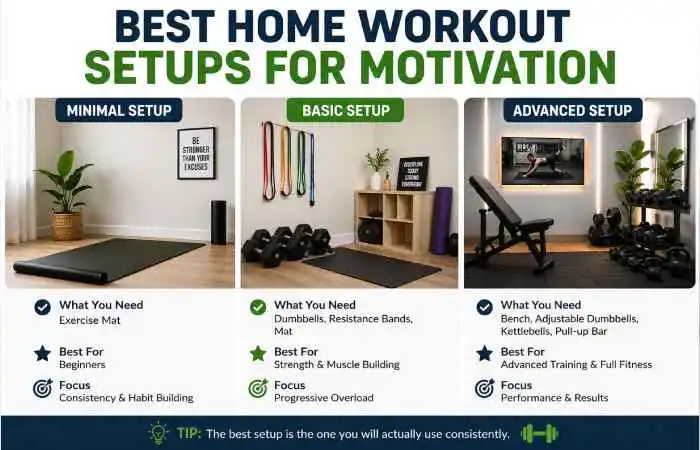
Your surroundings can greatly affect how consistent you are.
Setup Comparison (2026)
| Setup Type | Cost Range | Motivation Impact | Best For |
| Minimal Setup (Mat Only) | ₹500–₹1500 | Medium | Beginners |
| Basic Setup (Bands + Dumbbells) | ₹3000–₹8000 | High | Muscle building |
| Smart Setup (App + Equipment) | ₹8000–₹25000 | Very High | Serious users |
Key Setup Tips:
- Dedicate a fixed workout corner
- Keep equipment visible
- Use a mirror for feedback
Home Exercise Routine Ideas
20-Minute Daily Routine
- Jumping Jacks – 3 mins
- Pushups – 10 repitition × 3
- Squats – 15 reps × 3
- Plank – 30 seconds × 3
- Stretching – 5 mins
New exercisers can benefit from these beginner workout motivation strategies that make it easier to develop a regular routine.
Weekly Split Example:
- Day 1: Full Body
- Day 2: Cardio
- Day 3: Rest
- Day 4: Strength
- Day 5: HIIT
- Day 6: Core
- Day 7: Rest
This the week’s plan.
Indoor Workout Challenges
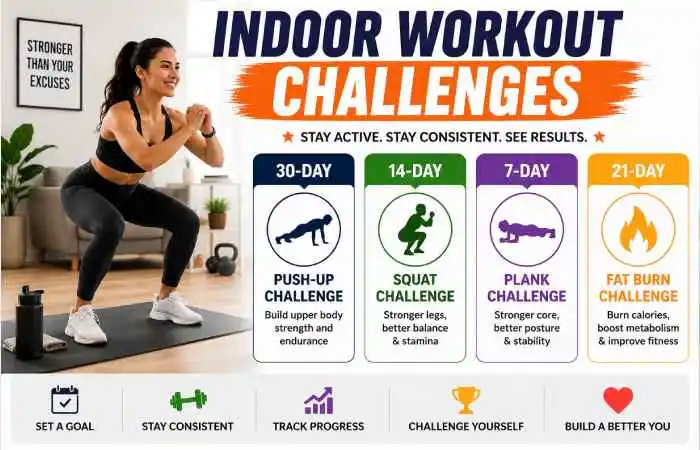
Working out at home is really easy. You can do it anytime but there are some problems with indoor workouts that can get in the way of your exercise plan. If you know what these problems are, with workouts you can figure out ways to deal with them and keep doing your indoor workouts to reach your fitness goals with your indoor workouts.
Understanding the connection between mental health and fitness motivation can help you overcome common barriers to exercise.
Common Indoor Workout Challenges
- The thing is, when you exercise by yourself at home you do not have the energy of a gym or being outside to keep you going.
- There are a lot of things, at home that can stop you from working out like your family, pets things you need to do around the house and your phone or television.
- Not everyone has the things they need to work out like weights or special bands that help you get stronger.
- When you see the things every day it can get boring to work out.
- If your room does not have air it can be really uncomfortable when you are doing a hard workout like when you are really pushing yourself.
| Potential Impact | Challenge |
| Restricts exercise variety and movement | Limited Space |
| Reduces focus and workout efficiency | Home Distractions |
| Limits exercise options and progression | Equipment Shortage |
| Increases the likelihood of skipped workouts | Lack of Motivation |
| Causes discomfort and reduced performance | Poor Ventilation |
I think indoor workouts are a way to stay active. If you make a space for working out follow a plan and change up your routine a lot you will probably stay motivated and get better at working out over time. Indoor workouts are really good, for this. You can do workouts and still get very good results.
Building consistency at home is one of the most effective ways to learn how to motivate yourself to work out and create lasting fitness habits.
No Equipment Workout Motivation Tips
Consistency in the absence of equipment is largely a behavioral design challenge, rather than a resource challenge. With low friction and high cues, adherence happens without external tools. The strategies below are arranged in a way to decrease cognitive load and increase consistency.
Core Motivation Framework (No Equipment)
If you’re struggling to stay consistent, these practical workout motivation tips can help you stay focused on your fitness goals.
| Strategy | What It Means | Why It Works (2026 Insight) | Practical Example |
| Reduce Friction | Make starting effortless | Lower activation energy improves consistency | Keep a mat ready in one spot |
| Time Anchoring | Fix a daily workout time | Builds automatic habit loops | Workout at 7 AM daily |
| Micro-Workouts | Start with small sessions | Increases completion rate by 60% | 10-minute circuits |
| Visual Cues | Trigger action through environment | Environment drives behavior | Workout clothes visible |
| Progress Tracking | Measure small wins | Dopamine reinforcement loop | Tick a calendar daily |
Simple, Repeatable Routine Structure
- Warm-up (3–5 mins): Jumping jacks, arm circles
- Main Circuit (10–15 mins):
- Pushups – 10 reps
- Squats – 15 reps
- Plank – 30 seconds
- Lunges – 10 each leg
- Cool Down (3–5 mins): Stretching
Repeat 2–3 rounds depending on energy level.
High-Impact Motivation Tips
- Remove decision fatigue: Fix exercises in advance for the week
- Create a “non-negotiable” rule: Even on low days, do at least 1 round
- Use audio triggers: Same playlist daily builds psychological association
If your primary goal is fat loss, understanding how to stay motivated to work out for weight loss can help you remain consistent over time.
Common Mistakes and Fixes
| Problem | Likely Cause | Fix |
| Skipping workouts | Too long sessions | Cut to 10–15 mins |
| Losing interest | Repetitive routine | Change exercises every 2 weeks |
| Low energy | Poor timing | Shift to morning workouts |
| Inconsistency | No tracking | Use habit tracker |
FAQ
What is the best time to workout at home?
Well I think morning is a time to workout because you can get it out of the way and be consistent.
Really the best time to workout at home is when you can stick to it every day.
Can home workouts be as effective as gym workouts?
Yes you can get a workout at home if you do it right.
If you make your workouts intense and try to get a little each time you can get results that are similar to what you would get at the gym.
Even if you currently exercise at home, you may eventually benefit from learning how to stay motivated to go to the gym as your fitness goals evolve.
How long should a home workout be?
It does not have to be that long twenty to forty minutes is enough for people who want to get in shape.
Final Takeaway
So the thing to remember about working out at home is that it is not about trying hard all the time.
It is, about making it easy to workout so you do it every day without thinking about it.
When you set up your home and your routine to make working out it just happens and that is a great feeling.
Focus on:
- Simplicity
- Structure
- Sustainability
That’s how real fitness progress happens in 2026.
Afiya Jafar is a fitness and wellness writer who focuses on making health, exercise, and healthy lifestyle information simple and practical. Her work covers workouts, fitness motivation, strength training, nutrition, weight management, stress management, mindfulness, and everyday wellness.
Read Full Bio of Afiya Jafar →
Sameena Begum reviews selected health, wellness, fitness, and digital content for clarity, factual presentation, consistency, and reader usefulness. Her review work helps maintain clear and responsible editorial standards across PhysicalFitt content.
Read Full Bio of Sameena Begum →
Dr. Khizrana Begum is a qualified medical professional with MBBS and MD qualifications and 5+ years of experience in the medical field. She works as a General Physician and Dermatologist, with expertise in general medicine, dermatology, preventive healthcare, and skin health.
Read Full Bio of Dr. Khizrana Begum →