
 Afiya Jafar
Fitness & Wellness Writer
Afiya Jafar is a fitness and wellness writer who focuses on making health, exercise, and healthy lifestyle information simple and practical.
Read Full Bio of Author →
Afiya Jafar
Fitness & Wellness Writer
Afiya Jafar is a fitness and wellness writer who focuses on making health, exercise, and healthy lifestyle information simple and practical.
Read Full Bio of Author →
 Sameena Begum
Health, Fitness & Digital Content Reviewer
Sameena reviews selected health, wellness, fitness, and digital content for clarity, factual presentation, and reader usefulness.
Read Full Bio of Reviewer →
Sameena Begum
Health, Fitness & Digital Content Reviewer
Sameena reviews selected health, wellness, fitness, and digital content for clarity, factual presentation, and reader usefulness.
Read Full Bio of Reviewer →
 Dr. Khizrana Begum
General Physician & Dermatologist
Dr. Khizrana Begum is a General Physician and Dermatologist with MBBS and MD qualifications and 5+ years of experience in the medical field.
Read Full Bio of Medical Reviewer →
Dr. Khizrana Begum
General Physician & Dermatologist
Dr. Khizrana Begum is a General Physician and Dermatologist with MBBS and MD qualifications and 5+ years of experience in the medical field.
Read Full Bio of Medical Reviewer →
This is where the disciplines of Productively & Habit Building play the role for lifelong fitness success. Motivation will eb and flow in and out, but powerful habits provide consistent execution even when busy. All studies point to individuals that have built a system or routine around a behavior having greater success than those that rely solely on motivation. In this guide we will show you how to create lasting habit behaviors and leverage the power of productivity to create a lifestyle where fitness is just a part of what you do.
These tactics can help with not only weight loss, but building muscle and staying fit for all of 2026 and for the long haul. Statistics point to habit formation averaging around 66 days, so a habit has far more power over consistency than any one workout will.
Improving your schedule and daily habits is an effective way to learn how to motivate yourself to workout and stay consistent with exercise.
Why Productivity Matters for Fitness Success
Common belief is that fitness fails occur due to insufficient motivation, however failure is usually due to the lack of effective systems. Those successful are removing the necessity of decision-making and are simply following pre-arranged training sessions, by setting out clothes/equipment, and setting clear action plans. Research has shown that developing habits and systems has consistently led to increased exercise consistency and long-term success.
If you’re looking for practical methods to stay committed, these workout motivation tips can help you build long-term fitness habits.
Benefits of Productive Fitness Systems
- Reduced decision fatigue
- Better workout consistency
- Improved goal tracking
- Increased accountability
- Higher long-term success rates
2026 Fitness Habit Statistics
| Habit Factor | Impact on Success |
| Consistent workout schedule | 3x higher adherence |
| Habit stacking | Significantly improves consistency |
| Progress tracking | Higher motivation retention |
| Accountability systems | Better long-term results |
| Starting with small habits | Greater habit completion rates |
Reports have consistently shown that a structured routine will be more effective than using motivation to develop long term exercise habits.
❝
This article is a part of
Workout Motivation Hub
How to Build Long-Term Fitness Habits
Developing long-term fitness habits occur when an action is performed subconsciously.
Step 1: Start Small
New exercisers can benefit from beginner workout motivation strategies that make fitness easier to fit into a busy schedule.
Do not create a workout plan that is not sustainable.
Instead of:
- 90-minute workouts
- 6 days per week
Try:
- 10-minute workouts
- 3 days per week
Research indicates that smaller goals will significantly enhance consistency.
Step 2: Focus on Consistency
Don’t worry about consistency.
In addition to the above, taking short bursts of exercise will reinforce the habit loop, and cement your identity-based habit.
Step 3: Track Progress
Use:
- Habit trackers
- Fitness apps
- Workout journals
Visible progress creates positive reinforcement and increases motivation.
Habit Stacking for Exercise Success
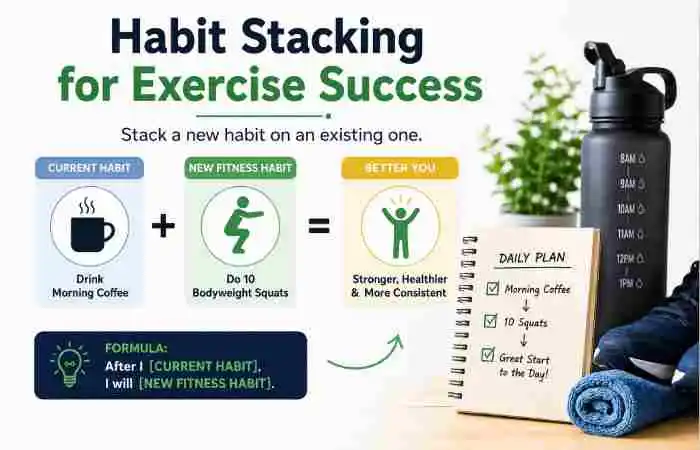
Habit stacking may just be the best strategy for changing behavior.
The concept is simple:
Attach a new habit to an existing habit.
Examples
| Existing Habit | New Fitness Habit |
| Morning coffee | 10 bodyweight squats |
| Brushing teeth | 5-minute stretching session |
| Lunch break | 15-minute walk |
| Evening TV | Mobility exercises |
Many individuals improve consistency by combining productivity techniques with a structured weight loss motivation plan.
Experts recommend using strong daily cues to increase repetition and habit automation.
Formula
After I [current habit], I will [new fitness action].
The dependency on motivation decreases and workouts become more memorable with this routine.
Best Productivity Tips for Fitness Goals
- Schedule Workouts Like Meetings
Treat workouts as non-negotiable appointments.
Add them to:
- Google Calendar
- Apple Calendar
- Work scheduling apps
- Prepare the Night Before
Successful exercisers reduce friction by preparing:
- Workout clothes
- Water bottles
- Gym bags
- Use Time Blocking
Reserve dedicated fitness blocks each week.
Managing your time effectively becomes even more important when following these home workout motivation ideas that eliminate common excuses.
Example:
| Time | Activity |
| 6:30 AM | Workout |
| 7:15 AM | Breakfast |
| 8:00 AM | Work |
- Minimize Decisions
Follow pre-planned routines instead of choosing workouts daily.
This reduces mental fatigue.
- Track Weekly Wins
Celebrate consistency milestones instead of focusing solely on weight loss.
People who train regularly can enhance consistency by applying gym motivation techniques that encourage routine attendance.
Time Management for Workouts
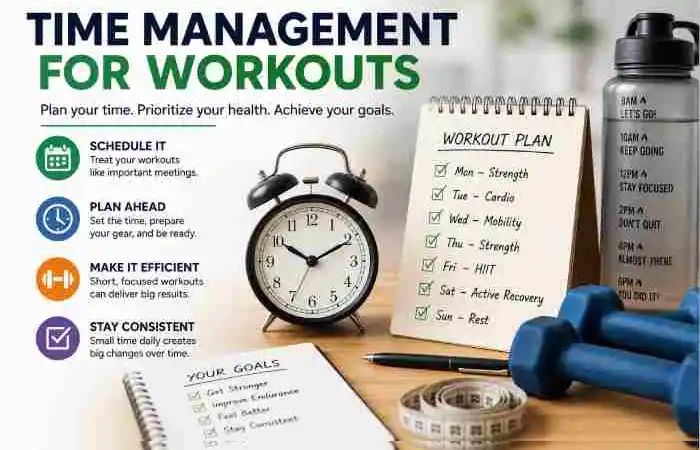
One of the biggest excuses for skipping exercise is lack of time.
However, many experts recommend focusing on efficiency rather than duration.
The 30-Minute Rule
Even short workouts provide meaningful benefits.
It has been stated that consistent movement, occurring multiple times each day is instrumental in both a healthy lifestyle and in habit formation.
Time Management Strategies
- Exercise before checking email
- Use calendar reminders
- Schedule active breaks
- Combine walking with phone calls
- Use lunch breaks strategically
Weekly Workout Planning Template
| Day | Activity |
| Monday | Strength Training |
| Tuesday | Walking |
| Wednesday | Strength Training |
| Thursday | Mobility |
| Friday | Strength Training |
| Saturday | Cardio |
| Sunday | Recovery |
Better productivity habits can positively influence both physical performance and the connection between mental health and fitness benefits.
How Successful People Stay Fit
Studies analyzing highly productive individuals reveal several common behaviors.
Common Fitness Habits
- Consistent routines
- Protected exercise time
- Strong morning or evening rituals
- Long-term thinking
- Focus on systems rather than motivation
Also, you don’t always have to wake up at 5 AM to be successful. These successful people have something in common, it is the consistency but not the time.
Lessons You Can Apply
- Build routines around your lifestyle.
- Remove obstacles.
- Focus on showing up.
- Track progress regularly.
- Improve gradually.
Productivity Tools Comparison (2026)
| Tool | Best For | Free Version |
| Notion | Habit tracking | Yes |
| Google Calendar | Scheduling workouts | Yes |
| TickTick | Daily task management | Yes |
| Habitica | Gamified habits | Yes |
| Streaks | Habit streak tracking | Limited |
Scheduling a consistent morning workout routine is one of the simplest ways to make exercise a daily priority.
These tools can foster consistency and ensure accountability.
Common Habit-Building Mistakes
Mistake 1: Starting Too Big
We become discouraged too quickly and abandon the habit.
Mistake 2: Waiting for Motivation
Motivation is temporary.
Systems remain.
Mistake 3: Missing Multiple Days
One missed workout is normal.
Several missed workouts can disrupt momentum.
Mistake 4: Tracking Only Weight
Measure:
- Workout frequency
- Strength gains
- Energy levels
- Habit streaks
Troubleshooting Problems
Problem: I Keep Skipping Workouts
Solution:
Reduce workout duration and make sessions easier to start.
Problem: Busy Schedule
Solution:
Schedule shorter sessions and use habit stacking.
Problem: Lack of Motivation
Solution:
Focus on systems, tracking, and accountability.
Problem: Frequent Travel
Solution:
Many people use fitness motivation challenges to create deadlines and improve accountability.
Use bodyweight workouts and portable routines.
Conclusion
Sustainable, long-term fitness success has nothing to do with a perfect workout routine and everything to do with systems that make healthy habits automatic. Productivity and habit building strategies get rid of excuses, limit decision making, and motivate you to stay on track during those moments where you don’t feel like it. You can build years of fitness habits, rather than weeks, by focusing on tiny wins, stacking habits, time blocking and tracking.
When productivity declines, reviewing inspiring success stories and workout inspiration ideas can help restore focus and motivation.
The most important aspect of long-term fitness is not to be perfect. Build slowly, focus on what is easily attainable for you to start with, then once that habit is established, expand and introduce another one, etc. Whether you are looking for fat loss, muscle gain, improved health, increased energy levels, or anything in between, a solid habit building system will always trump a period of motivation. Believe in your system, and allow your routine to become automatic, to integrate itself into your lifestyle naturally.
Afiya Jafar is a fitness and wellness writer who focuses on making health, exercise, and healthy lifestyle information simple and practical. Her work covers workouts, fitness motivation, strength training, nutrition, weight management, stress management, mindfulness, and everyday wellness.
Read Full Bio of Afiya Jafar →
Sameena Begum reviews selected health, wellness, fitness, and digital content for clarity, factual presentation, consistency, and reader usefulness. Her review work helps maintain clear and responsible editorial standards across PhysicalFitt content.
Read Full Bio of Sameena Begum →
Dr. Khizrana Begum is a qualified medical professional with MBBS and MD qualifications and 5+ years of experience in the medical field. She works as a General Physician and Dermatologist, with expertise in general medicine, dermatology, preventive healthcare, and skin health.
Read Full Bio of Dr. Khizrana Begum →