
 Afiya Jafar
Fitness & Wellness Writer
Afiya Jafar is a fitness and wellness writer who focuses on making health, exercise, and healthy lifestyle information simple and practical.
Read Full Bio of Author →
Afiya Jafar
Fitness & Wellness Writer
Afiya Jafar is a fitness and wellness writer who focuses on making health, exercise, and healthy lifestyle information simple and practical.
Read Full Bio of Author →
 Sameena Begum
Health, Fitness & Digital Content Reviewer
Sameena reviews selected health, wellness, fitness, and digital content for clarity, factual presentation, and reader usefulness.
Read Full Bio of Reviewer →
Sameena Begum
Health, Fitness & Digital Content Reviewer
Sameena reviews selected health, wellness, fitness, and digital content for clarity, factual presentation, and reader usefulness.
Read Full Bio of Reviewer →
 Dr. Khizrana Begum
General Physician & Dermatologist
Dr. Khizrana Begum is a General Physician and Dermatologist with MBBS and MD qualifications and 5+ years of experience in the medical field.
Read Full Bio of Medical Reviewer →
Dr. Khizrana Begum
General Physician & Dermatologist
Dr. Khizrana Begum is a General Physician and Dermatologist with MBBS and MD qualifications and 5+ years of experience in the medical field.
Read Full Bio of Medical Reviewer →
Mental toughness exercises are some of the most effective ways to enhance mental toughness, confidence, emotional stability and concentration. No matter whether you are an athlete, an entrepreneur, a student or a professional, training mental toughness regularly will enable you to perform under pressure without faltering, bounce back from negative situations and develop optimal performance on a regular basis.
The more you exercise your mental skills like controlled breathing, imagery, positive self-talk and goal-setting. The more beneficial outcomes research in sports psychology and behavioral science is documenting during the last few years. Including enhancement of performance, lowering of perceived stress and reinforcement of mental toughness.
The exercises described in the following sections may provide mental toughess club. Exercises provided are based on extremely user – friendly application, the page contains comparison table for the tools, frequently asked question section and internal links to ensure convenience while navigating the tool.
❝
This article is a part of
Mental Strength Hub
Why Mental Toughness Matters in 2026
Today’s lifestyles require a higher mental resilience besides just physical tolerance; be it continuous incoming notifications, working environments that foster pressure, competition or just ongoing unpredictability. (PubMed)
Individuals with a greater mental strength can experience an enhanced:
- Emotional tolerance
- Decision-making capacity under stress
- Performance regulation/ consistency
- High levels of confidence
- Faster response rate post
- Disruption, and more importantly
- Greater adaptability to challenges in changing environments.
Before choosing specific exercises, it helps to understand the fundamentals of mental toughness and how it affects your ability to handle pressure, setbacks, and challenges.
Comparison: Mentally Tough vs Reactive Mindset
| Reactive Person | Trait | Mentally Tough Person |
| Panics easily | Stress | Responds calmly |
| Gives up quickly | Failure | Learns and adapts |
| Easily distracted | Goals | Long-term focus |
| Depends on outcomes | Confidence | Built through habits |
| Avoids discomfort | Challenges | Sees opportunities |
2026 Insight: There continues to be support from sports psychology and resilience research for the fact that that mental skills training will not just assist focus, in addition to emotional self-controls, however performance will even improve with repeated training.
Combining these exercises with structured mental toughness training can help turn short-term motivation into consistent mental discipline.
Visualization Techniques
Training your brain to picture victory. Visualization can make you ready by practice thinking success. Famous sport figures, military service personnel, CEOs, singers often practice visualizing to know you are set to succeed in this.
Simple Visualization Exercise
- Take 5 minutes of stillness and quiet.
- Shut your eyes.
- Focus on doing something difficult and important successfully.
- Visualize every detail:
- Environment
- Sounds
- Emotions
- Body language
- Repeat daily.
Benefits
- Reduces anxiety
- Improves confidence
- Enhances focus
- Prepares the brain for real performance
Goal-Setting Exercises
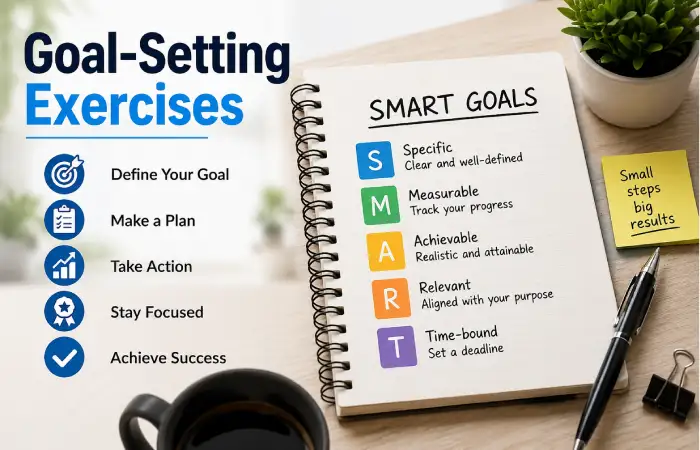
Those who are most tough mentally, don’t live by motivation – the live by systems.
SMART Goal Exercise
Instead of:
“I want to get healthier.”
Use:
“I will walk for 30 minutes five days a week for the next eight weeks.”
Daily Goal Routine
Morning:
- One major goal
- Three small tasks
Evening:
- What went well?
- What can improve?
- One lesson learned
Comparison Table
| Vague Goal | SMART Goal |
| Exercise more | Walk 30 minutes daily |
| Read books | Read 15 pages every night |
| Save money | Save £100 each month |
| Improve confidence | Speak up once in every meeting |
Positive Self-Talk
Self-talk impacts on confidence and performance If you repeat these four phrases to yourself constantly, they have the impact on your confidence and performance level. Repeated self negative talk is a factor of stress. But repetitive constructive self talk helps build up on resilience and helps in dealing with any emotional distress.
It’s also useful to understand mental toughness vs. resilience, since these related qualities involve different ways of responding to challenges and adversity.
Replace Negative Thoughts
| Negative Thought | Positive Alternative |
| I can’t do this. | I can improve with practice. |
| I’ll fail. | I’ll give my best effort. |
| I’m not good enough. | I’m learning every day. |
| This is too difficult. | This challenge will help me grow. |
Daily Exercise
Write three positive affirmations every morning, such as:
- I stay calm under pressure.
- I learn from setbacks.
- I become stronger through challenges.
Controlled Breathing
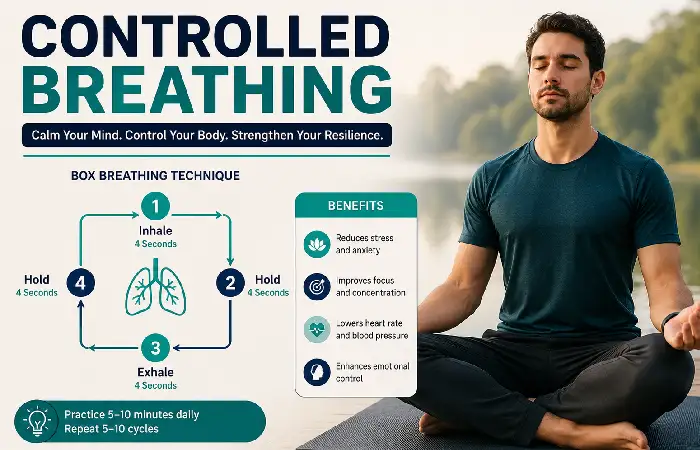
If you can also remember to pause the opportunity that this gives me at time not to turn on your entire autonomic nervous system. Breathing really does a fantastic tool you can use if you’re an impending or a large exam, performance or event and especially for upcoming large meetings and or difficult conversation.
Box Breathing Exercise
- Inhale for 4 seconds.
- Hold for 4 seconds.
- Exhale for 4 seconds.
- Hold for 4 seconds.
- Repeat for 5–10 cycles.
Benefits
- Lowers stress
- Improves concentration
- Supports emotional regulation
- Helps you stay composed
Daily Mental Challenges
You build mental toughness one bite-sized discomfort experience at time.
Here are a few ideas:
- Jump in a cold shower for 30-60 seconds.
- Read the paper for 20 mins (no instagram etc).
- Get one hard job done before checking in.
- Every week learn one thing that’s useful.
- Say hi to one new person.
- Drop in phone for one hour.
- Finish a work out regardless.
7-Day Mental Toughness Challenge
| Day | Challenge |
| Monday | 10-minute meditation |
| Tuesday | Cold shower |
| Wednesday | Gratitude journaling |
| Thursday | Digital detox for 2 hours |
| Friday | Difficult workout |
| Saturday | Learn a new skill |
| Sunday | Weekly reflection and planning |
Practicing these exercises consistently is one effective way to build mental toughness and become better equipped to deal with difficult situations.
Troubleshooting Common Challenges
| Solution | Problem | Possible Cause |
| Start with one small habit and build gradually. | I lose motivation after a few days. | Goals are too ambitious. |
| Begin with 2–3 minutes and increase over time. | My mind wanders during visualization. | Lack of practice. |
| Focus on realistic, evidence-based statements. | Positive self-talk feels unnatural. | Negative thinking patterns are ingrained. |
| Practise daily so the skill becomes familiar. | Breathing exercises don’t seem to help. | Practising only during high stress. |
| Schedule them at the same time each day and track progress. | I skip daily challenges. | No routine or reminders. |
2026 Research Snapshot
| Mental Skill | Practical Benefit |
| Visualization | Better confidence and preparation |
| Goal Setting | Greater consistency |
| Controlled Breathing | Improved emotional control |
| Positive Self-Talk | Increased resilience |
| Daily Challenges | Stronger mental toughness |
Note: Individual results may vary. All data represents a combination of overarching patterns documented across published research on sport and performance psychology, behavioural science, and neuroscience findings up to year 2026.
Many exercises become more effective when paired with the daily habits of mentally strong people, such as staying disciplined, managing emotions, and learning from setbacks.
Recommended Tools Comparison
| Tool | Best For | Pros | Considerations |
| Guided meditation app | Mindfulness and breathing | Easy for beginners | Subscription may be required |
| Goal planner or journal | Tracking progress | Builds consistency | Requires daily use |
| Habit-tracking app | Routine building | Visual progress | Notifications can become distracting |
| Breathing timer | Controlled breathing | Simple and focused | Limited features |
| Printed resilience workbook | Reflection exercises | No screen time | Less portable |
Frequently Asked Questions
What are mental toughness exercises?
Exercises for mental strength are activities, such as deep breathing exercises, imagery practices, using a system to coach themselves with self-speech or in setting goals and other kinds of skills.
Exercises that helps to build and develop your confidence and can also increase regulation of your emotions and allow yourself to become more able to recover from setbacks.
How to become mentally tough?
Once you have practiced these exercises for a week or two you may not only notice that you can better manage stress and feel more concentrate, but a month or so down the line you may discover positive differences in the mental toughness of your whole being.
What is the easiest exercise for mentally toughness in a newbie?
Controlled breathing can make you mentally tougher, and it doesn’t require anything or any special equipment.
What’s the best workout to learn mental toughness?
Yes, scientific reports suggest that mental strength is a developable habit you can acquire by forming steady and habitual ones, reflecting your work, and gradually getting exposed to it as a form of training.
Do all athletes undergo mental toughness training?
Yes, people like athletes, musicians, soldiers, and successful business owners consistently practice and rely on visualizing, setting goals, self-motivation talks, etc to perform well when facing intense and high-pressure conditions.
Athletes can use these strategies to strengthen mental toughness for athletes, particularly when competing under pressure or recovering from disappointing performances.
Conclusion
Mental toughness is definitely not some pre-programmed gene for sports heroes and other high flyers. These mental games should be a daily thing and can drastically boost your ability to ‘hold your nerve’ under duress and also bounce back quickly following a perceived failure or loss. Begin today and practice one or the combination of any one of these and in due course they have a cumulative effect. Practice your way into an inner game of success.
Afiya Jafar is a fitness and wellness writer who focuses on making health, exercise, and healthy lifestyle information simple and practical. Her work covers workouts, fitness motivation, strength training, nutrition, weight management, stress management, mindfulness, and everyday wellness.
Read Full Bio of Afiya Jafar →
Sameena Begum reviews selected health, wellness, fitness, and digital content for clarity, factual presentation, consistency, and reader usefulness. Her review work helps maintain clear and responsible editorial standards across PhysicalFitt content.
Read Full Bio of Sameena Begum →
Dr. Khizrana Begum is a qualified medical professional with MBBS and MD qualifications and 5+ years of experience in the medical field. She works as a General Physician and Dermatologist, with expertise in general medicine, dermatology, preventive healthcare, and skin health.
Read Full Bio of Dr. Khizrana Begum →