
Last Updated: July 31, 2026
What Mental Strength Training Techniques are applicable ways for people who wanna do better with concentration, confidence, managing your emotions, becoming more resilient in tough times, and making a great decision-making under pressure. The training methods increase your performance not only in sports but at your job, studies, or in your day to day. Recent studies are telling that using a systematic plan with training methods for mental skills training results in improved self-confidence, ability of using of mental skills, psychological well-being and so on.
Either you are in the field of sports, studying or you want to increase efficiency in your job as entrepreneurs or you just want to deal with your day-to-day challenges in a greater way.
In this guide, you’ll learn some accessible techniques for beginners based on contemporary research of sport psychology and neuroscience.
Mindfulness Training
Mindfulness is a state of focused mental awareness on the here and now as opposed to one’s thoughts or feelings.
Benefits include:
- Better concentration
- Lower stress
- Improved emotional regulation
- Reduced performance anxiety
- Better decision-making
Beginner Exercise
- Sit comfortably.
- Close your eyes.
- Breathe slowly.
- Focus only on breathing.
- When you get distracted, lovingly come back to your breath.
Start with just 5 minutes daily.
Best Time
- Morning
- Before workouts
- Before exams
- Before presentations
2026 Research Snapshot
| Outcome | Regular Mindfulness Practice |
| Focus | Improved |
| Stress | Reduced |
| Emotional control | Improved |
| Sleep quality | Better |
| Decision making | Improved |
Research continues to support mindfulness as part of effective mental performance training.
Visualization Practice
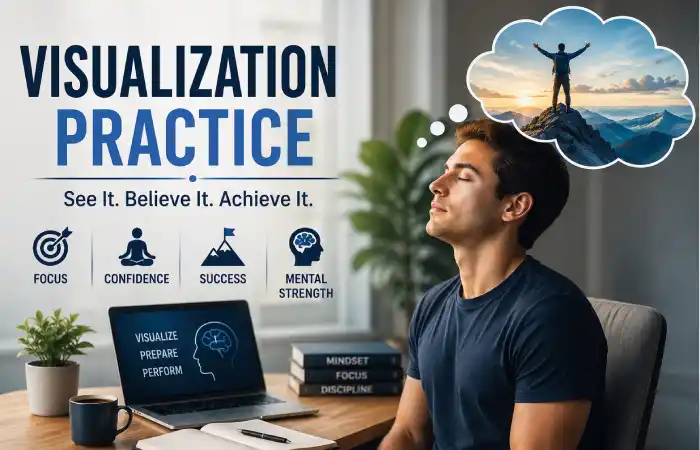
One of the most common yet powerful mental training methods utilized by competitive sports performers, military recruits, entrepreneurs, and public speakers is Visualization. This method is practiced by a wide range of professionals who are dedicated to enhancing the confidence and focus that helps them excel at their tasks and build their belief in their capability to perform. This exercise is also identified as mental imagery, and it involves picturing yourself perform the task well.
Research by psychologists and sport scientists reveals that including imagery in a training regimen leads to enhanced sport performance skills, confident behaviour and enhanced judgment on skills.
This is because many of the pathways in the brain are the same as those for actual performance.
Why Visualization Works
When you mentally rehearse yourself achieving, you’re firing the same neural circuits as when you successfully do it. This trains the brain so that you are:
- Improve focus during challenging situations
- Build confidence before important events
- Reduce performance anxiety
- Enhance reaction time and decision-making
- Prepare mentally for obstacles and setbacks
Proper visualization, as opposed to hoping, necessitates practicing yourself as successful and taking the necessary steps.
How to Practice Visualization
Easy steps for beginners to visualise:
- Choose somewhere in which you will be undisturbed
- Sit down or lie down and close your eyes
- Slowly take several deep breaths
- Focus and try to visualise your goals
- The clear as day, in extreme detail you can.
- Visualise yourself with the victory over and the sense of achievement
Visualization has to done for between 5-10 minutes every day for maximum results
Example: Visualization Before an Important Event
Imagine yourself going for a job interview. Just to do that. Don’t focus what can go wrong.
Picture the whole scenario:
- You entering a room with your head held high
- Your handshake and greeting to an interviewer a smile on face
- Giving a clear and precise answer
- Making a conscious choice to hold eye contacts
You leaving after the interviewer shaking his/her hands with a good handshake, having a firm conviction. ‘Today, i will walk out from this room feeling good’. Repeat it, repeat it all! You’ll gradually come out of it.
Types of Visualization
| Visualization Type | Best For | Purpose |
| Performance Visualization | Athletes, performers | Rehearse successful execution |
| Process Visualization | Learning new skills | Think through each part of a task |
| Goal Visualization | Motivation and consistency | Visualize yourself succeeding in meeting long term goals |
| Stress Scenario Visualization | Exams, interviews, competitions | Practice staying calm under pressure |
| Recovery Visualization | Building resilience | Mentally recover after setbacks |
Common Mistakes to Avoid
Many beginners don’t see results because they make these common mistakes:
- Visualizing only the end result instead of the process
- Practicing inconsistently
- Rushing through the exercise
- Ignoring potential obstacles
- Allowing negative thoughts to dominate the session
Our aim is to devise such a potent but positive mental rehearsal that will also ready us for adverse circumstances.
Visualization vs. Positive Thinking
| Visualization | Positive Thinking |
| Mentally rehearses actions and outcomes | Focuses mainly on optimistic thoughts |
| Activates performance-related neural pathways | Improves motivation and mindset |
| Develops practical confidence | Encourages a positive attitude |
| Prepares for real-life challenges | May not include action planning |
Both techniques complement each other, but visualization provides a more structured approach to building mental resilience.
Stress Management
Stress cannot always be avoided, but it can be managed effectively.
Effective Techniques
Controlled Breathing
Try:
- Inhale for 4 seconds
- Hold for 2 seconds
- Exhale for 6 seconds
Progressive Muscle Relaxation
Tense and relax each muscle group.
Journaling
Write down:
- Today’s challenges
- Your reactions
- Lessons learned
Physical Exercise
Exercise improves both physical and psychological well-being while helping reduce stress.
Stress Management Comparison
| Technique | Best For | Difficulty | Time |
| Meditation | Daily stress | Easy | 10 min |
| Breathing | Immediate calm | Very Easy | 2 min |
| Journaling | Emotional clarity | Easy | 10 min |
| Walking | Mood improvement | Easy | 20 min |
| Stretching | Relaxation | Easy | 10 min |
Confidence Building

Confidences cannot build by just having a positive thinking but through habits.
Build Confidence By
- Keeping promises to yourself
- Setting achievable goals
- Celebrating small wins
- Practicing positive self-talk
- Tracking progress
Daily Confidence Routine
Morning:
- Review goals
- Read affirmations
- Visualize success
Evening:
- Record one success
- Note one lesson
- Plan tomorrow
Research on mental training programs has shown improvements in self-confidence following structured practice. (Frontiers)
Mental Recovery
Mental recovery is essential after intense work, study, or competition.
Signs you need recovery:
- Irritability
- Poor focus
- Low motivation
- Mental fatigue
- Difficulty sleeping
Recovery Strategies
- Sleep 7–9 hours
- Spend time outdoors
- Limit screen time
- Practice mindfulness
- Take active recovery walks
- Connect with supportive people
Recovery Routine Example
| Time | Activity |
| Morning | Stretching |
| Afternoon | Walk outside |
| Evening | Meditation |
| Night | Reading instead of scrolling |
Troubleshooting Common Problems
| Problem | Solution |
| Can’t focus | Start with 2-minute sessions |
| Forget to practice | Set daily reminders |
| No motivation | Pair mental training with workouts |
| Negative thoughts | Use structured self-talk |
| Slow progress | Track weekly improvements instead of daily changes |
Frequently Asked Questions
What are mental strength training?
It is some kind of systematic practice that enhances one’s ability of concentration, toughness, confidence, self-control of anger and handling stress.
How long does mental strength training take to improve?
You could see improvement within a few weeks by practicing every day, but sustained enhancement requires continued consistency throughout your life.
Does visualization have scientifically proven efficacy?
Yes, there are some researches to support the visualization technique, such as, imagination practices stimulate neural pathways that are activated during physical performance. Research shows that visualization together with practiced regularly has the effect of enhancing confidence and accuracy.
Can novices do mental strength training?
Definitely, it seems all kinds of practices can help beginners benefit including practicing of breathing, mindfulness and journaling.
How often should I practice?
Ideally practice for 10-20 minutes every day for better long term results.
Conclusion
Luckily, developing our mental resilience is a skill that, with practice, anyone can improve. Mindfulness, visualization, stress and stress, build in the confidence and the ability to recover mentality and help to reach maximum performance, resilience and good all-round mentalhealth. With a combination of effective strategies such as these, a balance of physical and consistent physical effort, good sleep patterns and smart recovery and we have a robust model for long-term mental fitness.