

The practices and habits of mentally strong individuals aren’t based on the never experiencing fear, anger, disappointment, and overwhelm. Mental strength could actually be described as knowing the full spectrum of emotions (even the uncomfortable ones!), what to do about your reaction, how to adapt to change, and not giving up on moving towards important things. The great news here is that you can strengthen your mental durability by building habits.
According to available evidence through the next two years, mindfulness, resilience, emotional regulation, helpful daily routine and solid self-care practices are tied to excellent mental health and wellbeing.
For example, there was evidence in 2025 supporting that mindfulness predicts both resilience and cognitive reappraisal and in turn higher stress self-regulation abilities.
Building strong daily habits starts with understanding mental toughness and how it helps you stay focused and composed when life becomes challenging.
❝
This article is a part of
Mental Strength Hub
Daily Morning Habits
Mentally tough people don’t always have to get up at 5 a.m. Or have an extremely rigid morning routine. What they have is a predictable launch that minimizes arbitrary decision-making and maximizes time allocation for things that really matter.
A practical morning routine can include:
- Getting up at a consistent time
- Drinking water and eating a nourishing breakfast when appropriate
- Spending 5–10 minutes planning the day
- Avoiding immediate social-media scrolling
- Practicing deep breathing, mindfulness, or quiet reflection
- Identifying the day’s most important task
The goal is intentionality rather than perfection.
The “Top 3” approach: Pick three tasks, the accomplishment of which would turn the day into one that was worth living, in order to avoid being completely intimidated by an endless to-do list.
Simple morning routine comparison
| Habit | Low-effort approach | Mental-strength benefit |
| Planning | Choose 3 priorities | Improves focus |
| Mindfulness | 5 minutes of breathing | Creates a pause before reacting |
| Movement | Short walk/stretch | Helps establish an active routine |
| Digital boundaries | Delay unnecessary notifications | Protects attention |
If you want to make these habits part of your everyday life, learning how to build mental toughness can provide a practical framework for consistent improvement.
Emotional Control
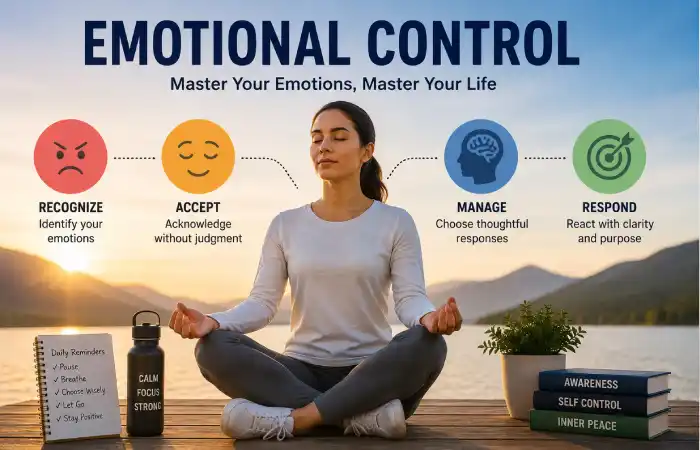
One of the most important habits of mentally strong people is learning to respond rather than react. (APA)
Emotional control is about managing your feelings rather than controlling them. Everyone feels angry, scared, sad or frustrated – that is normal. Real self-control is feeling angry without acting on it, then.
Try the STOP method:
S – Stop: Don’t immediately respond.
T – Take a breath: Slow down your physiological reaction.
O – Observe: Ask what you’re feeling and why.
P – Proceed: Choose a response that fits your values and situation.
One mindful tool that can bring about that pause is mindfulness, as is mentioned in the previous point. The systematic review and meta-analysis from 2026 mentioned in that section concluded that mindfulness-based interventions improve emotion regulation in those diagnosed with any sort of mental health concern.
This would be the point where you want to get acquainted with yourself a little more intimately. The way to do that would be to challenge how you define yourself, especially when your current feelings are negatively impacting you. So, rather than ‘i am angry,’ I say, ‘i am currently angry’. This second one creates a little more space so you have control in terms of if you engage the feeling or not.
Stress Management
In reality, the strongest people just don’t try to prevent anything from happening that is stressful for them. Instead, they understand the difference between things that he can influence, prevent or what he just has to accept.
Use this three-column exercise:
| Situation | What I can control | My next action |
| Difficult conversation | My words and tone | Speak calmly |
| Heavy workload | My priorities | Complete the most important task |
| Someone else’s opinion | My response | Stop trying to convince them |
This approach turns vague worry into specific action.
Stress management should also include recovery. Sleep, physical activity, social connection, relaxation, and breaks are not signs of weakness. They support the capacity to cope.
In the most recent APA Stress in America report, 62 percent of American adults surveyed indicated that societal division was an extremely stressful issue and more than half – 54 percent – reported feeling alone at least some or all of the time.
Meditation can help, too. A systematic review and meta-analysis of 17 randomized controlled trials with a total of 1,641 non-clinical adults discovered mindfulness based intervention with perceived stress after an intervention compared to active controls. Mindfulness based interventions reported lower levels of perceived stress after intervention compare to active controls .
Alert! Self-help tips should not be thought of as a replacement for getting help from your counselor, mental health clinician, therapist or the guidance of another mental health expert, if stress becomes persistent, too much for you to handle or significantly impact’s you normal everyday work.
Turning these behaviors into a routine through structured mental toughness training can make them easier to maintain over time.
Decision-Making Skills

Psychological strength also requires you to take decisions without getting hooked to fear, impulse, or the expectations of other people. Before making a big decision, think through:
How many facts actually do I hold?
What am I making assumption about?
Which areas am i having control over?
What are the foreseeable short and long-time effect of these options?
What of decision fits best into values that i hold?
Psychological strong people are capable to make comfortability with ambiguity of life, which include decisions without guarantee a perfect result to be. In the case to consider, i may ask my friend what do you think?
Here is useful guideline to understand your feelings when it comes to emotions: your feelings is information that, NOT command. Yes, being fear do indicate that, somewhere along the path of decisions may warrant some attention to be. But this alone do not give u guarantee that we are able to see ourselves right because it is not.
Alongside these habits, practicing mental toughness exercises can help reinforce discipline, focus, emotional control, and perseverance.
Continuous Self-Improvement
Mentally strong people treat mistakes as feedback rather than proof that they are failures.
At the end of each day, spend five minutes answering:
- What went well today?
- What challenged me?
- How did I respond?
- What would I do differently next time?
- What is one small thing I can improve tomorrow?
This creates a feedback loop: experience → reflection → adjustment → improvement.
Self-improvement should remain realistic. Trying to completely transform your personality overnight can create frustration. Small, repeatable behaviors are easier to maintain and evaluate.
Mental-strength habit scorecard
You can track five habits from 1–5 each day:
| Habit | Score |
| Morning intentionality | /5 |
| Emotional regulation | /5 |
| Stress management | /5 |
| Thoughtful decision-making | /5 |
| Self-reflection | /5 |
Don’t use the score to criticize yourself. Use it to identify patterns.
These same habits are especially valuable for mental toughness in athletes, where consistency, confidence, and the ability to handle pressure can affect performance.
FAQs
What are common practices of mentally strong individuals?
This is to mention the basics in controlling emotions, controlling those things within your power and managing stresses and dealing with all failures and building safe boundaries and to know yourself, constantly growing.
Can you learn to be mentally strong?
Mental strength isn’t the way some are. Things in intelligence are learned, similar to focusing. They include self- Mindfulness, Self Awareness and Self Assessment techniques such as self evaluation.
How do mentally strong people deal with stress?
They are aware of it rather than believing in nonexistent denial mechanisms. They know where their control actually lies, take concrete actions, maintain an adequate recovery phase and seek help when needed.
What is the quickest method for building mental strength?
There is no valid “get it overnight” technique. Begin with one small habit, for example take a pause before acting, write three key priorities in the morning or reflect on one challenging situation every night, and practice it continuously.
Does being mentally strong mean never seeking help?
No. Seeking competent help in fact can be a proof of good sense. Mental strength means being able to realize your boundaries and taking efficient actions rather than pretending that you have total control of everything.
Final Takeaway
This isn’t about learning how to be emotionless and un-pierceable. Strong mindset is learning to hit pause, process, pivot, regroup and respond consciously. Try to establish at least one good habit starting today – tiny enough to repeat tomorrow, big enough to build resilience.
Understanding mental toughness vs. resilience can also help explain why some habits improve performance under pressure while others support recovery after setbacks.

Sameena Begum
Sameena Begum has a broad interest in technology, beauty, health, fitness, wellness, lifestyle, and consumer topics. She values clear, accurate, and practical information and pays close attention to details, readability, and relevance.
Read full bio of Sameena Begum
Afiya Jafar
Afiya Jafar is a fitness and wellness writer who focuses on making health, exercise, and healthy lifestyle information simple and practical. Her work covers workouts, fitness motivation, strength training, nutrition, weight management, stress management, mindfulness, and everyday wellness.
Read full bio of Afiya Jafar