

Mental Toughness is less about becoming detached and stoic and more about developing your ability to stay focused, handle your impulses, come back stronger after failures and continue working toward valued goals when you run into struggles. As Mental Toughness grows with skill development, your mindset becomes one of “going on to do that other” (or “just moving along to the task”). As the title for this is on a training program; Mental Toughness is indeed a skill.
Newer mental skills approaches to toughness have emphasizes the 4 Cs model of “commitment, confidence, control and challenge” along with newer elements like commitment and emotional control to get it done instead of just the notion of ‘just bearing pain’.
Fortunately you dont need a major world crashing incident in order to build a greater mental toughness. Minor challenges can prepare you in practice for greater ones later.
Before learning how to improve your mindset, it helps to understand the fundamentals of mental toughness and why it matters for handling pressure, setbacks, and challenges.
❝
This article is a part of
Mental Strength Hub
Why Mental Toughness Can Be Learned
Many assume that people simply either ‘possess’ or ‘lack’ resilience as a quality. Psychological models and research offer a slightly less rigid interpretation, in that the qualities of people considered resilient, including the skills with which they effectively manage difficulty are potentially workable with and trainable.
‘Resilience is defined as both successful adaptation to aversive circumstances across the lifespan (through one or another pattern of development), and the development and practice of the skills and resources underpinning successful adaptation’.
As recently as 2026, and in the context of school children, not adults, one study examined mental toughness across a group of 105 primary children using a 12-week intervention underpinned by the 4Cs of mental toughness and found improvements in resilience scores post-intervention.
The 4Cs of Mental Toughness
| Skill | Everyday example | What it means |
| Control | Staying calm after receiving criticism | Managing your reactions and focusing on what you can influence |
| Commitment | Completing your study or workout plan | Continuing toward an important goal |
| Challenge | Trying something unfamiliar | Treating difficulty as an opportunity to learn |
| Confidence | Speaking up despite nervousness | Trusting your ability to handle setbacks |
One practical way to strengthen your mindset is by using mental toughness exercises that improve focus, discipline, emotional control, and perseverance.
Consider these four zones as actual muscles. You work them out by doing the work, over and over again. It comes from practice, not from reading a single inspirational quote.
Daily Habits That Build Resilience
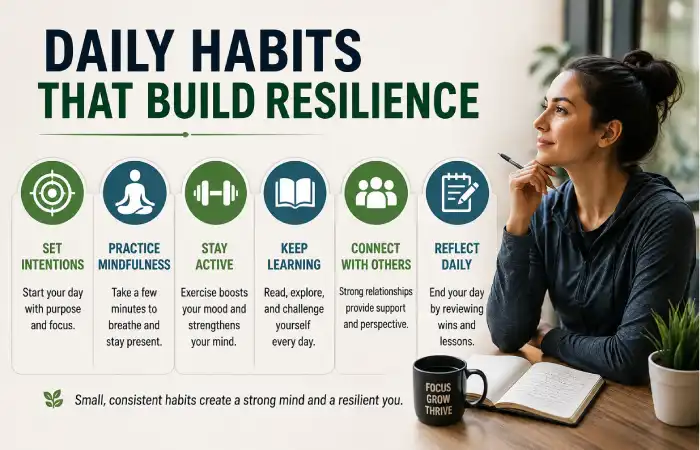
There’s really no need to have an intensely extreme mental-strengthening routine. You should begin with habits and routines of emotional self-discipline, consistency as well as recuperation (as well as healing).
- Keep One Small Promise to Yourself
Choose one realistic daily commitment.
For example:
- Walk for 20 minutes.
- Read 10 pages.
- Complete one important work task before scrolling social media.
- Spend 10 minutes practicing a difficult skill.
The goal is not intensity. It is consistency.
Every time you follow through, you create evidence that your intentions can become actions.
- Practice the Pause
When something frustrating happens, avoid reacting immediately.
For people involved in competitive sports, developing mental toughness in athletes can be especially valuable for maintaining confidence and performing effectively under pressure.
Try this simple sequence:
Pause → Breathe → Name the problem → Choose the response.
This does not mean suppressing emotions. It gives you a moment to decide how you want to behave rather than allowing the first emotional reaction to control the situation.
- Reframe Setbacks
Instead of asking:
“Why does this always happen to me?”
Ask:
“What can this situation teach me?”
This shifts your attention from helplessness toward problem-solving.
- Train Your Attention
Mental toughness also involves staying focused when distractions, discomfort or negative thoughts appear.
Try 10–15 minutes of focused work with your phone away from reach. Gradually increase the duration.
The objective is to practice returning your attention when it wanders.
- Protect Recovery
Resilience is not endless effort.
A structured approach to mental toughness training can help turn these psychological skills into consistent practices that support long-term growth.
Ability to coping coping strategies, relationships, exercise, as well as good health can all make it easier to withstand stress. The APA suggests in particular that social resources and coping mechanisms are factors found in people who tend to show more reselience.
Stepping Outside Your Comfort Zone
The key to building mental toughness is by intentionally seeking small levels of discomfort. Obviously, this is not suggesting seeking danger, Ignoring injury or tolerate toxic environments. It is about climbing challenge ladders.
| Level | Example challenge |
| Easy | Start a conversation with someone new |
| Moderate | Ask a question during a meeting or class |
| Challenging | Give a short presentation |
| Advanced | Attempt a meaningful goal where failure is possible |
Choose something uncomfortable but safe.
Then repeat it.
“If presenting publicly scares you, you certainly don’t want to opt in for an hourlong speech the very first time,” says Ms. Storch, the career coach. “Instead, give yourself to: 30 seconds, two minutes, five minutes.”
This approach turns discomfort into practice.
Use the “Controllables” Rule
When facing a difficult situation, divide it into two columns:
I can control:
- My preparation
- My effort
- My attitude
- My communication
- My next action
I cannot control:
- Other people’s opinions
- The past
- Unexpected events
- Every outcome
Daily behaviors also play an important role, and adopting the habits of mentally strong people can make it easier to stay disciplined, manage setbacks, and keep moving toward your goals.
Put most of your mental energy into the first column.
Tracking Your Progress
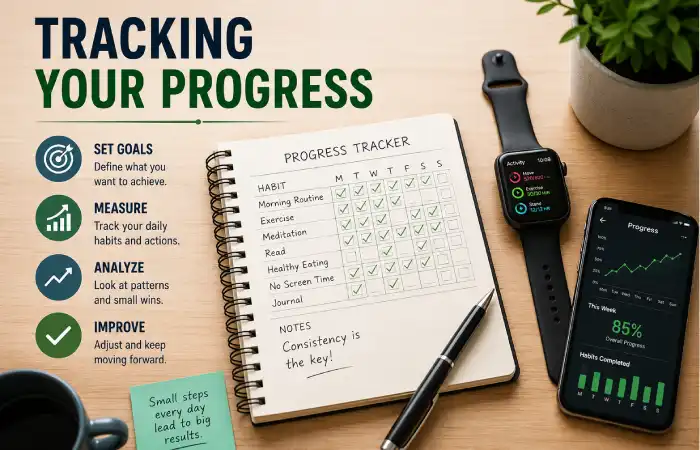
Mental toughness is difficult to improve if you never measure your behavior.
Create a simple weekly tracker from 1–5.
| Skill | Monday | Wednesday | Friday | Sunday |
| Emotional control | /5 | /5 | /5 | /5 |
| Commitment | /5 | /5 | /5 | /5 |
| Confidence | /5 | /5 | /5 | /5 |
| Handling challenges | /5 | /5 | /5 | /5 |
| Recovery after setbacks | /5 | /5 | /5 | /5 |
At the end of each week, answer three questions:
- What challenge did I handle better than before?
- Where did I lose control or give up?
- What is one behavior I will practice next week?
Common Mistakes
1. “Mental toughness means never experiencing fear, disappointment, anger and stress.”
Psychologically-tough individuals experience negative emotions the same way everyone else does but have the ability to follow these feelings with appropriate action.
2. “Confusing toughness with suppressing emotions” Ignoring emotions is just an ineffective coping mechanism.
3. “Taking on Challenges that are “too large.”
If you are facing unreasonable challenges, continued failure could be demotivating.
4. “Relying solely on motivation.” motivation fluctuate.
Systems, routines and commitment work!
It is also useful to understand mental toughness vs. resilience, since the two concepts overlap but describe different ways of responding to pressure, adversity, and change.
5. Treating “exhaustion” with mental toughness,” Mental toughness does not excuse the pursuit of exhaustion, safety, danger or any of those other physical and mental ill. (APA)
Troubleshooting: What If You Keep Giving Up?
If you repeatedly abandon your goals, make the goal smaller before assuming you lack discipline.
Try this:
Goal too large → reduce the task → create a fixed time → remove distractions → repeat → gradually increase difficulty.
Instead of “I will work out more,” say, “I will walk for 15 minutes after dinner on Tuesday, Wednesday and Saturday this week.”
If you skip a session, just do your workout the following available day. It’s an isolated slip, that’s a setback. If it’s a month-long avoidance, it’s a rut.
FAQs
How Long to Become Mentally Tough?
No easy answers: there’s no standard “length of time” – it grows through regular use of certain psychological processes. Structured programs show observable results in weeks, but sustained use may be needed to embed changes.
One ongoing school-based trial starting in 2026 “aims to show changes from a 12 week mental toughness intervention.”
Can you actually learn to be mentally tough?
Psychology now widely treats these traits as learnable skill. Under existing psychological theories many elements that relate to “mental toughness and resilience” can be seen as develop- able skills practiced over time: it is learnable through different strategies.
What are the four “Cs” of mental toughness?
Control. Commitment. Challenge. Confidence.
That roughly, “Controls-react,” – manage response rather than “react”; “Commitment”- to the goal no matter what; “Challenge”-sees the obstacles as opportunity rather than threatening; “Confidence”-in our ability to rise to these situations.
What’s the quickest way to gain some mental toughness?
The psychology does not support a silver bullet, quick fix solution. Perhaps something tangible would be to ‘pick’ 1 achievable challenge, “practice responding” as opposed to “reacting”, make 1 small goal every day and review at end of day, be it at home or in work.
Does physical exercise make one more mentally tough?
I’ve long advocated for physical activity in building this muscle of resilience. For example, exercising often forces you into discipline, grit and dealing with some (and I realize this might seem minor for most of us, but let’s try to relate). Exercise can promote: Discipline, discomfort tolerance, consistency and goal setting-all these traits contribute to mental toughness … however mental toughness extends beyond mere physical endurance.
Does having goodmental toughness mean you’re the most resilient person there is?
You have to have a “resilience gene”, right?
Mental toughness and resilience are similar concepts – so much so that you can use the terms interchangeably. Both involve adapting to and overcoming a challenging situation … but these are not precisely the same construct ..”
Final Takeaway
Mental strength has nothing to do with becoming a non-emotional, cold, people, and going until your body gives up. Mental strength isn’t any the rest than teaching themselves how to endure when you want to quit, manage things, discover from failures, handle a certain level of a hard, bounce again into points when you stumble. Begin on the small…Do so routinely. Monitor progress… With consistency, these small, average repetitions transform into mental toughness.

Afiya Jafar
Afiya Jafar is a fitness and wellness writer who focuses on making health, exercise, and healthy lifestyle information simple and practical. Her work covers workouts, fitness motivation, strength training, nutrition, weight management, stress management, mindfulness, and everyday wellness.
Read full bio of Afiya Jafar