
 Afiya Jafar
Fitness & Wellness Writer
Afiya Jafar is a fitness and wellness writer who focuses on making health, exercise, and healthy lifestyle information simple and practical.
Read Full Bio of Author →
Afiya Jafar
Fitness & Wellness Writer
Afiya Jafar is a fitness and wellness writer who focuses on making health, exercise, and healthy lifestyle information simple and practical.
Read Full Bio of Author →
 Sameena Begum
Health, Fitness & Digital Content Reviewer
Sameena reviews selected health, wellness, fitness, and digital content for clarity, factual presentation, and reader usefulness.
Read Full Bio of Reviewer →
Sameena Begum
Health, Fitness & Digital Content Reviewer
Sameena reviews selected health, wellness, fitness, and digital content for clarity, factual presentation, and reader usefulness.
Read Full Bio of Reviewer →
 Dr. Khizrana Begum
General Physician & Dermatologist
Dr. Khizrana Begum is a General Physician and Dermatologist with MBBS and MD qualifications and 5+ years of experience in the medical field.
Read Full Bio of Medical Reviewer →
Dr. Khizrana Begum
General Physician & Dermatologist
Dr. Khizrana Begum is a General Physician and Dermatologist with MBBS and MD qualifications and 5+ years of experience in the medical field.
Read Full Bio of Medical Reviewer →
Practicing Yoga Poses to Reduce Stress may give you a chance to move more slowly, release tightness in your body and bring some brief quietude to a hectic day. Stress relief yoga isn’t typically active – yoga poses to relieve stress involve comfortable stretching and flowing, controlled breathing, relaxation and long rests in between poses.
The practice of yoga can be one approach for the management of stress, though it lacks adequate research to recommend it in lieu of other professional treatments. In a 2024 systematic review and meta-analysis of 13 randomized controlled trials on 1,026 adults, there was some indication that short-term reduction in stress with yoga compared to a passive control, although the authors assessed the evidence quality as low.
The goal is therefore not to push yourself into advanced poses. The goal is to facilitate movement, breath, and awareness of the present moment.
❝
This article is a part of
Yoga Hub
How Yoga Reduces Stress
Stress has an impact on both your brain as well as your body. If you’ve been feeling on edge, you could recognize it physically in the kind of stiff shoulders, shallow breaths, headaches, muscle pains, rest difficulties, as well as the lack of ability to remain concentrated. Yoga exercises a mix of variables that may serve you to loosen up your body: breathing exercises, movements, mindful awareness, and stillness.
Stress can sometimes contribute to muscle tension, including tightness around the back and shoulders. If back discomfort is part of your concern, explore these yoga poses for back pain for a more targeted practice.
Actually, research study has actually shown that yoga might ease stress, promote sound sleep, support emotional wellness as well as general wellness, according to the National Facility for Complimentary and also Integrative Wellness.
Breathing exercise specifically, provides something concrete you could take focus to in order to reduce the effect on you mind. Rather than repeating the thought of a stressful situation, you can divert this focus toward slow, deliberate breaths and pleasurable movements.
Yoga offers many different approaches, from gentle stretching and relaxation to more active and challenging movements. Explore our complete collection of yoga poses to find practices that fit your needs and experience level.
What the research says
| Research finding | What it means |
| 13 randomized controlled trials | Yoga has been studied in controlled research |
| 1,026 total participants | Evidence comes from more than 1,000 participants |
| Short-term stress benefit | Yoga performed better than passive controls in the analysis |
| Evidence quality | Researchers rated the evidence as low quality |
| Quality-of-life benefit | Moderate-quality evidence supported short-term improvement versus passive controls |
These findings support yoga as a complementary stress-management strategy, not as a guaranteed treatment.
Relaxing Yoga Poses
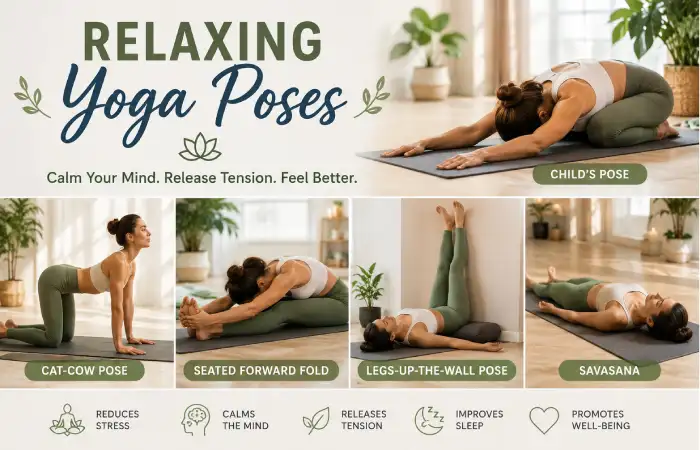
You do not need advanced flexibility to practice yoga for stress relief. Begin with poses that feel stable and comfortable.
Gentle stretching can be a useful addition to a relaxing yoga routine, especially when you want to release physical tension and improve mobility. Explore these yoga poses for flexibility to complement your stress-relief practice.
Child’s Pose
One of the simplest to bring a slowing motion to the yoga practice. Kneel with your feet pointing in the same direction as your legs, tuck them into an inward, or slightly outwardly turned direction (for the big toes and heels), and allow yourself to fall forward towards your heels. Rest the forehead on the mat, or cushion.
Extend your arms toward the head of the mat, or keep them on either side of your body to lengthen the outer edges.
Child’s Pose should be experienced while relaxing there into the floor with many breaths. Allow for many. This may include sliding your hips onto, or as close as possible to the feet. A support under your tail area (a pillow or bolster, for instance) will facilitate the process if this position is not coming with ease.
Cat-Cow Pose
Cat-Cow links movement and breath and is helpful if you have tight back and shoulders.
You start on your hands and knees, inhale as you slightly lift your chest up and let your spine sag down toward the ground and exhale to round your back with your chin pulled in toward your chest. Repeat this for 1 minute, rather than trying to speed through the exercise. Healthline’s 2026 stress guide also suggested this as an easy way to get started and deal with stress.
Standing Forward Fold
Place your feet at the width of your hips in a relaxed position. Gently bend from your hips as you allow your head and arms to reach toward the floor. Don’t worry about whether or not you touch your feet. Feel free to bend your knees if needed-the idea here is relaxation, not maximum range of motion.
A stress-relief routine doesn’t always have to be performed on the floor. You can incorporate gentle standing yoga poses to combine mindful movement with balance and body awareness.
Legs-Up-the-Wall Pose
This position is particularly well-suited for a peaceful evening. If you sit down on your side next to a wall then roll down to your back and then up against the wall with your legs above you. Place your arms comfortably to your sides.
If this posture is not comfortable, a rolled blanket under your head and/or a bolster under your hips might help to improve it.
The UW Medicine’s restorative yoga section includes Legs-Up-the-Wall as a form of relaxation.
Savasana
This involves basically no movement at all. Simply lie back on your comfortable mats with your arms resting along your body with your legs slightly separated, your eyes gently shut and allow your breath to fall back into it’s natural rhythm. Hang out here for about 2-5 minutes. For quite a few novices at yoga this final stretch may just feel rather more crucial then to introduce the poses which can be more complicated.
Best poses at a glance
| Pose | Best for | Beginner level | Suggested time |
| Child’s Pose | Mental reset and gentle relaxation | Easy | 1–3 min |
| Cat-Cow | Back and shoulder tension | Easy | 1 min |
| Forward Fold | Quieting a busy practice | Easy | 30–60 sec |
| Legs-Up-the-Wall | Restorative evening practice | Easy | 3–5 min |
| Savasana | Final relaxation | Easy | 2–5 min |
These are practical starting points rather than medically prescribed durations.
Breathing Techniques During Yoga
Begin with gentle breathing at the diaphragm . Sit up right with your body straight or make your posture comfortable. Close the space between your thumb and pointer with any one hand put one hand there from where it appears the abdomen is visible on that side and breath slowly with the use of nostrils and let it rise the portion on where placed the thumb.
Release slow air.
There’s a great breathing pattern with movement of asana. Take inhale when in open posture, example for cat cow asana it means in to the flat back posture and take breath at your spine being rounding at that condition.
Try Alternate Nostril Breath– Also commonly known as Nadi Shodhana – it’s an all time favorite on a yogamat whichaimsat bringing about tranquility and clarity into body and mind.
This alternate breathing method also requires holding your breath for a short duration, but if you aren’t ready for breath holding, then don’t – just focus on natural breathing.
However, if at any point you feel any symptoms of light headedness, dizziness or any kind of discomfort do immediately go back to normal breathing.
If you’ve already developed a consistent yoga practice, you may eventually want to explore more challenging movements while continuing to make relaxation and mindful breathing part of your routine. See these advanced yoga poses for more demanding practices.
Creating a Calm Practice
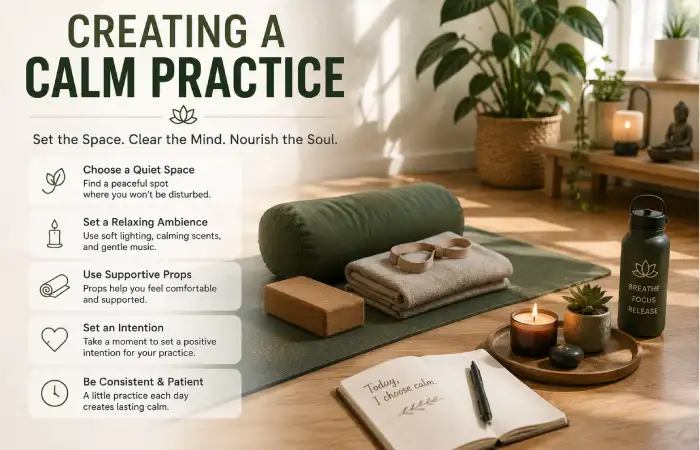
The room where you do your yoga has as much of an impact as having all the high-tech gear. The good news is you don’t need to go out and spend your rent money. All you truly require is an open patch of floor space where you can safely extend your arms and legs and a decent mat (an extra padding may be required – consider the mat itself, a block, strap, fold-up cushion/bolster).
Basic equipment comparison
| Equipment | Main purpose | Essential for beginners? |
| Yoga mat | Grip and cushioning | Helpful |
| Yoga block | Support and positioning | Optional |
| Yoga strap | Assistance with stretches | Optional |
| Bolster | Restorative support | Optional |
| Blanket | Cushioning and warmth | Useful |
You do not need to buy everything at once. A comfortable mat and a quiet space are enough to begin.
Troubleshooting common problems
“I can’t reach my toes.”
No you can’t! You don’t have to! Drop your knees or use props like blocks to bring the floor to you.
“My mind is racing.”
And so are many minds during meditation. You are meant to bring your awareness back to the breath rather than empty your mind.
“Yoga makes me feel uncomfortable.”
Come out of the pose and opt for a gentler stretch. Discomfort or mild sensations during a pose should not turn into sharp or persistent pain that require you to “push through it”.
“I don’t have 30 minutes.”
You don’t need to carve out a 30 min workout. A few minutes of Cat Cow, Child’s pose, deep breathing and a short Savasana is a useful yoga “short” routine.
NCC IH regards yoga to be safe for most healthy individuals provided the activity is done properly as there are risks of sprains and strains associated with the practice. Positions should not be strained and should be modified as necessary. Beginners may wish to find the guidance of a good instructor.
Daily Stress Relief Routine
Consistency matters more than creating a complicated sequence.
Try this beginner-friendly routine:
- 1 minute: Sit quietly and notice your breathing.
- 1 minute: Perform slow Cat-Cow movements.
- 2 minutes: Rest in Child’s Pose.
- 1 minute: Practice slow, comfortable breathing.
- 2–3 minutes: Relax in Legs-Up-the-Wall.
- 2 minutes: Finish in Savasana.
That gives you a roughly 9–10 minute stress-relief practice.
In fact, for the most chaotic of days, just two to three minutes of practice is often a good place to start. Once a routine feels familiar, you could ease in by holding some poses a little longer, or by fitting in a few additional restful poses. The trick to a sustainable yoga practice is that it really does have to be realistic.
Seated movements can be particularly convenient when you’re looking for a calmer practice focused on breathing, mindfulness, and gentle mobility. Try these seated yoga poses as part of a relaxing routine.
FAQs
The best pose of yoga that will relieve stresses?
These poses Child’s Pose, Cat-Cow pose, Leg-Up-the-Wall Pose, Gentle Forward Bend, and Corpse pose are pretty safe and a good place for a beginner to start and try out. But the best pose will be the poses you feel okay in, and able to breathe in freely.
Will yoga help immediately relieve stress?
While some individuals find immediate relief and a sense of calm after just one yoga session, others experience different results. One study says that it will decrease perceived stress in the immediate term, but more research is needed to determine the full extent of yoga’s impact.
How long should I yoga practice stress relief?
There is no definitive minimum time. A session of 5 to 10 minutes should be achievable, while additional time will allow for an even longer practice.
Is yoga a better stress relief technique than meditation?
Not necessarily; these styles are not inherently more beneficial or useful than others. While meditation involves a more explicit concentration on attention and awareness of mental activity, yoga integrates physical movement with the use of breathing techniques and awareness of the body. You can practice them separately or together.
Can beginners do yoga to relieve stress?
Beginners absolutely can. A gentle practice will not push their limits, but they must ensure that they are properly aligned in every pose they choose, or else support poses if needed. Advanced inversions and strenuously stretching will not be for them until they’ve built experience and received proper guidance on correct technique.
When should I see a professional help about the stress?
Yoga can assist you by being an component of healthy stress-management habits, but you should seek the help of a professional when stress become overwhelming and is negatively impacting your life. NCCIH says to get help whenever you cannot make your symptoms go away.
Conclusion
Yoga Poses For Stress Relief – Don’t have to be difficult or physically taxing to relieve everyday stress. With just a few gentle motions, some deep breaths, and a few minutes of stillness, you can practice yoga in a simple and sustainable way to help you manage stress. As strong you can make this with the right tools is with consistency, comfort level, mindfulness, proper attention, and healthy expectations of your ability.
Remember yoga is often just one part of a more involved program of stress relief that should also involve plenty of sleep, exercise, relationship support, and help from mental health professionals when needed.
If you’re looking to start for the first time, pay attention to getting set with an easy routine that can grow with time, and you will not be able to deny the relief.
Afiya Jafar is a fitness and wellness writer who focuses on making health, exercise, and healthy lifestyle information simple and practical. Her work covers workouts, fitness motivation, strength training, nutrition, weight management, stress management, mindfulness, and everyday wellness.
Read Full Bio of Afiya Jafar →
Sameena Begum reviews selected health, wellness, fitness, and digital content for clarity, factual presentation, consistency, and reader usefulness. Her review work helps maintain clear and responsible editorial standards across PhysicalFitt content.
Read Full Bio of Sameena Begum →
Dr. Khizrana Begum is a qualified medical professional with MBBS and MD qualifications and 5+ years of experience in the medical field. She works as a General Physician and Dermatologist, with expertise in general medicine, dermatology, preventive healthcare, and skin health.
Read Full Bio of Dr. Khizrana Begum →