
 Afiya Jafar
Fitness & Wellness Writer
Afiya Jafar is a fitness and wellness writer who focuses on making health, exercise, and healthy lifestyle information simple and practical.
Read Full Bio of Author →
Afiya Jafar
Fitness & Wellness Writer
Afiya Jafar is a fitness and wellness writer who focuses on making health, exercise, and healthy lifestyle information simple and practical.
Read Full Bio of Author →
 Sameena Begum
Health, Fitness & Digital Content Reviewer
Sameena reviews selected health, wellness, fitness, and digital content for clarity, factual presentation, and reader usefulness.
Read Full Bio of Reviewer →
Sameena Begum
Health, Fitness & Digital Content Reviewer
Sameena reviews selected health, wellness, fitness, and digital content for clarity, factual presentation, and reader usefulness.
Read Full Bio of Reviewer →
 Dr. Khizrana Begum
General Physician & Dermatologist
Dr. Khizrana Begum is a General Physician and Dermatologist with MBBS and MD qualifications and 5+ years of experience in the medical field.
Read Full Bio of Medical Reviewer →
Dr. Khizrana Begum
General Physician & Dermatologist
Dr. Khizrana Begum is a General Physician and Dermatologist with MBBS and MD qualifications and 5+ years of experience in the medical field.
Read Full Bio of Medical Reviewer →
Sure-and it may be obvious to those that it isn’t about touching your toes, touching the ground with your hands in one shape or another on the mat. It is about strength, mobility, balance, body awareness, breath work, and repeated diligent effort-and above all-moving into it progressively, not forcing into it.
In their look at the best yoga resources in 2026, you’ll note that top tier publishinghouses place less importance on flexibility and are increasingly focused on preparation, alignment, modifications, props, and progression toward these shapes. In fact, Yoga International highlights the strengths, flexibility, balance, body awareness, mental fortitude, and guidance of the teacher when moving into challenging shapes.
Here’s when to know if you’re ready, the poses people often define as ‘advanced,’ how you can prepare to them from the intermediate level, and decrease the possibility of risk where unnecessary.
❝
This article is a part of
Yoga Hub
What the Top-Ranking Competitors Cover
A current review of leading pages and pose libraries reveals three dominant content approaches:
| Competitor/resource | Main content approach | Search intent served |
| Yoga International | Preparation, physical requirements, props, mental discipline and teacher guidance | Informational + learning |
| Yogapedia | Extensive pose directory, difficulty levels, benefits, categories and cautions | Informational + exploratory |
| Yoga Journal | Individual advanced poses, challenge poses, preparation sequences and modifications | Informational + practical |
| Yoga Journal Advanced Archive | Handstands, arm balances, inversions, backbends and preparation drills | Informational + skill development |
| Yoga International Levels | Structured progression from foundations through advanced practice | Informational + commercial |
For instance, a directory by Yogapedia might list challenging poses such as Handstand, Peacock, Scorpion, Flying Pigeon, Dragonfly, and various Wheel Pose modifications while also pointing out the required strength, balance, inversion and mobility challenges associated. Yoga Journal similarly provides dedicated advanced-pose instruction and preparation content.
Competitive gap: Many existing pages are either large pose directories or individual tutorials. A stronger topical-hub article can combine readiness criteria, progression, pose comparison, safety, troubleshooting, equipment and FAQs in one beginner-friendly resource.
Advanced yoga requires a strong foundation and familiarity with different types of movements. If you’re building your practice step by step, explore our complete collection of yoga poses.
When You’re Ready for Advanced Yoga
There is no universal number of months or years that makes someone “advanced.” Your readiness depends more on movement quality than on how long you have owned a yoga mat.
Before attempting difficult inversions, arm balances or deep backbends, you should generally be able to:
- Maintain controlled breathing during challenging poses.
- Move through basic transitions without losing alignment.
- Support your bodyweight comfortably through your hands, shoulders and core.
- Demonstrate reasonable hip, shoulder and spinal mobility for the target pose.
- Hold foundational strength positions such as Plank and Downward-Facing Dog with control.
- Recover from challenging poses without significant pain.
- Understand when to use a block, strap, wall or other modification.
They point out, in Yoga International, the false premise that if a person is naturally flexible and have a certain body shape, they will surely progress to the advanced practice. Body proportion and joint structure can also be a limiting factor in posing comfortably and safely.
A simple readiness check
| Skill | Developing | Ready to progress |
| Core control | Shaky under load | Stable during transitions |
| Shoulder strength | Limited weight bearing | Controlled plank/inversion prep |
| Balance | Frequent loss of balance | Can correct position |
| Mobility | Compensation appears | Controlled range of motion |
| Breathing | Frequently held | Steady throughout |
| Body awareness | Pushes through discomfort | Recognizes limits |
This is a practical screening framework, not a medical clearance test.
Many challenging yoga positions require sufficient mobility and flexibility. Incorporating yoga poses for flexibility into your regular practice can help you work on your range of motion before progressing to more demanding movements.
Strength and Balance Requirements
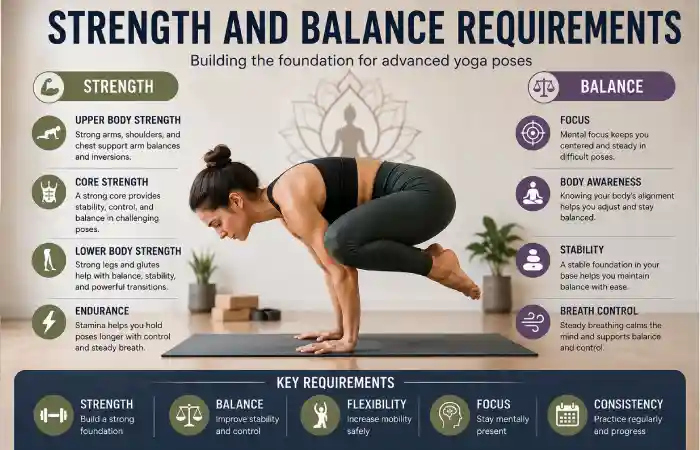
Common misconception about yoga is that it’s just flexibility competition; many hard poses actually involve a huge amount of strength.
Arm balances like Crow, Flying Pigeon, and Peacock require upper body strength and core strength. Backbends like Deep backbends require balanced spinal extension along with good shoulder and hip mobility. Inversions like Handstand and Scorpion require balance, spatial awareness and shoulder stability.
The broader physical-activity evidence also supports combining strength and balance work. WHO recommends muscle-strengthening activity involving major muscle groups on at least two days per week for adults, while older adults are advised to include multicomponent activity emphasizing balance and strength.
Advanced-pose demand comparison
| Pose | Strength | Balance | Mobility | Skill |
| Crow | High | High | Moderate | High |
| Handstand | Very high | Very high | Moderate | Very high |
| Peacock | Very high | High | Moderate | Very high |
| Flying Pigeon | High | Very high | High | Very high |
| Wheel | High | Moderate | Very high | High |
| Scorpion | Very high | Very high | Very high | Expert |
Important: These ratings are editorial difficulty indicators, not standardized scientific scores.
A balanced practice should also include movements that support comfortable mobility and allow you to work within your body’s limits. If you’re looking for a more targeted routine, explore these yoga poses for back pain.
Popular Advanced Yoga Poses
- Handstand — Adho Mukha Vrksasana
Handstand requires arm strength, shoulder stability, core strength and balance. Rather than just kicking repeatedly to a wall, work on controllable weight shifts and plan variations and supported inversions. The yoga journal pose library has instruction specific to safely working difficult handstand variations and acquiring the necessary strength for inversions.
- Scorpion Pose — Vrischikasana
Scorpion combines an inversion with a deep backbend. It requires substantial shoulder stability, balance and spinal mobility. It should not be a first inversion.
- Peacock Pose — Mayurasana
Peacock is an advanced arm balance requiring strong wrists, forearms, shoulders and core. Because the hands and wrists support significant bodyweight, preparation is essential.
- Flying Pigeon — Eka Pada Galavasana
This challenging arm balance combines hip mobility, upper-body strength and balance. Useful preparation can include Crow, hip-opening work and controlled single-leg balance.
- Wheel Pose — Urdhva Dhanurasana
Wheel requires strength as well as shoulder, hip and thoracic mobility. Avoid forcing the lower back into deeper extension simply to create a more dramatic shape.
- Dragonfly Pose
Dragonfly combines twisting, hip mobility, core strength and arm balance. Yogapedia categorizes it as an advanced posture involving arm balance, balance, core, hip opening, strength and twisting.
Even an advanced practice can benefit from slower movements, mindful breathing, and relaxation. For routines focused more specifically on calming the mind and releasing tension, try these yoga poses for stress relief.
Safety and Injury Prevention
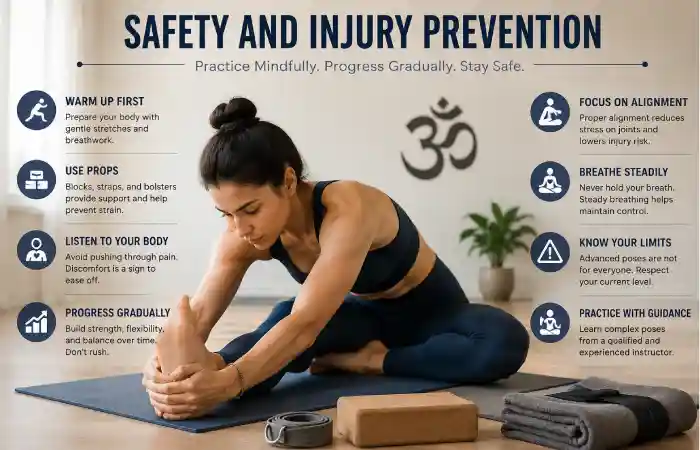
The biggest mistake with advanced yoga is treating discomfort as evidence that a pose is working.
Use these principles:
- Warm up before diving into advanced exercises.
- Work your way through preparatory postures.
- Avoid forcing any joint to the end range.
- Breathe, don’t hold your breath.
- Props are friends, not signs of deficiency.
- Practice inversions only within your comfort zone and safety.
- Stop if the pain is sudden, sharp and/or unusual.
- An advanced teacher can provide much-needed guidance while learning challenging poses.
Yoga International suggests that straps, blocks, bolsters, a chair, or blankets can be used to adapt postures that are tricky and you can learn to determine the difference between a positive stretch that is good and excessive and painful stretch that is dangerous. I believe for more complex inversions learning how to teach them professionally can bring one step more in safe teaching:
Yoga Alliance’s standards for teaching yoga clearly require and insist on safe, readily accessible and ethical teaching of yoga and a RYT will have some.
Advanced practitioners often combine challenging movements with foundational work on balance and stability. Explore these standing yoga poses to develop control and body awareness as part of your practice.
Troubleshooting common problems
| Problem | Likely issue | Try this |
| Falling out of balance | Poor weight distribution | Practice controlled weight shifts |
| Wrists hurt | Excessive loading or poor preparation | Reduce intensity and strengthen gradually |
| Lower back feels compressed | Insufficient hip/shoulder mobility | Improve mobility and reduce depth |
| Shoulders collapse | Insufficient shoulder stability | Add plank and shoulder-strength drills |
| Breath becomes strained | Pose is too demanding | Return to an easier variation |
| Repeatedly failing | Progression is too large | Add intermediate preparation steps |
Progressing from Intermediate Practice
Instead of jumping from Crow directly to Handstand, build a progression.
Example pathway:
Plank → Dolphin → Crow → Side Crow → Handstand preparation → Wall Handstand → Freestanding Handstand
For backbends:
Cobra → Bridge → Wheel preparation → Wheel → Advanced backbend variations
For flexibility-heavy poses:
Basic hip/hamstring mobility → Half variation → Supported full variation → Full pose
The principle is simple: change one major demand at a time.
Yoga International’s level system similarly describes progression as a guide rather than a rigid linear ladder; its advanced Level 3 practices assume an established practice and include challenging inversions and deep backbends.
A practical 2026 progression model
| Stage | Primary goal | Typical focus |
| Foundation | Control | Alignment + breathing |
| Intermediate | Capacity | Strength + mobility |
| Pre-advanced | Integration | Balance + transitions |
| Advanced | Skill | Complex poses |
| Mastery | Refinement | Efficiency + control |
Advanced practice does not mean performing the hardest pose every session. A highly skilled practitioner may spend more time refining fundamentals than chasing new shapes.
Equipment Comparison for Advanced Practice
| Equipment | Best use | Beginner-friendly? |
| Yoga blocks | Height and support | Yes |
| Yoga strap | Mobility and alignment | Yes |
| Bolster | Supported mobility/rest | Yes |
| Wall | Inversion practice | Yes, with care |
| Yoga wheel | Backbend assistance | Intermediate |
| Mat with strong grip | Stability | Yes |
For most people, a quality non-slip mat, two blocks and a strap are enough to begin progressing. More specialized equipment should solve a specific training problem rather than simply make the practice look more advanced.
Seated positions can complement an advanced routine by providing opportunities for controlled stretching, mobility work, breathing, and recovery. Explore these seated yoga poses for a more varied practice.
FAQs
Which yoga poses are the hardest advanced poses?
The level of a posed’s complexity can vary by person, butposes such as ScorpionPose Handstandvariants; PeacockPose Flying PigeonPose Dragonflyand advanced back bends are often considered the most difficult to perform because of their combination of motor skills. Yogapedia’s advanced poses directory features numerous poses from these types of groups.
Can beginners practice an advanced yoga posture?
Yes, if as a beginner’s goals they should gradually be progressed toward complex pose without attempting any extreme joint mobility, complex inversions or dynamic poses. They must work up to strength, mobility, body awareness and technique before attempting an advanced poses. How much time does it take to become advanced in yoga? There is no correct way to estimate time because individual factors of your physiology, mobility level and athletic ability can influence how quickly you progress.
Do I need flexibility for advanced poses?
Not all; many advanced poses require a strong balance of strength, coordination and body awareness; not merely flexibility.
Are advanced yoga poses healthy for muscle?
While some poses for advanced practitioner can increase strength, these also require and can build muscular strength in arms, shoulders, core, and legs.
However, they do not substitute a holistic strength-training routine; they are an enhancement.
Must I practice an advanced yoga pose everyday?
Generally not.
Advanced poses will place stress on tissue; alternate daily practice routines between technique, easier recovery pose, basic fundamentals or general mobility.
Final Takeaway
Your aim in mastering advanced yoga poses should not be to just create pretty shapes. Real progression actually lies in the control-stronger movement, stronger body awareness, practice with difficult shapes-ability to perform these poses in a way that does not force you to compromise yourself.
The best strategy to tackle each advanced pose is to break each element down-build each posture from there:-Strength Balance Mobility Preparation Refinement ControlledPractice
In order to create topical pages on a yoga content hub, this would need internal links pointing to supportive resources, like Seated Yoga Poses, Yoga for Flexibility, Yoga for Balance, Yoga for Beginners, Handstand Preparation, Yoga Props, and Yoga Injury Prevention.. Linking internally is a great way to improve reader navigation while building topicalauthority.
Afiya Jafar is a fitness and wellness writer who focuses on making health, exercise, and healthy lifestyle information simple and practical. Her work covers workouts, fitness motivation, strength training, nutrition, weight management, stress management, mindfulness, and everyday wellness.
Read Full Bio of Afiya Jafar →
Sameena Begum reviews selected health, wellness, fitness, and digital content for clarity, factual presentation, consistency, and reader usefulness. Her review work helps maintain clear and responsible editorial standards across PhysicalFitt content.
Read Full Bio of Sameena Begum →
Dr. Khizrana Begum is a qualified medical professional with MBBS and MD qualifications and 5+ years of experience in the medical field. She works as a General Physician and Dermatologist, with expertise in general medicine, dermatology, preventive healthcare, and skin health.
Read Full Bio of Dr. Khizrana Begum →