
Last Updated: September 4, 2026
It’s not a magic bullet to managing low back pain. What helps most people with lower back pain consist of: Staying mobile with the right kind of activity Improving how you move in daily activity Using hot and cold to help with pain Controlling supporting muscle growth Seeking professional assistance if symptoms don’t resolve and if you note red flag symptoms. More on low back pain Low back pain is a very widespread condition.
By the WHO’s estimates, 619 million people globally in 2020 struggled with low back pain, which makes it among the most commonly disabling issues around the globe.
Studies applying these data for GBD expect this rise to more than 843 million by 2050. There are good news – most instances of pain start to improve over time with conservative treatment. The best way to approach low back pain management: what you can help yourself to do What you can help yourself to do to reduce low back pain generally involves being sufficiently active while also ensuring you’re improving how you move.
Back Pain at a Glance: What the 2026 Evidence Tells Us
| Evidence point | Current finding |
| People affected globally in 2020 | 619 million |
| Projected cases by 2050 | 843 million |
| Low back pain’s global disability ranking | Leading cause of disability |
| Approximate proportion of low back pain that is nonspecific | ~90% |
| Chronic low back pain | Pain lasting more than 3 months |
WHO reports that nonspecific low back pain accounts for about 90% of cases, meaning a specific disease or structural cause cannot always be identified.
❝
This article is a part of
Pain and Recovery Hub
What Causes Back Pain?
Back pain has many possible causes, and sometimes there is no obvious trigger.
Common causes include:
- Muscle or tendon strains
- Ligament sprains
- Repetitive lifting or bending
- Sudden twisting movements
- Herniated or degenerative disks
- Arthritis
- Spinal stenosis
- Sciatica or nerve irritation
- Osteoporosis-related fractures
- Certain inflammatory conditions
Referred back pain Back pain can also be a sign of illness or dysfunction in another area of the body. Kidney, abdominal disorders, and even other systemic conditions sometimes cause pain that is perceived as originating from your back. You need a distinction between pain that will fade and long-term pain Acute vs.
Chronic back pain Acute back pain generally refers to pain of four weeks or less.
Pain of four to 12 weeks in duration is considered subacute; anything more than 12 weeks of duration is considered chronic. Don’t overlook underlying conditions If your pain resulted from an accident, fall, or traumatic event of any kind, do not automatically conclude that it is just a back muscle sprain.
How Is Back Pain Managed?
Management of back pain is often guided by the reason, degree and length of time your pain has been there. Management for straightforward back pain may well include: Carry on performing movements and activities which your human body may take. Usually stay away from rest in bed.
Consider heat or cooling to obtain short relief. Undertake appropriate movement, strengthening workouts or stretches. Enhance work/lifestyle and action patterns. Seek the advice of a physio, Chiropractor or Osteopath if your symptoms carry on to be troubled your day. Employ pain relief medications sparsely, and beneath professional guidance only.
For persistent primary minimal back soreness WHO suggests a person focused approach which might involve teaching, physical exercise, certain physical modalities, mental treatments and medication.
NICE advises encouraging regular pursuits, and exercise-focused applications in individuals with minimal again discomfort or sciatica.
Treatment Comparison
| Best suited for | Approach | Main purpose | Important consideration |
| Many uncomplicated cases | Gentle activity | Maintain movement/function | Don’t push through worsening symptoms |
| Recurrent or persistent pain | Exercise | Improve strength/mobility | Program should match ability |
| Persistent or function-limiting pain | Physical therapy | Individualized rehabilitation | Professional assessment can guide exercises |
| Some acute/subacute symptoms | Heat | Temporary pain/stiffness relief | Avoid burns |
| Some recent injuries | Cold | Temporary pain/swelling relief | Protect skin |
| Selected patients | Medication | Symptom control | Consider contraindications and interactions |
| Selected serious conditions | Surgery | Treat specific structural problems | Not usually first-line for nonspecific pain |
NICE recommends NSAIDs only after considering individual risks, using the lowest effective dose for the shortest appropriate period. It also advises against routine opioids for chronic low back pain.
Best Exercises for Back Pain
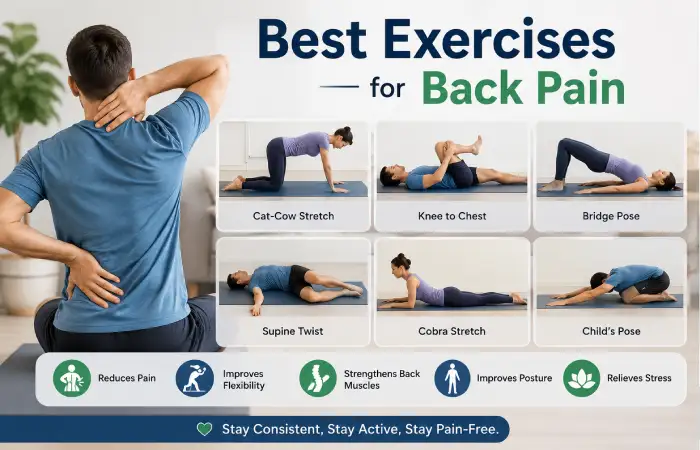
Exercise is one of the most important components of long-term back pain management.
Depending on your condition and fitness level, useful options can include:
- Walking
- Gentle core strengthening
- Pelvic tilts
- Bird-dog exercises
- Glute strengthening
- Controlled bridges
- Mobility exercises
- Low-impact aerobic activity
No Single Exercise is ‘Best’
There isn’t a “single exercise best type” for everyone. “There isn’t compelling evidence to date indicating that any single type of exercise or intervention is superior to all others for chronic primary low back pain,” the WHO reports. In their forthcoming 2025 guidelines, the Cleveland Clinic also encourages movement, not resting.
A “beginner rule” cited in a Cleveland Clinic patient article: “Focus on what works for you and begin with movements you can perform in a safe and Controlled and paced manner and build activity from there.
“ If you experience much pain during an exercise, it gets worse as you do it, or if you suddenly get weakness, numbness, or any other symptom, Stop and Talk to your Doctor.
Stretching for Back Pain
Stretching can be useful when stiffness or restricted mobility contributes to discomfort.
Gentle options may include:
- Knee-to-chest stretches
- Hamstring stretches
- Hip-flexor stretches
- Cat-cow movements
- Gentle trunk rotations
Avoid ‘jerk’ style stretches. You shouldn’t be bouncing or ‘cracking’/ forcing your back to go straight with a stretch; it should be gentle and guided.
If you have suffered an accident which caused the pain or have other signs like sickness, nerve symptoms or a lot of pain travelling from the back don’t stretch without advice first!
Daily Habits That Can Help Manage Back Pain
Small changes often matter more than a single intense workout.
Try these habits:
Break up long periods of sitting. Stand, walk or change position regularly.
Lift carefully. Keep loads close to your body and avoid twisting while lifting.
Build strength gradually. Stronger abdominal, hip and back muscles can support movement.
Stay physically active. Walking is a simple way to maintain regular movement.
Prioritize sleep. Poor sleep can make persistent pain harder to manage.
Control your weight when necessary. Overweight increases your back pain risk.
Don’t continue to wear a back brace without talking to your GP, therapist etc first. NICE specifically recommends that belts or corsets shouldn’t routinely be used for low back pain.
WHO also recommended physical activity, healthy sleep, and positive psychological state, ergonomics and healthy life styles.
How Posture Affects Back Pain
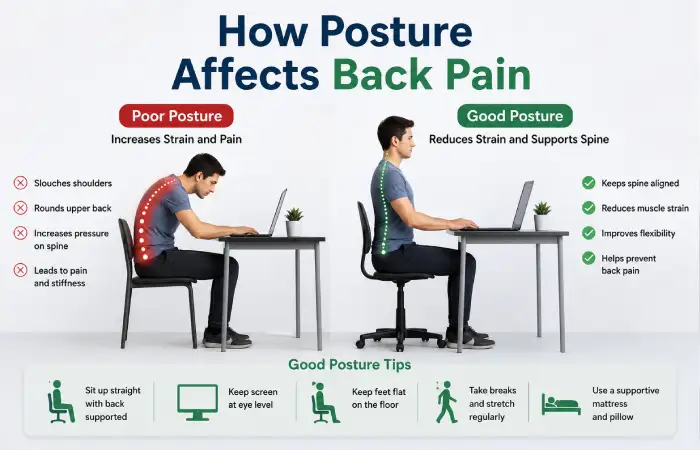
“Perfect posture” is not a realistic cure for back pain.
Research suggests that the relationship between individual spinal postures and developing back pain is complicated. An umbrella review found no clear consensus establishing specific postures as a direct cause of low back pain.
However, prolonged static sitting and poor sitting habits can aggravate symptoms. A 2025 scoping review involving 22 studies and 7,814 participants found associations between longer sitting, poor posture, fewer breaks and low back pain.
A practical desk setup
Aim for:
- Feet supported on the floor
- Screen close to eye level
- Keyboard and mouse within comfortable reach
- Hips and knees in a comfortable position
- Lower back supported if that feels helpful
- Regular movement breaks
The goal isn’t to maintain one rigid posture all day. Comfortable movement and changing positions regularly are often more useful.
Heat and Cold Therapy for Back Pain
Heat and cold can both provide short-term relief, but they serve different purposes.
| Option | Potential benefit | When people commonly try it |
| Cold pack | Can numb pain and reduce perceived swelling | After a recent injury or flare |
| Heating pad | Can reduce stiffness and relax muscles | Muscle tightness or ongoing discomfort |
| Warm shower/bath | Provides soothing superficial heat | Stiffness and relaxation |
Cleveland Clinic notes that cold may help with pain and swelling after a recent onset, while some people find heat more useful once acute inflammation has settled.
The American College of Physicians has also identified superficial heat as an evidence-supported non-drug option for acute and subacute low back pain.
Safety tip: Never place extreme heat or ice directly against bare skin, and don’t fall asleep while using a heating device.
Product comparison for home management
| Product | Advantage | Limitation |
| Reusable cold pack | Convenient and inexpensive | Can irritate skin if overused |
| Heating pad | Easy to use at home | Burn risk if excessively hot |
| Hot-water bottle | Simple and portable | Temperature is less controlled |
| Gel hot/cold pack | Can serve both purposes | Requires appropriate preparation |
| Heat wrap | Convenient while moving | May cost more per use |
Choose products based on safe temperature control, comfortable fit and ease of use, rather than assuming the most expensive option is medically superior.
When Should You Seek Help for Back Pain?
Some back pain can be managed at home, but certain symptoms need medical attention.
Seek urgent medical help if back pain occurs with:
- Numbness or weakness in both legs
- Loss of sensation around the genitals or anus
- New difficulty controlling your bladder or bowel
- Severe pain following major trauma
- Fever or feeling seriously unwell
- Rapidly worsening severe pain
When to seek professional advice Signs of an emergency are bilateral neurological findings and new bladder or bowel problems, according to NHS guidelines. You need professional advice also when there’s consistent pain, repeated episodes of pain, pain that stops you carrying out daily activities, significant unintentional weight loss, severe pain in the night or Other serious signs of back and back disorders. Other expert bodies, such as Cleveland Clinic and Johns Hopkins, advise seeking professional medical advice if your symptoms are severe, lasting, or affect your functional abilities.
Final Takeaway
The optimum management of back pain normally centers on managing the bigger picture rather than finding the wonder solution, this normally includes remaining appropriately active, developing strength systematically, applying heat or cold if appropriate, modifying movements to increase physical fluency and seek professional guidance if pain persists.
The findings of these reviews also highlight an important, yet general lesson; while back pain is prevalent there is no one-size-fits-all remedy to an injury which is of the chronic primary low back pain. WHO promotes self-management, nonsurgical treatment to back pain which consists of education and prescribed exercises. The selection of physical and psychological treatment approaches is individualized.