
 Afiya Jafar
Fitness & Wellness Writer
Afiya Jafar is a fitness and wellness writer who focuses on making health, exercise, and healthy lifestyle information simple and practical.
Read Full Bio of Author →
Afiya Jafar
Fitness & Wellness Writer
Afiya Jafar is a fitness and wellness writer who focuses on making health, exercise, and healthy lifestyle information simple and practical.
Read Full Bio of Author →
 Sameena Begum
Health, Fitness & Digital Content Reviewer
Sameena reviews selected health, wellness, fitness, and digital content for clarity, factual presentation, and reader usefulness.
Read Full Bio of Reviewer →
Sameena Begum
Health, Fitness & Digital Content Reviewer
Sameena reviews selected health, wellness, fitness, and digital content for clarity, factual presentation, and reader usefulness.
Read Full Bio of Reviewer →
 Dr. Khizrana Begum
General Physician & Dermatologist
Dr. Khizrana Begum is a General Physician and Dermatologist with MBBS and MD qualifications and 5+ years of experience in the medical field.
Read Full Bio of Medical Reviewer →
Dr. Khizrana Begum
General Physician & Dermatologist
Dr. Khizrana Begum is a General Physician and Dermatologist with MBBS and MD qualifications and 5+ years of experience in the medical field.
Read Full Bio of Medical Reviewer →
Work stress management simply involves acknowledging work stressors, minimizing unnecessary pressure and finding new, healthier means of coping with work demands. Moderate levels of stress can be positive and provide motivation; however, unmanageable levels of stress can have detrimental effects on focus and concentration, mood and sleep, as well as health and overall productivity at work.
Workplace pressure can be easier to handle when you build a consistent stress management routine that includes healthy habits, regular movement, and effective coping strategies.
This has become ever more prominent in 2026 as it was recorded by Gallup that in 2025 that 40% of employees experienced a lot of stress throughout most of the previous day. Managers actually experience an increased level of work stress throughout the day compared to individual employees (45% and 39% respectively). Workers in South Asia, however experienced only 30% of stress at work but still work-related stress remains a key workplace wellness issue.
A good way to manage workplace stress does not have to involve removing all the stress that comes from the workplace. The question here is finding the cause of workplace stress and trying to handle what you can control and realizing what has become to be much and seeking help.
❝
This article is a part of
Stress Management Hub
Using practical stress management techniques can help you stay focused, manage daily pressure, and respond more effectively to challenging situations at work.
What Causes Stress at Work?
Work stress can come from a single major problem or from many smaller pressures that accumulate over time.
Common workplace stressors include:
- Heavy or unrealistic workloads
- Tight deadlines
- Long working hours
- Lack of control over how work is performed
- Unclear responsibilities
- Conflicting instructions
- Poor communication
- Lack of support from managers or coworkers
- Job insecurity
- Workplace bullying or conflict
- Poor work-life boundaries
- Frequent interruptions and excessive meetings
- Rapid organizational or technological changes
Taking short movement breaks during the workday can help release physical tension, and these stress relief exercises can be a simple way to stay active while managing workplace stress.
Job stress, according to NIOSH, consists of negative physical and emotional reactions occurring when demands within the job do not match what an employee is capable of handling, or when the demands match but the worker is not able to achieve them, given their capacity, resources, or need.
It should be noted that not all stress is bad. A difficult project, while stimulating, may provide a motivational reward. But work overload and under load occur when the demands placed on the employee are greater than what the worker is able to do.
Along with setting boundaries and managing your workload, incorporating natural stress relief strategies can support relaxation and a healthier work-life routine.
How to Manage Work Stress
Effective work stress management usually requires more than one technique. Try the following practical approach.
- Identify your biggest stressors
For one week, write down situations that repeatedly trigger stress.
For example:
| Stressor | How it affects you | Possible response |
| Too many tasks | Feeling overwhelmed | Prioritize with your manager |
| Constant notifications | Poor concentration | Create notification-free periods |
| Unclear deadlines | Anxiety | Confirm priorities and due dates |
| Long meetings | Fatigue | Request agendas or shorter meetings |
| Difficult coworker | Irritability | Set communication boundaries |
Practicing mindfulness for stress can help you become more aware of stressful thoughts and bring your attention back to the task at hand.
This simple exercise can reveal whether your stress comes mainly from workload, people, lack of control, environment or poor organization.
- Prioritize instead of multitasking
Create three categories at the beginning of your workday:
Must do: Critical tasks with firm deadlines
Should do: Important but less urgent tasks
Can wait: Tasks that can be postponed or delegated
Time-blocking will help lessen the mental burden of making decisions on what to do next every hour. Forbes suggests actively scheduling your tasks, and then “buffer it with enough breathing room to catch what’s inevitable.”
- Set realistic boundaries
When overwhelmed, say yes automatically: take on more work and get more stressed, even while struggling with your existing task load.
Rather than saying no outright, try to provide reasoning about your current work focus:
‘I can take this on, but it means I’ll have to push Task B until tomorrow. Which is most urgent’
This makes an awkward encounter a discussion about work load, rather than responsibility. NHS suggests managing work load, and having confidence to turn down new work as it will impose too great a pressure.
After a demanding workday, meditation techniques for stress can provide a simple way to relax, slow down, and mentally transition away from work.
Communicate with your manager
If your stress is due to either ambiguous expectations, lack of necessary resources, or simply having too much to do, bring the problem to your boss. Remember that focus more on your expectations than merely saying that you are stressed. It’s better to say:
” I have 5 urgent tasks due this week,”
” Can we rank these by priority?”
” Could you clarify what tasks are actually a part of my responsibilities?”
” Are we sure that this deadline is actually going to be realistic?”
APA advises discussing workplace stress with superiors, developing a realistic approach including specific actions, resources and expectations that are needed.
Signs That Work Stress Is Affecting You
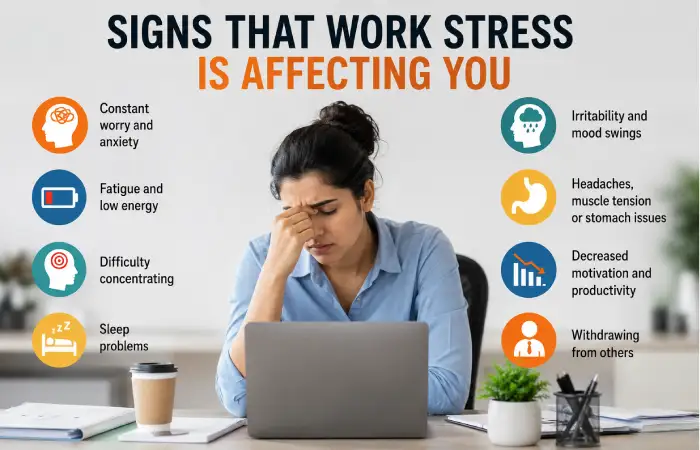
Work stress can appear mentally, emotionally, physically and behaviorally.
Possible signs include:
- Constant worrying about work
- Irritability
- Feeling exhausted before the day begins
- Difficulty concentrating
- Headaches or muscle tension
- Sleep problems
- Changes in appetite
- Loss of motivation
- Procrastination
- Withdrawing from coworkers or family
- Feeling unable to switch off after work
APA notes that persistent work stress can be associated with problems including sleep disturbances, difficulty concentrating, headaches and irritability.
Stress vs. burnout
They are related but aren’t identical.
Work stress can be temporary and may improve when a particular pressure is removed.
Burnout is chronic workplace stress, not successfully cope. WHO define burnout as an occupational phenomenon, not a medical disease.
If the symptoms is long, it seems serious and the daily life has been serious disturbed by the symptoms. Talking to appropriate professional healthcare/mental-health person would be recommended.
Time Management and Work Stress
Poor time management can make a manageable workload feel overwhelming.
Try this simple system:
Plan → Prioritize → Focus → Break → Review
- Choose your three most important tasks.
- Estimate how long each will take.
- Work on one important task at a time.
- Schedule short breaks.
- Review unfinished tasks before ending the day.
Avoid filling every minute of your calendar. Unexpected requests, technical problems and meetings can disrupt even a well-planned schedule.
A realistic schedule is generally more useful than an ideal schedule that leaves no room for change.
Exercise and Work Stress
Physical activity can be a useful part of a stress-management routine.
You don’t necessarily need a long gym session. Consider:
- Walking during lunch
- Taking the stairs
- Stretching between tasks
- Walking during a phone call
- Cycling to work when practical
- Doing a short workout before or after work
MedlinePlus includes regular exercise and relaxation techniques among approaches that can help people manage stress.
The goal is consistency rather than perfection.
How to Take Effective Breaks
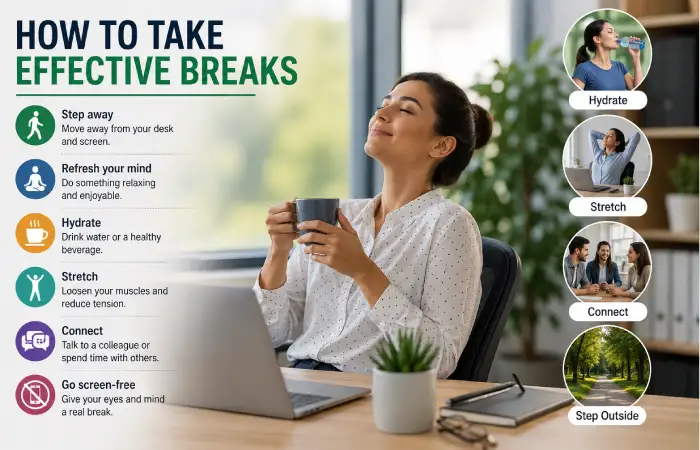
A break is more useful when it actually separates you from work.
Instead of switching from your work computer to your phone while remaining mentally engaged, try:
- Standing up
- Walking outside
- Stretching
- Drinking water
- Looking away from your screen
- Taking several slow breaths
- Talking briefly with a coworker
- Eating lunch away from your workstation
NIOSH identifies infrequent breaks and long working hours among workplace conditions associated with job stress.
Quick rule: if possible, make at least some breaks screen-free and work-free.
Creating a Healthier Work Routine
A healthier routine doesn’t require completely redesigning your life.
Before work
- Decide your top priorities.
- Avoid immediately checking every notification.
- Prepare what you need for the first task.
During work
- Focus on one priority at a time.
- Take regular movement breaks.
- Keep water nearby.
- Communicate when priorities conflict.
At the end of work
- Review unfinished tasks.
- Write down tomorrow’s priorities.
- Close unnecessary work applications.
- Create a clear stopping point.
After work
- Move your body.
- Spend time away from work-related screens.
- Connect with people you enjoy.
- Give yourself time to mentally transition out of work mode.
A healthy routine should make work more sustainable, not simply help you tolerate increasingly unreasonable demands.
Final Takeaway
When we talk about managing work stress, we don’t mean working on coping with an unhealthy work environment better. It begins with recognizing where the pressure is coming from and then developing strategies that can affect the stress-causing factors we can manage, and then looking for external help for the ones that are beyond our reach.
Prioritize your tasks, ensure you have a real break, ensure you stay mobile, set healthy limits and don’t shy away from giving an alert to everyone around you when your load gets too much. At the organizational level employers too need to consider work load, work role clarity, support and working conditions.
Strongest way to address work stress therefore is a combined approach-individual effort to develop good working coping strategies and organizational efforts in developing environments which do not inherently have loads which stress out their employees on a daily basis.
Afiya Jafar is a fitness and wellness writer who focuses on making health, exercise, and healthy lifestyle information simple and practical. Her work covers workouts, fitness motivation, strength training, nutrition, weight management, stress management, mindfulness, and everyday wellness.
Read Full Bio of Afiya Jafar →
Sameena Begum reviews selected health, wellness, fitness, and digital content for clarity, factual presentation, consistency, and reader usefulness. Her review work helps maintain clear and responsible editorial standards across PhysicalFitt content.
Read Full Bio of Sameena Begum →
Dr. Khizrana Begum is a qualified medical professional with MBBS and MD qualifications and 5+ years of experience in the medical field. She works as a General Physician and Dermatologist, with expertise in general medicine, dermatology, preventive healthcare, and skin health.
Read Full Bio of Dr. Khizrana Begum →