
 Afiya Jafar
Fitness & Wellness Writer
Afiya Jafar is a fitness and wellness writer who focuses on making health, exercise, and healthy lifestyle information simple and practical.
Read Full Bio of Author →
Afiya Jafar
Fitness & Wellness Writer
Afiya Jafar is a fitness and wellness writer who focuses on making health, exercise, and healthy lifestyle information simple and practical.
Read Full Bio of Author →
 Sameena Begum
Health, Fitness & Digital Content Reviewer
Sameena reviews selected health, wellness, fitness, and digital content for clarity, factual presentation, and reader usefulness.
Read Full Bio of Reviewer →
Sameena Begum
Health, Fitness & Digital Content Reviewer
Sameena reviews selected health, wellness, fitness, and digital content for clarity, factual presentation, and reader usefulness.
Read Full Bio of Reviewer →
 Dr. Khizrana Begum
General Physician & Dermatologist
Dr. Khizrana Begum is a General Physician and Dermatologist with MBBS and MD qualifications and 5+ years of experience in the medical field.
Read Full Bio of Medical Reviewer →
Dr. Khizrana Begum
General Physician & Dermatologist
Dr. Khizrana Begum is a General Physician and Dermatologist with MBBS and MD qualifications and 5+ years of experience in the medical field.
Read Full Bio of Medical Reviewer →
Stress is and always will be a normal aspect of life; however, too much or too often can have an impact on how you feel, how you sleep, how well you focus on your work, on others and in some instances on physical health. The art of managing your stress is really an ability to identify it when you feel the stress, what makes you feel the stress, what stress is doing to you and how to deal with it more healthily. It isn’t about removing all stressful factors as not every single one can always be avoided.
For example, short burst stress can actually provide you motivation to make them happen in the first place.
Managing your stress, on the other hand is the process by which you will remove the possibility that these stressful factors could overwhelm you and that you do not adopt any detrimental habits that your mind and body will benefit greatly from. So the WHO have defined the term stressing simply as “a natural reaction of the body to change” and the World Health Organization has strongly stressed how an individual is able to cope with this stress can make a significant difference on their health.
Learning practical stress management techniques can help you cope with daily pressure and develop healthier ways to manage stressful situations.
❝
This article is a part of
Stress Management Hub
What Is Stress Management?
Stress management involves implementing practical methods, skills for coping and lifestyle options for assisting you in responding to events that trigger stress and minimizing the negative effects of long-term chronic stress.
It is defined by the American Psychological Association as methods, techniques or programs-like preparing in advance for stress responses and utilizing different breathing methods to relax-for dealing with sources of stress and the condition of stress.
Stress management is not merely relaxing yourself during overwhelming moments; it’s also:
- Identifying where most stressors originate.
- Recognizing your stress triggers.
- Modifying stressful situations, if it’s feasible.
- Adapting yourself rather than the situation, in case it can’t be modified.
- Enhancing your lifestyle with regular exercise and good sleep habits.
- Employing relaxation methods or mindful practices.
- Keeping good and supportive connections with others.
- Establishing and adhering to appropriate limitations and reasonable goals.
- Seeking professional help, when required.
Regular physical activity can reduce tension and improve your mood, making stress relief exercises a useful part of a healthy stress-management routine.
TheMayo Clinic also considers that stress management is a series of methods which could combine better problem-solving, better time-management skills, the prioritization of significant activities, emotional assistance techniques or strategies, sleep improvement as well as the involvement in physical exercise and more satisfying associations.
To be more precise, quality stress management deals with two important levels:
Lowering unwanted stress when feasible.
For instance, you could simply avoid the hassle and delegate part of your work or switch off unwanted alarms.
Maximizing your inner resource, when faced with no other option but to endure stress.
Breathing exercises and relaxation techniques, physical exercise, consistent sleep habits, support from family and friends-all these facilitate building immunity at a psychological level.
Why Is Stress Management Important?
When you experience stress, your body activates the stress response. For a short time, this reaction helps you to tackle an challenge. Your heart and breathing will get faster, concentration becomes tighter and your body stands ready.
But there is a problem when the reaction to a stressful incident is repeated several times without adequate opportunity for recuperation.
According to the WHO it is too much the stress a cause for both physical and psychic health concerns and also makes a it very difficult to unbend, concentrate and in the sleep. When there is chronic exposure to stress, it will also possibly contribute to:
- Sleep: difficulty going to sleep or staying asleep or deep sleep (or) restlessness during sleep
- Mood: irritability, nervousness or a generally unhappy disposition
- Focus/Concentration: difficulty focusing and making decisions.
- Muscles: increase in their tension and aches and pains (or) headaches.
- Digestive system: aches and pains in the stomach or changes in appetite.
- Energy: a lack of energy.
- Behavior: staying to themselves, and postponing actions or developing bad habits.
The Association of the psychology of the American: Stress causes a physical and a psychological changes that can also determine, as one behaves and feel.
For people dealing with workplace pressure, learning how to manage work stress can make it easier to handle deadlines, heavy workloads, and other job-related challenges.
Stress management vs. stress elimination
You do not need a stress free life. In reality, pursuing the elimination of every stress can add to the burden and also become an additional stress factor. The more achievable and realistic aim is:
- Perceive the stress,
- Respond effectively to stress,
- Recover from stress,
- Building resilience against future stresses.
The sooner stress is observed, you gain time to opt for the suitable response before becoming overwhelmed by it.
What Causes Stress?
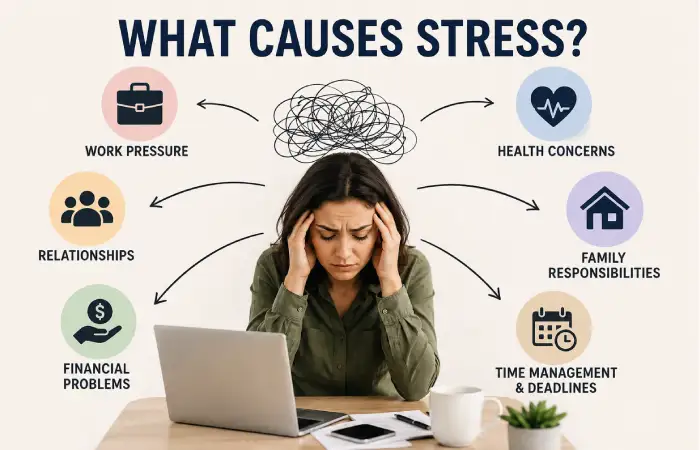
Stress can come from almost any situation that feels demanding, threatening, uncertain or outside your control.
Common stressors include:
Work and school
- Heavy workloads
- Tight deadlines
- Exams
- Job insecurity
- Difficult colleagues
- Long working hours
- Performance pressure
Relationships
- Arguments
- Separation or divorce
- Family responsibilities
- Caregiving
- Social isolation
- Communication problems
Financial concerns
- Debt
- Unexpected expenses
- Job loss
- Housing costs
- Financial uncertainty
Major life changes
Even positive events can be stressful.
Examples include:
- Moving
- Marriage
- Starting a new job
- Having a baby
- Retirement
- Relocation
Health concerns
Your own health problems or concern about someone you care about can create significant stress.
Everyday stressors
Simple lifestyle changes and healthy daily habits can support natural stress relief and help promote a greater sense of calm.
Small problems can accumulate:
- Traffic
- Noise
- Crowded environments
- Constant notifications
- Too many appointments
- Lack of sleep
- Household responsibilities
One person’s stressor may not affect another person in the same way. Stress depends partly on how an individual perceives and responds to a situation.
What Are the Common Signs of Stress?
There can be several different areas where your body, mind, feelings and behavior show signs of stress.
Symptoms outlined by the NHS: physical symptoms (headache, dizzyness, muscle tension, stomach complaint, pounding heart), and mental symptoms (problems concentrating, feeling out of control, racing thoughts, short tempered)
Physical signs
You may notice:
- Headaches
- Muscle tension
- Fatigue
- Faster heartbeat
- Stomach discomfort
- Changes in sleep
- Sweating
- Feeling restless
- Changes in appetite
Emotional signs
Stress may cause:
- Irritability
- Anxiety
- Feeling overwhelmed
- Frustration
- Difficulty relaxing
- Low mood
- Feeling unable to cope
Cognitive signs
Practicing mindfulness for stress can help you stay focused on the present moment and reduce the impact of overwhelming thoughts.
You might experience:
- Racing thoughts
- Poor concentration
- Forgetfulness
- Difficulty making decisions
- Constant worrying
- Negative thinking
Behavioral signs
Stress can also change what you do.
You may:
- Avoid people or activities
- Procrastinate
- Work excessively
- Sleep too much or too little
- Eat more or less than usual
- Use alcohol, tobacco or other substances to cope
- Withdraw socially
Recognizing your personal warning signs is an important part of stress management because it allows you to intervene earlier.
What Are the Best Stress Management Techniques?
There isn’t a perfect method for everyone.
However the best method for you will likely be one which targets your body, thoughts, environment, behavior and relationships.
Stress-management techniques at a glance
| Technique | Main advantage | Best used for |
| Slow breathing | Simple and portable | Immediate stress |
| Exercise | Supports physical and mental health | Ongoing stress and low energy |
| Mindfulness | Builds present-moment awareness | Racing thoughts and emotional stress |
| Sleep routine | Supports recovery | Stress + poor sleep |
| Time management | Creates greater control | Workload-related stress |
| Social connection | Provides support | Isolation and emotional stress |
| Journaling | Helps reveal patterns | Identifying triggers |
| Progressive muscle relaxation | Encourages bodily relaxation | Physical tension |
| Professional therapy | Individualized support | Persistent or severe stress |
Mayo Clinic and the NCCIH both describe relaxation practices such as breathing, meditation and progressive relaxation as useful components of stress management.
How Can Exercise Help Manage Stress?
When considering which of the practical strategies below is for you-and the others you plan to include to build healthy, stress-reducing habits-think about how they will best fit into your daily schedule and into your needs. One of the best practical ways to make stress-management more a part of your daily life is physical activity. (CDC)
You don’t have to start with 150 minutes
Incorporating meditation techniques for stress into your daily routine may help promote relaxation and improve your ability to respond calmly to stressful situations.
If you’re currently inactive, starting small can be more realistic.
Try:
- A 10-minute walk
- Taking the stairs
- Walking during a lunch break
- Stretching between work sessions
- Dancing at home
- Cycling
- Swimming
- Yoga
- Strength training
Even small amounts of physical activity are better than none.
Simple weekly movement plan
| Day | Example |
| Monday | 30-minute brisk walk |
| Tuesday | Strength training |
| Wednesday | 20–30-minute walk |
| Thursday | Yoga or mobility |
| Friday | 30-minute brisk walk |
| Saturday | Recreational activity |
| Sunday | Rest or gentle movement |
The best activity is usually one you can enjoy consistently.
How Does Mindfulness Help With Stress?
Mindfulness means intentionally paying attention to the present moment with greater awareness and less automatic judgment.
Instead of becoming absorbed in thoughts such as:
“What if everything goes wrong?”
mindfulness encourages you to notice:
“I’m having a worried thought right now.”
That small change can create space between the thought and your response.
All evidence collected supports the use of mindfulness as a potential useful stress management technique. NCCIH states that the evidence collected points towards mindfulness meditation’s ability to help alleviate symptoms of stress like depression and anxiety as well as to sleep.
A 2026 systematic review and meta-analysis compiled and reviewed 17 randomized controlled trials focusing on a total of 1,641 non-clinical adults with an assessment on the effects of mindfulness-based interventions on perceived stress.
Simple 2-minute mindfulness exercise
- Sit comfortably.
- Notice your breathing.
- Feel your feet or body against the chair.
- Notice sounds around you.
- When your mind wanders, gently return attention to your breathing.
- Continue for two minutes.
You don’t have to empty your mind. The goal is to notice where your attention goes and gently bring it back.
Breathing Exercises for Stress Management
Breathing exercises are particularly useful because they can be performed almost anywhere.
Slow, controlled breathing can encourage the body’s relaxation response. NCCIH notes that slow, deep breathing may modestly lower blood pressure and cortisol and may help reduce stress.
Diaphragmatic breathing
Try this:
- Sit or lie comfortably.
- Place one hand on your abdomen.
- Slowly inhale through your nose.
- Allow your abdomen to expand.
- Exhale slowly.
- Repeat for several breaths.
Don’t force the breath or make yourself uncomfortable.
Box breathing
A simple version involves:
Inhale → hold → exhale → pause
using equal counts.
Controlled breathing exercises, such as the box breathing technique, may help to manage stress according to the American Heart Association.
In case you feel dizzy, unwell or you feel worse as a consequence of a breathing exercise, cease practicing it and resume to breathe normally. Those with existing heart and/or lung conditions should consult their health provider before practicing breathing exercises.
How Does Sleep Affect Stress?
Stress and sleep can impact one another. Stress may make it hard to get sleep and sleep deprivation can also make it harder to deal with a particular situation’s stresses. The WHO has recommend regular sleep/wake times, making sleep and wake space comfortable, reducing use of screen devices before sleep and regular exercise.
The CDC generally recommends that ages 18-60 get at least 7 hours sleep each night.
2026 CDC data brief stated that 30.5% of all US adults have been getting less than 7 hours sleep per night in 2024.
Build a stress-friendly sleep routine
Try:
- Going to bed at a consistent time
- Waking at a consistent time
- Reducing stimulating activities before bed
- Keeping the bedroom comfortable and quiet
- Avoiding large meals close to bedtime
- Limiting caffeine later in the day
- Using relaxation techniques before bed
If persistent sleep problems continue, talk with a healthcare professional rather than assuming stress is the only cause.
How Can You Manage Everyday Stress?
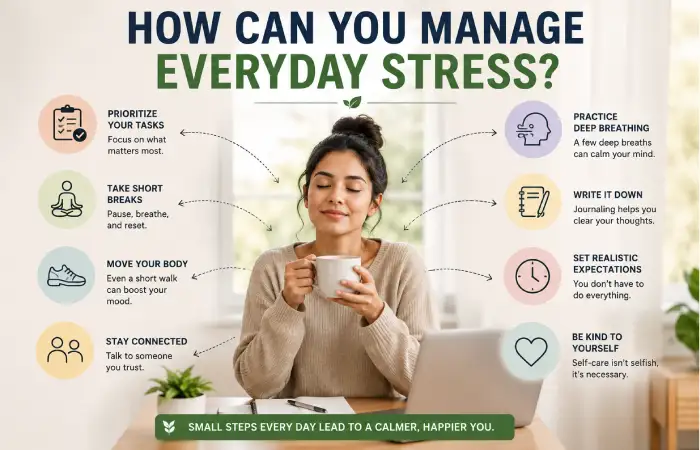
You don’t need to wait until you’re overwhelmed.
Small changes throughout the day can prevent stress from accumulating.
Try the “stress reset” approach
Step 1: Stop
Pause what you’re doing for a moment.
Step 2: Breathe
Take several slow, comfortable breaths.
Step 3: Identify
Ask:
- What exactly is stressing me?
- Is this something I can change?
- What do I need right now?
Step 4: Choose
Select one action:
- Solve the problem
- Delay it
- Delegate it
- Set a boundary
- Take a break
- Ask for help
Step 5: Recover
Return to your day without expecting yourself to be perfectly calm.
This approach is consistent with the broader stress-management principle of distinguishing between stressors you can change and situations where changing your response is more realistic.
Stress Management at Work
Work can be a major source of ongoing stress.
Common workplace stressors include:
- Excessive workload
- Unclear expectations
- Long hours
- Lack of control
- Workplace conflict
- Poor work-life boundaries
- Constant digital communication
Practical workplace strategies
Prioritize three important tasks
Instead of treating everything as urgent, identify the tasks that genuinely matter most.
Break large projects into smaller steps
A large task can feel threatening when viewed as one enormous problem.
Break it into:
Goal → Task → Next action
Take short breaks
A short walk, breathing exercise or change of environment can help interrupt prolonged mental strain.
Set communication boundaries
If possible, establish periods when you aren’t checking work messages.
Delegate when appropriate
You don’t need to personally complete every task.
Learn to say no
A healthy boundary can be more effective than trying to become better at tolerating an overloaded schedule.
2026 workplace evidence
A 2026 systematic review & meta-analysis of 132 RCT’s in 23,080 participants suggested that meditation interventions in employees led to better perceptions of stress,job stress, anxiety, depression, well being, resilience & sleep. Despite this, they comment that evidence for both is diverse and inconsistent, varying in certainty with outcome.
This is important distinction: while meditation is a potential workplace stress management intervention and should perhaps not be framed in the broadest, most simplistic “cure” of an unhealthy workload and/or organizational system,
Natural Ways to Reduce Stress
Many of us use ways to help cope with stress that are cheap and easy.
Get outdoors
Just being for a short time outdoors is good if you can incorporate taking some exercise and an environment change which can then lead to recovery.
Get together with people
Speaking to someone in whom you have confidence can help ease feeling alone.
WHO recommend staying in touch with family and friends; talk things over with someone in whom you have confidence.
Eat meals regularly and healthily
A regular, healthy intake of food will support overall health and help ensure you don’t have crashes of energy during the day.
Challenge yourself and reduce unhealthy behaviours that might lead to issues: too much alcohol, smoking, recreational drugs, too much comfort eating or excessive time spent online or on social media should perhaps only be used for a brief reprieve as they can generate further concerns.
NHS specifically advices against the use of alcohol, cigarettes, gambling and illegal drugs in attempting to deal with stress.
Have some enjoyment
Hobbies aren’t something we should feel like are a waste of time to pursue; reading, gardening, music, eating, walking, painting and creativity all offer the restorative opportunity from the insistent demands that life can present.
How to Create a Daily Stress Management Routine
The most effective routine is one you’ll actually follow.
Don’t build a 12-step morning ritual if your schedule makes it unrealistic.
Instead, start with a few repeatable behaviors.
Example morning routine
5 minutes: slow breathing or mindfulness
10–20 minutes: walking or movement
Healthy breakfast: balanced meal and fluids
Plan: identify your three most important tasks
During the workday
- Take short movement breaks
- Avoid unnecessary multitasking
- Practice slow breathing when tension rises
- Eat lunch away from your workspace when possible
- Check whether your workload is realistic
Evening routine
- Finish work at a defined time when possible
- Reduce stimulating screen use before bed
- Spend time with people you care about
- Do something enjoyable
- Prepare for tomorrow
- Use a short relaxation exercise
A simple 15-minute stress-management routine
| Time | Activity |
| 2 minutes | Slow breathing |
| 5 minutes | Gentle movement |
| 3 minutes | Identify priorities |
| 3 minutes | Mindfulness |
| 2 minutes | Plan one enjoyable activity |
You don’t need to perform the routine perfectly.
Consistency matters more than complexity.
WHO’s 2026 guidance similarly emphasizes practical self-help skills, daily routines, sleep, exercise and connection as part of managing stress.
Which Stress Management Technique Should You Choose?
Different situations call for different tools.
| Situation | First strategy to try | Longer-term strategy |
| Sudden stressful moment | Slow breathing | Regular relaxation practice |
| Racing thoughts | Mindfulness | Meditation or CBT-based strategies |
| Work overload | Prioritization | Boundary and workload changes |
| Physical tension | Movement/relaxation | Regular exercise |
| Poor sleep | Wind-down routine | Consistent sleep habits |
| Loneliness | Contact someone | Build social support |
| Repeated worrying | Write thoughts down | Professional support if persistent |
| Chronic stress | Multiple strategies | Healthcare/mental-health assessment |
There is no requirement to choose only one technique.
A combined approach is often more practical.
Stress Management Tools: What Is Worth Trying?
Stress-management tools range from completely free techniques to paid digital products and professional services.
| Tool | Cost | Convenience | Best use |
| Breathing exercises | Free | Very high | Immediate stress |
| Walking | Free/low cost | High | Daily stress |
| Journaling | Low | High | Identifying patterns |
| Meditation apps | Free/paid | Very high | Guided mindfulness |
| Fitness tracker | Paid | High | Activity awareness |
| Therapy | Usually paid/covered depending on location | Moderate | Persistent or complex stress |
| Structured stress program | Varies | Moderate | People who prefer guided learning |
A useful commercial strategy is to focus on the problem the tool solves, not simply promote products.
For example:
- Need reminders? Consider a digital habit tracker.
- Prefer guided meditation? Consider a meditation platform.
- Need accountability? Consider professional coaching or therapy where appropriate.
- Want to understand triggers? Try a journal or stress diary.
Tools should support healthy behavior—not become another source of pressure.
How to Track Your Stress
You don’t need an expensive wearable to understand your stress patterns.
Try a simple stress journal.
Record:
Trigger: What happened?
Thought: What went through my mind?
Body: What did I feel physically?
Emotion: What did I feel?
Response: What did I do?
Outcome: Did it help?
After a week or two, look for patterns.
You may discover that your stress isn’t random.
For example:
Poor sleep → rushed morning → missed tasks → work pressure → irritability → poor evening routine
Once you see the cycle, you can intervene earlier.
Cleveland Clinic recommends journaling as one way to identify stressors and patterns in how you respond to them.
What Does the 2026 Evidence Say About Stress Management?
Current evidence supports stress management as a multidimensional approach, rather than a single intervention.
2026 evidence snapshot
| Area | Current evidence | Practical takeaway |
| Physical activity | Strong general health evidence | Make movement part of regular life |
| Relaxation techniques | Evidence supports potential benefits | Useful as a low-cost complementary strategy |
| Mindfulness | Growing evidence, including 2026 reviews | Useful for stress and emotional regulation |
| Sleep | Strong relationship with health and well-being | Protect consistent sleep |
| Social connection | Recommended by major health organizations | Don’t manage persistent stress alone |
| Therapy/CBT | Established psychological approach | Consider when stress is persistent or impairing |
| Meditation at work | 2026 meta-analysis found improvements across several outcomes | Potential workplace intervention, but evidence has limitations |
NCCIH notes that relaxation techniques—including deep breathing, progressive relaxation, guided imagery and biofeedback—can activate a relaxation response, although evidence varies depending on the condition and technique.
The evidence for mindfulness is growing too. NCCIH reported in 2007 on meta-analysis specifically addressing the link between mindfulness and stress perception between studies published after 2000. One of NCCIH’s main findings was that research varies considerably by meditation technique and study rigor; moreover, several of NCCIH’s published trials indicated undesirable side-effects.
That is why responsible stress-management content should avoid claims such as “this technique will cure stress.”
A better statement is:
“This approach may help reduce stress for some people and can be used alongside other healthy strategies.”
When Should You Seek Professional Help for Stress?
Self-help strategies can be valuable, but you don’t have to manage severe or persistent stress alone.
Consider speaking with a healthcare professional or mental-health professional if:
- Stress is interfering with work, school or relationships
- You feel overwhelmed most of the time
- Your symptoms aren’t improving
- You frequently experience anxiety or low mood
- You have persistent sleep problems
- You increasingly rely on unhealthy coping behaviors
- Stress causes significant physical symptoms
- You are avoiding important activities because of stress
The NHS notes that talking therapies may help people who are struggling with stress, while Cleveland Clinic recommends professional support when stress becomes overwhelming or symptoms persist.
Don’t assume every physical symptom is “just stress”
All physical symptoms like chest pain, critical shortness of breath, loss of consciousness, or neurological effects may not be related to the stress.
Ensure you are under the right medical care.
For life-threatening situations and suicidal thoughts, call emergency numbers/country crisis lines immediately.
The Bottom Line on Stress Management
Managing your stress effectively doesn’t mean creating a life that no longer goes wrong.
It means getting yourself ready to deal with whatever does occur, better.
The most effective stress-management routine is not necessarily the most complicated.
It is the routine you can stick with.
Afiya Jafar is a fitness and wellness writer who focuses on making health, exercise, and healthy lifestyle information simple and practical. Her work covers workouts, fitness motivation, strength training, nutrition, weight management, stress management, mindfulness, and everyday wellness.
Read Full Bio of Afiya Jafar →
Sameena Begum reviews selected health, wellness, fitness, and digital content for clarity, factual presentation, consistency, and reader usefulness. Her review work helps maintain clear and responsible editorial standards across PhysicalFitt content.
Read Full Bio of Sameena Begum →
Dr. Khizrana Begum is a qualified medical professional with MBBS and MD qualifications and 5+ years of experience in the medical field. She works as a General Physician and Dermatologist, with expertise in general medicine, dermatology, preventive healthcare, and skin health.
Read Full Bio of Dr. Khizrana Begum →