
 Afiya Jafar
Fitness & Wellness Writer
Afiya Jafar is a fitness and wellness writer who focuses on making health, exercise, and healthy lifestyle information simple and practical.
Read Full Bio of Author →
Afiya Jafar
Fitness & Wellness Writer
Afiya Jafar is a fitness and wellness writer who focuses on making health, exercise, and healthy lifestyle information simple and practical.
Read Full Bio of Author →
 Sameena Begum
Health, Fitness & Digital Content Reviewer
Sameena reviews selected health, wellness, fitness, and digital content for clarity, factual presentation, and reader usefulness.
Read Full Bio of Reviewer →
Sameena Begum
Health, Fitness & Digital Content Reviewer
Sameena reviews selected health, wellness, fitness, and digital content for clarity, factual presentation, and reader usefulness.
Read Full Bio of Reviewer →
 Dr. Khizrana Begum
General Physician & Dermatologist
Dr. Khizrana Begum is a General Physician and Dermatologist with MBBS and MD qualifications and 5+ years of experience in the medical field.
Read Full Bio of Medical Reviewer →
Dr. Khizrana Begum
General Physician & Dermatologist
Dr. Khizrana Begum is a General Physician and Dermatologist with MBBS and MD qualifications and 5+ years of experience in the medical field.
Read Full Bio of Medical Reviewer →
As a response to the common feeling of everyday stress mediation is a relatively simple, practical way to pause and train your mind how to experience stress in a less overwhelming and potentially more grounded manner. No serene retreat, special meditation cushion or expensive yoga clothing necessary here; minutes of sitting quietly and breathing deeply may be all that you need.
New research evidence confirms meditation and mindfulness practice are of value for treating perceived stress. A 2026 systematic review, including 17 random control trials on1,641 adults showed that mindfulness based intervention could lower perceived stress. The findings from a 2026 systematic review including 24,494 individuals indicated that there is a meaningful relation between mindfulness and reduced perception of stress.
Meditation can be a useful part of a broader stress management routine, especially when combined with healthy sleep, exercise, and other relaxation practices.
Mindfulness can be an effective part of a broader stress management routine, especially when combined with healthy lifestyle habits and relaxation practices.
The mind practices of mediation are never intended as a substitute treatment should your stress begin to reach extreme levels. See it instead as a tool among healthy eating, sleeping, exercise, relaxation and any medical and psychological treatment if necessary.
❝
This article is a part of
Stress Management Hub
Can Meditation Help Reduce Stress?
Yes. Instead of getting rid of intrusive thoughts, meditation focuses on an awareness and detection of your surroundings, without immediately reacting. That is, if you detect a runaway thought, tense shoulders, shallow breathing etc., you should return your attention gently back to your breath or body. NCCIH confirms: Mindful meditation may assist with stress symptoms, and may reduce depression/anxiety and sleep quality.
What the 2026 evidence tells us
| Key finding | Evidence | Participants/data |
| Mindfulness-based interventions were studied for perceived stress | 2026 systematic review & meta-analysis | 17 RCTs / 1,641 adults |
| Greater mindfulness was associated with lower perceived stress | 2026 mindfulness meta-analysis | 56 samples / 24,494 people |
| Mindfulness may help with stress, anxiety and sleep | NCCIH evidence review | Multiple reviews |
| Meditation may promote relaxation and help manage stress | Mayo Clinic guidance | Clinical overview |
Meditation is one option among many, so exploring different stress management techniques can help you choose strategies that match your needs and daily routine.
Mindfulness is one of several approaches you can use, so exploring different stress management techniques can help you find strategies that work best for your needs.
Best Meditation Techniques for Stress
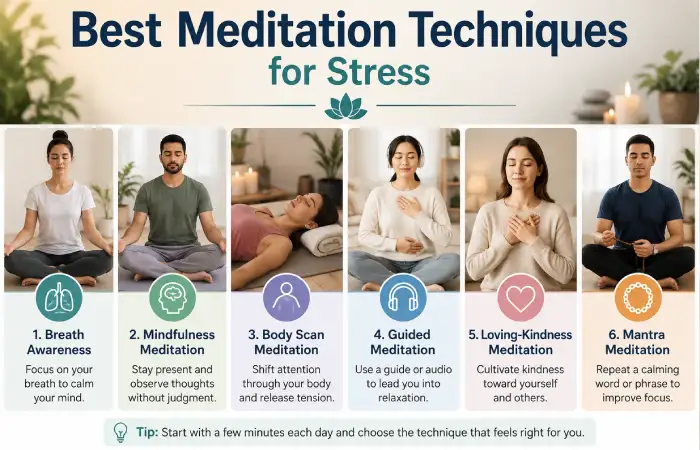
There is no single “best” meditation for everyone. Beginners generally benefit from choosing a technique that is easy enough to practice consistently.
Mindful movement can also complement physical activity, and incorporating stress relief exercises such as walking, stretching, or yoga can help combine movement with greater body awareness.
| Technique | Typical starting time | Best for | Beginner difficulty |
| Breath-focused meditation | 5–10 min | Racing thoughts | Easy |
| Mindfulness meditation | 5–10 min | Everyday stress | Easy |
| Body scan | 5–15 min | Physical tension | Easy–moderate |
| Guided meditation | 5–20 min | Beginners who need direction | Very easy |
| Loving-kindness meditation | 5–15 min | Emotional stress | Moderate |
| Mantra meditation | 5–15 min | Difficulty concentrating | Moderate |
For a more active approach to stress reduction, you can combine meditation with stress relief exercises such as walking, yoga, stretching, or other enjoyable physical activities.
If stressful thoughts are connected to your job, practicing mindfulness alongside strategies for managing work stress may help you become more aware of workplace triggers and respond to them more calmly.
As one of the simplest ways to start your journey is to meditate on the breath. The Mayo Clinic suggests you focus your attention on the breath as this makes meditation very approachable for beginners.
If workplace pressure is affecting your ability to relax, meditation can complement practical strategies for managing work stress and creating healthier workday habits.
If you are feeling tension in the body then a body scan is good for you as it moves the awareness from one body part to another
Guided Meditation for Stress Relief
Guided meditation may also be more user-friendly for beginners due to someone else instructing you on what to focus on, rather than allowing you to work things out for yourself.
A basic guided session may ask you to:
- Sit comfortably.
- Close your eyes or soften your gaze.
- Take several comfortable breaths.
- Notice physical sensations.
- Observe thoughts without judging them.
- Return attention to your breathing.
- Slowly bring your attention back to the room.
For readers who want guided resources, both free and subscription-based options exist.
Meditation app comparison
| Option | Cost model | Beginner friendly | Guided sessions | Best suited to |
| Medito | Free forever | ★★★★★ | Yes | Beginners on a budget |
| Headspace | Subscription/free trial options | ★★★★★ | Yes | Structured programs |
| YouTube guided sessions | Usually free | ★★★★☆ | Yes | Quick sessions |
| Self-guided meditation | Free | ★★★☆☆ | No | Experienced users |
Mindfulness can also be included as part of a healthy lifestyle focused on natural stress relief, alongside sleep, physical activity, breathing exercises, and time outdoors.
Meditation can also be incorporated into a broader routine focused on natural stress relief, alongside movement, mindful breathing, adequate sleep, and healthy lifestyle habits.
The app from Medito allegedly has guided meditations, breathing exercises, introductory courses, stress and anxiety programs all included without needing to pay subscription or sign up for an account.
Headspace uses expert-led meditations and stress-relieving programs in its app designed to boost the user’s mental well-being.
Breathing Meditation for Beginners
Meditation focused on breath can be most useful at the moments in time stress has made our mind race uncontrollably.
Give these five minutes a try:
Minute 1: Rest yourself where you are and focus your attention on your regular breathing.
Minutes 2-3: Feel your breath moving into your body, and then coming out of your body. Resist trying to control its depth.
Minute 4: Accept without judgment thoughts that arise about where your attention is and redirect it gently to the breath.
Minute 5: Take a moment to acknowledge any physical sensations of the body or perceptions of your environment, then your emotional state, and then open your eyes.
You cannot cease thoughts. What you do is observe when your attention drifts away from you and you gently re-direct it back.
That repeated return is the practice.
How Long Should You Meditate for Stress?
Because meditation and mindfulness often work together, practicing mindfulness for stress can help you develop greater awareness of your thoughts, emotions, breathing, and physical sensations.
You don’t need a 30- or 60-minute session to begin.
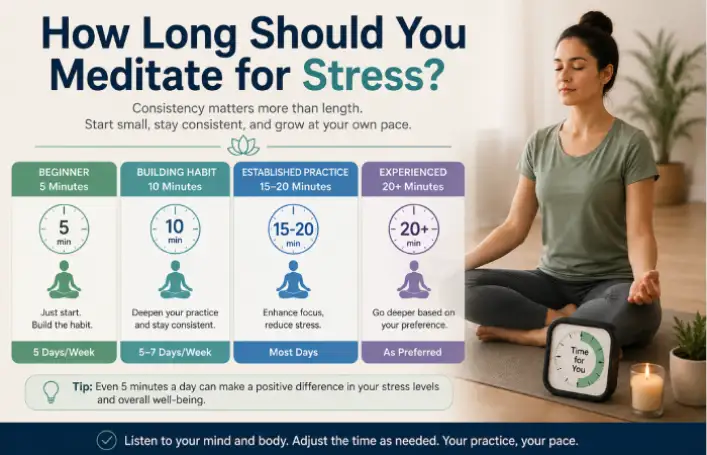
A practical progression is:
For a more structured mindfulness practice, you can explore different meditation techniques for stress, including breath-focused meditation, body scans, and guided meditation.
5 minutes → 10 minutes → 15 minutes → longer if comfortable
Mass General Brigham notes that shorter meditation sessions can still be useful and specifically highlights 10 minutes as a practical amount for people who have limited time.
Mayo Clinic also notes that meditation can be practiced for just a few minutes and doesn’t require special equipment.
A simple weekly target
| Experience | Session length | Frequency |
| Complete beginner | 5 minutes | 5 days/week |
| Building consistency | 10 minutes | 5–7 days/week |
| Established practice | 15–20 minutes | Most days |
| Experienced | 20+ minutes | Based on preference |
Consistency matters more than forcing yourself through long sessions.
How to Start a Daily Meditation Practice
Make meditation easy enough that you can repeat it.
- Choose a reliable time.
After waking, during a lunch break, or before bed can work well. - Pick one location.
A chair, bed-side space, or quiet corner is enough. - Start with five minutes.
Don’t wait until you have an hour. - Use a timer or guided session.
This removes the need to keep checking the clock.
Both Mayo Clinic and Medito suggest that you need no fancy equipment or any special training to get started, “Meditation can be simple, and you don’t need any equipment or much training to start.”
The Bottom Line
You don’t need to blank your mind when you meditate for stress, nor you need to spend an hour a day. Just try with 5 minutes and observe your breath and when you mind get lost, bring it back to your breath without pressure.
The field of 2026 research, continue to support mind-based approaches as a beneficial choice in managing perceived stress, at the same time point out the importance of realist expectation and EBP, thus..
Choose a method you can really use everyday with pleasure, 5 mindful minutes this morning is definitely a good step instead of trying to develop the ‘ideal’ method.
Afiya Jafar is a fitness and wellness writer who focuses on making health, exercise, and healthy lifestyle information simple and practical. Her work covers workouts, fitness motivation, strength training, nutrition, weight management, stress management, mindfulness, and everyday wellness.
Read Full Bio of Afiya Jafar →
Sameena Begum reviews selected health, wellness, fitness, and digital content for clarity, factual presentation, consistency, and reader usefulness. Her review work helps maintain clear and responsible editorial standards across PhysicalFitt content.
Read Full Bio of Sameena Begum →
Dr. Khizrana Begum is a qualified medical professional with MBBS and MD qualifications and 5+ years of experience in the medical field. She works as a General Physician and Dermatologist, with expertise in general medicine, dermatology, preventive healthcare, and skin health.
Read Full Bio of Dr. Khizrana Begum →