
 Afiya Jafar
Fitness & Wellness Writer
Afiya Jafar is a fitness and wellness writer who focuses on making health, exercise, and healthy lifestyle information simple and practical.
Read Full Bio of Author →
Afiya Jafar
Fitness & Wellness Writer
Afiya Jafar is a fitness and wellness writer who focuses on making health, exercise, and healthy lifestyle information simple and practical.
Read Full Bio of Author →
 Sameena Begum
Health, Fitness & Digital Content Reviewer
Sameena reviews selected health, wellness, fitness, and digital content for clarity, factual presentation, and reader usefulness.
Read Full Bio of Reviewer →
Sameena Begum
Health, Fitness & Digital Content Reviewer
Sameena reviews selected health, wellness, fitness, and digital content for clarity, factual presentation, and reader usefulness.
Read Full Bio of Reviewer →
 Dr. Khizrana Begum
General Physician & Dermatologist
Dr. Khizrana Begum is a General Physician and Dermatologist with MBBS and MD qualifications and 5+ years of experience in the medical field.
Read Full Bio of Medical Reviewer →
Dr. Khizrana Begum
General Physician & Dermatologist
Dr. Khizrana Begum is a General Physician and Dermatologist with MBBS and MD qualifications and 5+ years of experience in the medical field.
Read Full Bio of Medical Reviewer →
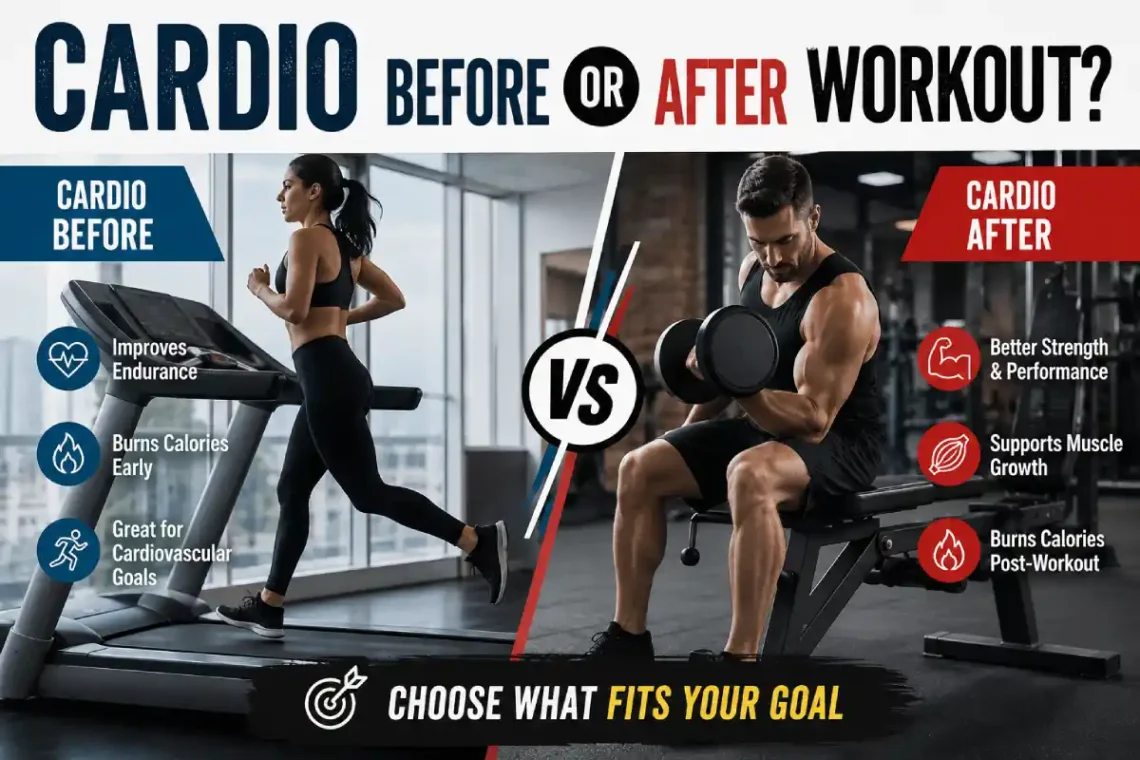
Cardio Before Or After Workout?
One of the fitness world’s burning questions… If you are aiming to get fat, build muscle, increase your stamina or just get a healthy body, then your cardio and weight training arrangement would have an impact. Studies from exercise scientists due to be released between now and the next 2025 and 2026 show neither strategy is necessarily the optimal choice.
Ultimately, whether to put cardio before or after a workout depends entirely on your goal.
Here we breakdown the pros of putting cardio before or after strength training, compare the two, and outline which is better for you depending on the fitness target.
❝
This article is a part of
Cardio Hub
Does Timing Matter?
Yes—but not as much as consistency.
Exercise timing influences:
- Available energy during workouts
- Muscle performance
- Recovery
- Training quality
- Total calorie expenditure
The biggest factor is preserving energy for your highest-priority activity.
For example:
- Want bigger muscles? Lift first.
- Training for a marathon? Run first.
- General health? Either order works.
Comparison Table: Cardio Before vs After Workout
| Factor | Cardio Before | Cardio After |
| Fat Loss | Excellent | Excellent |
| Muscle Growth | Lower | Best |
| Strength Performance | Reduced | Higher |
| Endurance Training | Best | Moderate |
| Athletic Performance | Goal-dependent | Goal-dependent |
| Energy for Lifting | Lower | Higher |
| Calories Burned | Similar overall | Similar overall |
| Recommended For | Runners, cyclists | Most gym users |
Before deciding when to perform cardio, explore our complete guide to cardio exercises in the gym to understand the different workout options available.
Benefits of Doing Cardio Before Weights
Starting with cardio is ideal when cardiovascular fitness is your main priority.
Advantages
- Improves aerobic endurance
- Better preparation for endurance events
- Increases heart rate gradually
- Good for race training
- Effective warm-up when performed moderately
Potential Drawbacks
Long or intense cardio before lifting may:
- Reduce lifting performance
- Cause muscle fatigue
- Lower training volume
- Reduce power output
Example:
Running 45 minutes before squats often results in lifting lighter weights.
Benefits of Doing Cardio After Weights
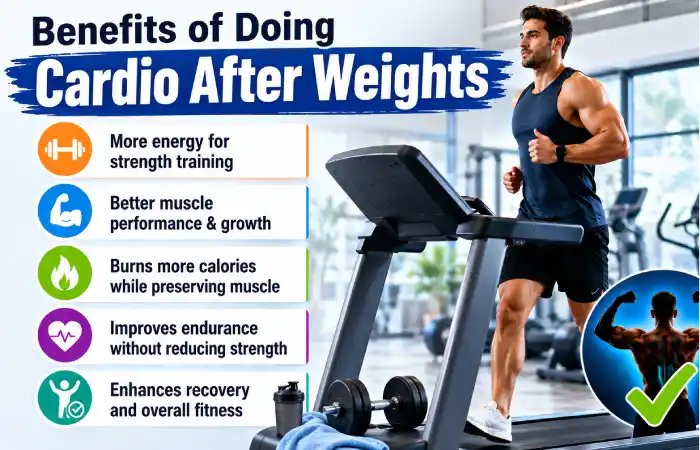
Most strength coaches recommend lifting first if muscle growth or strength is your primary goal.
Benefits
- More energy for heavy lifts
- Better muscle recruitment
- Higher strength output
- Improved resistance training quality
- Better recovery between strength sets
Research continues to support resistance training before cardio for maximizing muscle-building adaptations.
Performance Comparison
| Goal | Recommended Order |
| Build Muscle | Weights → Cardio |
| Increase Strength | Weights → Cardio |
| General Fitness | Either |
| Marathon Training | Cardio → Weights |
| Cycling Performance | Cardio → Weights |
| Weight Maintenance | Either |
| Heart Health | Either |
Best Option for Fat Loss
How often should I do weight training and cardio to lose weight. “Weight Training before cardio for fat loss When you want to lose body fat, it is very normal to wonder what method is better – weight training before cardio, or cardio before weight training. The way you organize your workouts can play a role in how you feel while you are exercising and the intensity you will work at, but the fact is that as long as you maintain a consistent calorie deficit and a solid training program, the order does not matter a great deal to your fat loss.
That said, for most of the population weight training comes before cardio.
Reason is this will retain your lean muscle mass whilst in calorie deficit – as muscle is key for metabolism, as well as your overall physique. When you do weights before you will find that you will have enough energy for a weight training session where you are working heavier and you will be able to do more repetitions, and over time will be progressive with weight training. After you have had your weight training session, finish with a 20-30 minute moderate intensity cardiovascular training session – which can contribute a little extra calorie burn. B risk walk incline or treadmill, cycle, rower or elliptical are all great options here.
However, as previously mentioned – if you are an individual that finds it more beneficial to do your cardiovascular workout before strength training, and you’ll actually stick to a programme that includes this, that is fine too.
Consistency trumps sequencing every time.
If preserving muscle while reducing body fat is your goal, learn how cardio for fat loss can be structured for better long-term results.
Why Weights Before Cardio Often Works Better
- Preserves muscle mass during weight loss
- Allows better performance during resistance training
- Supports progressive overload for long-term results
- Increases total calorie burn when cardio follows lifting
- Helps improve body composition by reducing fat while maintaining muscle
If your primary objective is losing body weight, our guide to cardio for weight loss explains the most effective workout strategies and weekly routines.
Fat Loss Strategy Comparison
| Approach | Fat Burning | Muscle Preservation | Best For |
| Cardio Before Weights | High | Moderate | Endurance-focused individuals |
| Weights Before Cardio | High | Excellent | Most people aiming for fat loss |
| Separate Cardio and Strength Sessions | Very High | Excellent | Intermediate and advanced exercisers |
Tips to Maximize Fat Loss
1. Eat a sustainable calorie deficit. Do not embark on a extreme fad diet.
2. Get in 2 to 4 days per week of resistance training.
3. Mix in 150-300 minutes of moderate intensity cardio or 75-150 minutes of intense cardio training per week (depending on your current level of fitness).
4. Get plenty of protein-1.6 to 2.2 grams per pound of body weight – as this can support muscle maintenance while you’re in a deficit.
5. Make sure you get enough quality sleep. Sleep plays a crucial role in appetite, energy levels and training performance.
The Bottom Line – Most beginner and intermediate recreational exercisers will find a balance of muscle preservation, fat loss, and long-term gains when using this format. Most importantly, the ideal workout is one that can be adhered to consistently in conjunction with a sound nutrition plan and a recovery protocol.
New to fitness? Start with our beginner cardio workout plan to build endurance before experimenting with workout timing strategies.
Fat Loss Comparison
| Method | Effectiveness |
| Cardio Before | ★★★★☆ |
| Cardio After | ★★★★★ |
| Combined Weekly Plan | ★★★★★ |
Best Option for Muscle Gain
If muscle growth is your priority, cardio should usually come after weight training.
Reasons include:
- More available glycogen for lifting
- Better training intensity
- Greater mechanical tension
- Reduced fatigue during compound exercises
Keep cardio moderate:
- 20–30 minutes
- Walking
- Incline treadmill
- Stationary cycling
- Easy rowing
Avoid excessive high-intensity cardio immediately before heavy lifting sessions.
Whether you walk, jog, or sprint, our treadmill cardio workout guide includes routines that fit different fitness levels and goals.
Combining Cardio and Strength Training
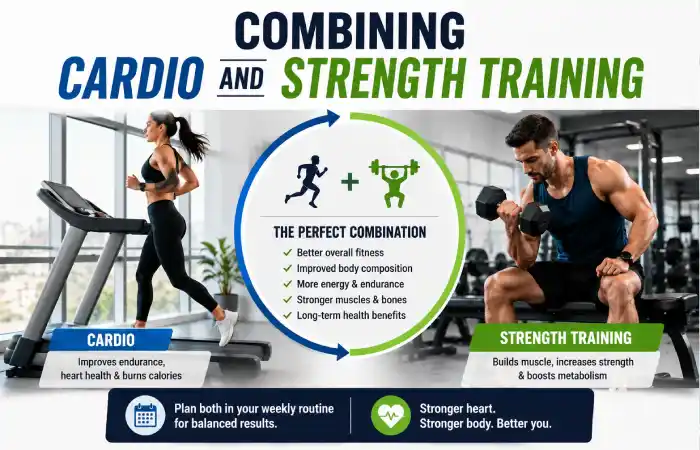
You don’t have to choose one over the other.
A balanced weekly plan provides benefits for both cardiovascular health and muscular fitness.
Example Weekly Schedule
| Day | Workout |
| Monday | Upper Body + 20 min cardio |
| Tuesday | Moderate cardio |
| Wednesday | Lower Body |
| Thursday | HIIT |
| Friday | Full Body Strength |
| Saturday | Walking or Cycling |
| Sunday | Recovery |
This approach reduces fatigue while allowing steady progress in multiple fitness areas.
Short on time? HIIT cardio workouts can help improve endurance while maximizing calorie burn in efficient training sessions.
Expert Recommendations
Sports scientists and certified strength coaches generally recommend:
- Keep your goal front and center.
- Lift before cardio for muscle or strength.
- Do cardio first if endurance is your ultimate goal.
- Give long cardio and heavy lifting the space (in hours, maybe even workout sessions) they need, as separated as possible.
- Meet the basic guidelines for aerobic fitness and strength training with 150+ minutes of moderate-intensity cardio plus 2+ days of strength training per week.
Decision Guide
| Your Goal | Best Workout Order |
| Lose Fat | Weights → Cardio |
| Build Muscle | Weights → Cardio |
| Improve Running | Cardio → Weights |
| Improve Cycling | Cardio → Weights |
| Stay Healthy | Either |
| Beginner | Weights → Light Cardio |
Common Mistakes to Avoid
- Doing intense cardio before heavy leg workouts
- Skipping recovery days
- Ignoring nutrition after exercise
- Performing excessive cardio while trying to gain muscle
- Believing workout order matters more than consistency
- Not progressing resistance training over time
Recommended Fitness Equipment
| Product | Why Choose It | Best For |
| Adjustable Dumbbells | Progressive overload with minimal space | Home strength training |
| Smart Fitness Watch | Monitors heart rate, pace, and recovery | Cardio tracking |
| Resistance Bands | Portable and versatile | Beginners |
| Treadmill | Indoor walking and running year-round | Cardio sessions |
| Exercise Bike | Joint-friendly endurance training | Low-impact cardio |
FAQ
Should cardio come before or after weight lifting?
After, if the goal is strength or hypertrophy. Before, if endurance is the goal.
Will doing cardio after lifting lose more fat?
No. It will primarily depend on creating a calorie deficit, although lifting first helps maintain muscle.
Can beginners mix cardio and strength training?
Absolutely, they’re highly compatible and a routine consisting of strength training and some light/moderate cardio works well.
How much cardio should I do after weights?
20-30 minutes is usually adequate for most people but it depends on recovery and goal.
Should I do HIIT before weights?
No.
It’s a performance killer when it comes to strength training and unless you’re looking to max your performance at the end of a HIIT workout, lift first.
Troubleshooting
| Problem | Solution | Likely Cause |
| Too tired to lift | Lift before cardio | Intense cardio first |
| Slow muscle gains | Reduce cardio frequency or duration | Excessive cardio volume |
| Poor endurance progress | Schedule dedicated cardio days | Prioritizing weights every session |
| Constant soreness | Improve sleep, nutrition, and rest days | Insufficient recovery |
| Low workout energy | Eat a balanced pre-workout meal 1–3 hours before training | Inadequate fueling |
Conclusion
Whether you choose to perform your cardio before or after resistance training is based on what your main fitness goal is. For the majority of individuals whose goal is to build muscle, strength and/or shed body fat while preserving lean muscle mass, it’s recommended to get resistance training in first, followed by some moderate intensity cardio. Conversely, if your goal is to improve endurance or to fuel performance for running or biking competitions, you should do your cardio first.
Afiya Jafar is a fitness and wellness writer who focuses on making health, exercise, and healthy lifestyle information simple and practical. Her work covers workouts, fitness motivation, strength training, nutrition, weight management, stress management, mindfulness, and everyday wellness.
Read Full Bio of Afiya Jafar →
Sameena Begum reviews selected health, wellness, fitness, and digital content for clarity, factual presentation, consistency, and reader usefulness. Her review work helps maintain clear and responsible editorial standards across PhysicalFitt content.
Read Full Bio of Sameena Begum →
Dr. Khizrana Begum is a qualified medical professional with MBBS and MD qualifications and 5+ years of experience in the medical field. She works as a General Physician and Dermatologist, with expertise in general medicine, dermatology, preventive healthcare, and skin health.
Read Full Bio of Dr. Khizrana Begum →