
 Afiya Jafar
Fitness & Wellness Writer
Afiya Jafar is a fitness and wellness writer who focuses on making health, exercise, and healthy lifestyle information simple and practical.
Read Full Bio of Author →
Afiya Jafar
Fitness & Wellness Writer
Afiya Jafar is a fitness and wellness writer who focuses on making health, exercise, and healthy lifestyle information simple and practical.
Read Full Bio of Author →
 Sameena Begum
Health, Fitness & Digital Content Reviewer
Sameena reviews selected health, wellness, fitness, and digital content for clarity, factual presentation, and reader usefulness.
Read Full Bio of Reviewer →
Sameena Begum
Health, Fitness & Digital Content Reviewer
Sameena reviews selected health, wellness, fitness, and digital content for clarity, factual presentation, and reader usefulness.
Read Full Bio of Reviewer →
 Dr. Khizrana Begum
General Physician & Dermatologist
Dr. Khizrana Begum is a General Physician and Dermatologist with MBBS and MD qualifications and 5+ years of experience in the medical field.
Read Full Bio of Medical Reviewer →
Dr. Khizrana Begum
General Physician & Dermatologist
Dr. Khizrana Begum is a General Physician and Dermatologist with MBBS and MD qualifications and 5+ years of experience in the medical field.
Read Full Bio of Medical Reviewer →
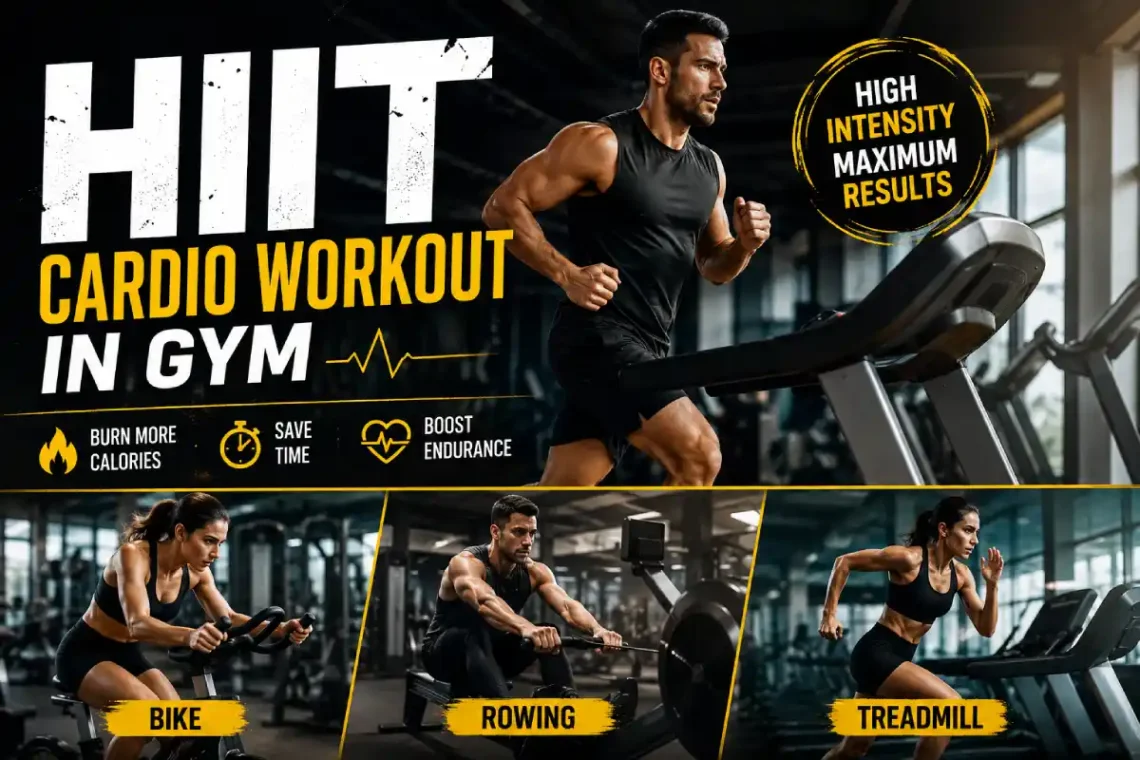
Looking to create the best HIIT cardio workout in the gym? You are certainly not alone. High-Intensity Interval Training (HIIT) is the one of the go-to workout approaches these days.
High intensity cardio training torch fat and is effective to get maximum burn of calories for your work without actually working hard for an extended period of time.
No matter if you prefer a tread mill, an exercise bike, or any other cardio machines, HIIT workout can cater any level.
❝
This article is a part of
Cardio Hub
What Is HIIT Cardio?
The basic principle behind High-Intensity Interval Training (HIIT) is relatively straightforward: bursts of exercise of extremely high intensity are interleaved with brief recovery periods of low-intensity exercise. This might mean, rather than going for a 40-minute run, for example, that you run extremely hard for 30 seconds, then have 90 seconds of rest/slow walk, repeated throughout a 20-minute period.
HIIT workouts can be performed using:
- Treadmills
- Stationary bikes
- Rowing machines
- Stair climbers
- Ellipticals
- Battle ropes
- Air bikes
Most gym members can complete an effective HIIT workout in just 15–30 minutes.
Benefits of HIIT Training
Studies published by major sports medicine organizations continue to show that HIIT delivers major health and fitness gains in a much shorter workout period than moderate intensity cardio.
Major Benefits
| Benefit | How HIIT Helps |
| Fat Loss | Burns high calories during and after exercise |
| Better Heart Health | Improves cardiovascular endurance |
| Time Efficient | Effective in 20–30 minutes |
| Muscle Preservation | Less muscle loss compared to long cardio sessions |
| Higher Metabolism | Increased calorie burn after workouts |
| Insulin Sensitivity | Supports blood sugar control |
| Improved Athletic Performance | Builds speed and power |
A lot of people beginning to work out will start noticing improvements in their stamina within four to six weeks of regular training.
To better understand how interval training supports body composition, read our complete guide on cardio for fat loss.
HIIT Treadmill Workout
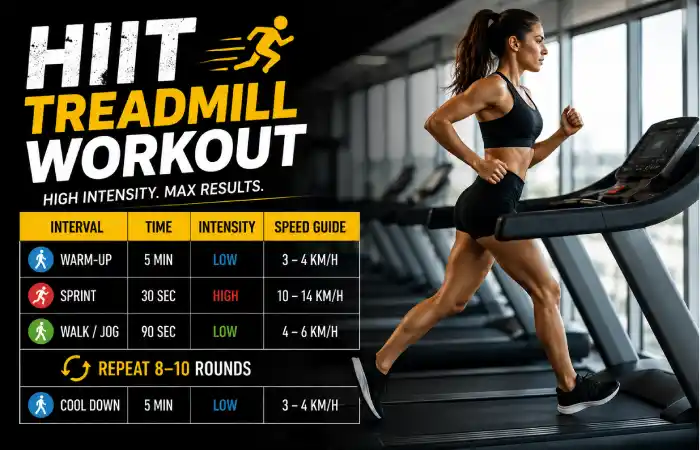
It is the simplest of machines that is available to anyone starting withHIITtraining.
Beginner HIIT Treadmill Routine
| Time | Activity |
| 5 min | Warm-up walk |
| 30 sec | Sprint (80–90% effort) |
| 90 sec | Walk |
| Repeat | 8–10 rounds |
| 5 min | Cool-down walk |
Workout Duration:
Approximately 25 minutes
As you increase your conditioning, extend the sprint time, shorten recovery time.
Prefer using a treadmill? Follow our treadmill HIIT workout guide to perform safe and effective interval sessions indoors.
HIIT Bike Workout
Stationary bikes help lower your knee impact and still provide you a high intensity bike workout.
Sample Bike HIIT Routine
| Interval | Duration |
| Warm-up | 5 minutes |
| Fast Pedaling | 40 seconds |
| Easy Cycling | 80 seconds |
| Repeat | 10 rounds |
| Cool-down | 5 minutes |
A bike HIIT session will particularly benefit obese patients and novice cyclists, as well as those undergoing a period of recovery from impact damage to their legs.
HIIT Rowing Machine Routine
Rowing is one of the few cardio exercises that train both the upper and lower body simultaneously.
Beginner Rowing HIIT
| Interval | Time |
| Easy Row | 5 minutes |
| Fast Row | 45 seconds |
| Slow Row | 90 seconds |
| Repeat | 8 rounds |
| Cool-down | 5 minutes |
If you’re exploring different training styles, our complete guide to cardio exercises in the gym covers the best machines and workouts for every fitness level.
HIIT vs Traditional Cardio
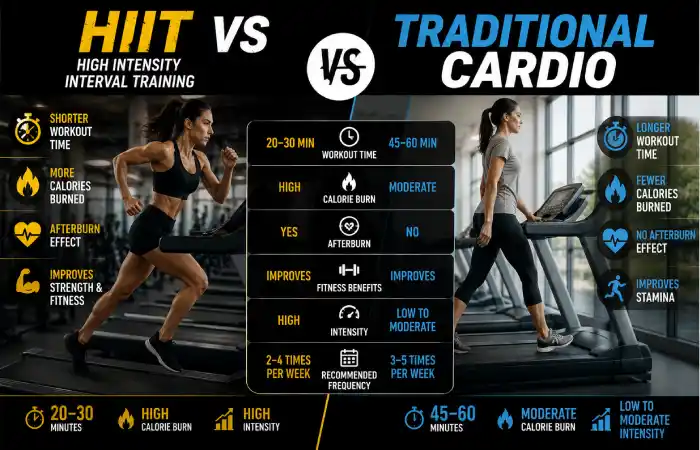
Which one you choose: The one that’s right for you all depends on the kind of workout you’re after
| Feature | HIIT | Traditional Cardio |
| Workout Time | 20–30 min | 45–60 min |
| Calorie Burn | High | Moderate |
| Afterburn Effect | High | Low |
| Fitness Improvement | Faster | Gradual |
| Beginner Friendly | Yes (with progression) | Yes |
| Muscle Preservation | Better | Moderate |
| Recovery Needed | Higher | Lower |
If HIIT feels too challenging at first, start with our beginner cardio workout plan to build endurance before increasing workout intensity.
Which One Is Better?
Choose HIIT if you:
- Have limited workout time
- Want faster fat loss
- Enjoy varied workouts
- Want better athletic conditioning
HIIT is one of the most effective methods, but our guide to cardio for weight loss compares multiple workout options for sustainable results.
Choose traditional cardio if you:
- Are recovering from illness
- Prefer low-intensity exercise
- Train for endurance events
- Need active recovery days
Many trainers recommend combining both methods during the week for balanced cardiovascular fitness.
2026 Comparison: Calories Burned on Popular Gym Machines
This table displays an estimated amount of calories that you may be burning if you are a 70 kg (154 lb) individual doing a high-intensity, high-intensity interval training for 20 minutes. The calorie burned also differs by bodyweight and training intensity.
| Gym Machine | Estimated Calories Burned (20 min HIIT) | Muscle Engagement |
| Air Bike | 260–340 | Full Body |
| Rowing Machine | 220–300 | Full Body |
| Treadmill | 210–290 | Lower Body |
| Stair Climber | 200–280 | Lower Body & Glutes |
| Spin Bike | 180–260 | Lower Body |
| Elliptical | 170–240 | Full Body (Low Impact) |
Common HIIT Mistakes
The treadmill is among the top in order to easy for a first time exerciser. A common mistake among beginner workout enthusiasts are trying to do too much too fast. Follow these tips to stay injury-free and motivated.
| Mistake | Why It Happens | Solution |
| Skipping the warm-up | Trying to save time | Warm up for 5–10 minutes before every session |
| Sprinting every interval at maximum effort | Poor pacing | Aim for 80–90% effort rather than all-out every round |
| Doing HIIT every day | Believing more is better | Limit HIIT to 2–4 sessions per week |
| Ignoring recovery | Lack of planning | Include easy cardio or rest days between sessions |
| Poor running or rowing form | Fatigue during intervals | Reduce speed and prioritize proper technique |
Safety Tips for HIIT
Despite being good for most individuals, HIIT can also have downsides if not properly prepared for.
If it’s the right workout plan for you, just be sure to:
- Do at least 5 minutes of light warm-up.
- Gradually build up to intense training sessions.
- Perform the form for each interval with good exercise technique.
- Drink lots of water before and after exercise.
- Use athletic, supportive shoes.
- If you become dizzy, feel breathless or have chest pains, stop at once.
- Include rest days to avoid the pain, aches and exhaustion of overworked muscle groups.
You can get heart conditions, high blood pressure that cannot be regulated or other disorders and need to get doctor approval before taking on any high-intensity exercise plans.
Recommended Weekly HIIT Schedule for Beginners
A simple weekly plan helps you build consistency without overtraining.
| Day | Workout |
| Monday | HIIT Treadmill (20–25 min) |
| Tuesday | Strength Training |
| Wednesday | Light Walking or Mobility |
| Thursday | HIIT Bike Workout |
| Friday | Full-Body Strength Training |
| Saturday | HIIT Rowing Machine Routine |
| Sunday | Rest or Stretching |
This middle road offers sufficient recovery and better endurance, aerobic capacity, and conditioning.
Workout timing can influence performance and recovery. Learn whether cardio before or after weights is the right approach for your goals.
FAQ’s
Can beginners do HIIT cardio?
Absolutely. Beginners can implement HIIT using shorter bursts of work time, extended recovery periods and reduced exertion until a person’s stamina is more established over a period of time.
How often should you do HIIT a week?
Two to three sessions per week is sufficient for beginners, whilst many people do as many as four sessions a week depending on training goals and recovery time.
What’s the best gym machine for HIIT?
Treadmills are usually the easiest machines for beginner HIIT classes, but air bikes and rowing machines generally give a greater total body burn.
Is HIIT better than running?
HIIT burns more calories and is better for Cardiovascular development in a shorter period of time.
Running is generally better for developing distance endurance, and should be incorporated along side HIIT classes.
What should a HIIT class be?
Generally, a HIIT class will range from 15 to 30 minutes in length, including the cool down and warm up periods.
Conclusion
The HIIT cardio workout at the gym can be your quickest fitness builder, calorie-blaster and endurance-enhancer. Whether it’s the treadmill, the bike or the rowing machine, focus on high-intensity periods followed by enough rest to allow you to recover and complete the next block of effort with good form.
Start off with 2 or 3 sessions per week and work your way up in intensity from there. Combining this with strength training, great nutrition, and rest, you’ll be on your way to a sustainable, lifelong fitness routine and seeing results like never before!
Afiya Jafar is a fitness and wellness writer who focuses on making health, exercise, and healthy lifestyle information simple and practical. Her work covers workouts, fitness motivation, strength training, nutrition, weight management, stress management, mindfulness, and everyday wellness.
Read Full Bio of Afiya Jafar →
Sameena Begum reviews selected health, wellness, fitness, and digital content for clarity, factual presentation, consistency, and reader usefulness. Her review work helps maintain clear and responsible editorial standards across PhysicalFitt content.
Read Full Bio of Sameena Begum →
Dr. Khizrana Begum is a qualified medical professional with MBBS and MD qualifications and 5+ years of experience in the medical field. She works as a General Physician and Dermatologist, with expertise in general medicine, dermatology, preventive healthcare, and skin health.
Read Full Bio of Dr. Khizrana Begum →