
 Afiya Jafar
Fitness & Wellness Writer
Afiya Jafar is a fitness and wellness writer who focuses on making health, exercise, and healthy lifestyle information simple and practical.
Read Full Bio of Author →
Afiya Jafar
Fitness & Wellness Writer
Afiya Jafar is a fitness and wellness writer who focuses on making health, exercise, and healthy lifestyle information simple and practical.
Read Full Bio of Author →
 Sameena Begum
Health, Fitness & Digital Content Reviewer
Sameena reviews selected health, wellness, fitness, and digital content for clarity, factual presentation, and reader usefulness.
Read Full Bio of Reviewer →
Sameena Begum
Health, Fitness & Digital Content Reviewer
Sameena reviews selected health, wellness, fitness, and digital content for clarity, factual presentation, and reader usefulness.
Read Full Bio of Reviewer →
 Dr. Khizrana Begum
General Physician & Dermatologist
Dr. Khizrana Begum is a General Physician and Dermatologist with MBBS and MD qualifications and 5+ years of experience in the medical field.
Read Full Bio of Medical Reviewer →
Dr. Khizrana Begum
General Physician & Dermatologist
Dr. Khizrana Begum is a General Physician and Dermatologist with MBBS and MD qualifications and 5+ years of experience in the medical field.
Read Full Bio of Medical Reviewer →
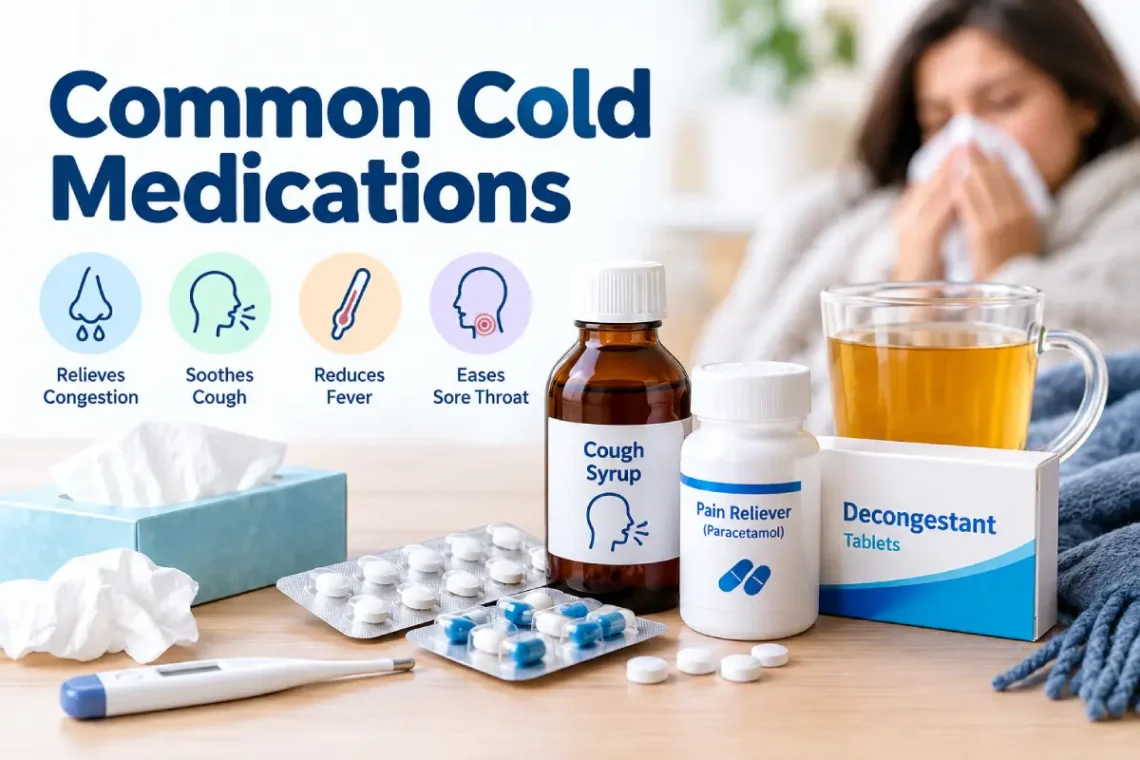
The common cold may leave you simultaneously dealing with nasal congestions, coughs, sore throats, headaches, fever and body aches. Certain cold remedies can ease the pain while your body fights the infection virus with all it has got. Nonetheless, you must not mistake these cold remedies as cure for common cold or elimination of viruses. Colds predominantly subside on their own, whereas the cure is centered around alleviating the pain.
The kind of medication that is apt for your illness should be chosen based on what kind of health problem(s) you’re exhibiting, age group you belong to, other medication you might already be on, and preexisting health complications you may have. A little know-how of ingredients might also enable you to prevent taking the same medicine again under a different product name.
❝
This article is a part of
Medicines Hub
What Are Common Cold Medications?
Prescription and non-prescription cold and flu remedies consist of largely over the counter (OTC) drugs taken to alleviate one’s symptom/symptom and may relieve nasal stuffiness, a nagging cough, thin an excessive nasal discharge, provide relief for headaches and body pains, or lower fever.
Cold medicines are among the many common medications people may use to manage everyday symptoms and health conditions.
No cure for an common cold exists. No evidence shows antibiotics to be effective for the viral induced illness. They will only be helpful if you develop secondary bacterial infection and this has been diagnosed by a professional.
Common medication categories
| Medication type | Main purpose | Common active ingredients |
| Decongestants | Relieve nasal congestion | Pseudoephedrine, oxymetazoline |
| Cough suppressants | Reduce troublesome coughing | Dextromethorphan |
| Expectorants | Loosen mucus | Guaifenesin |
| Pain/fever relievers | Reduce pain and fever | Acetaminophen, ibuprofen |
| Antihistamines | May help runny nose/sneezing | Chlorpheniramine, diphenhydramine |
| Combination products | Treat several symptoms | Multiple ingredients |
MedlinePlus identifies these same broad categories and stresses the importance of checking labels because different products can contain the same active ingredient.
Because some allergy symptoms can resemble a cold, it is useful to understand how allergy medications differ from medicines used for cold symptoms.
Cold Symptom Relief
Before choosing a medicine, identify your main symptom.
| Main symptom | Medication category to consider |
| Stuffy nose | Decongestant or saline spray |
| Runny nose/sneezing | Some antihistamines |
| Dry, disruptive cough | Cough suppressant |
| Thick mucus | Expectorant |
| Headache/body aches | Pain reliever |
| Fever | Fever-reducing medicine |
| Multiple symptoms | Combination product, used cautiously |
While many cold medicines are available over the counter, certain symptoms or underlying conditions may require prescription medications recommended by a healthcare professional.
Non-drug measures can also help. Rest, fluids, saline nasal sprays and a cool-mist humidifier are recommended options for symptom management.
Decongestants

Decongestants are designed to temporarily reduce a blocked or stuffy nose.
Common examples include:
- Pseudoephedrine — an oral decongestant.
- Oxymetazoline — a nasal decongestant spray.
- Phenylephrine — found in some oral and nasal products.
There is an important change coming in 2026 with regard to oral phenylephrine. The FDA has proposed taking oral phenylephrine out as an OTC nasal decongestant ingredient stating that the evidence is lacking on its efficacy. This does not pertain to nasal sprays containing phenylephrine. Products containing oral phenylephrine will still be available on shelves pending the completion of FDA process.
People with certain conditions, such as high blood pressure, should check with their health care provider before taking a nasal spray to treat this. The spray should not be used for long periods otherwise rebound congestion may occur.
Cough Medicines
It’s often not necessary to medicate coughs as the natural function of the airway to remove any build-up of mucus or particulate matter in the throat. Cough medicines can be categorised into broadly two groups:
Dextromethorphan, which reduces the need to cough and can relieve symptoms when they prevent you from sleeping or performing daily tasks. Dextromethorphan does interact with other medications and in order not to develop medication side effects individuals that are taking or have very recently ceased using some of the MAOI drugs need to talk to a Doctor before taking.
Before taking a cold medicine, understanding its medication uses and side effects can help you use it appropriately.
Guiafenesin, which is an expectorant helping to break up and thin the mucus making it easier to bring up by coughing. Ensure ample fluids are drunk if taking guaiafenicin.
Pain and Fever Relievers
Both acetaminophen and ibuprofen are useful in treating fever, headache, throat pain, body aches, and overall sickness tied to the common cold.
With these medicines, extra are not best.
Always look at the label of your combination medicine to be sure you know how much of your addition pain reliever you have taken. Often times, the addition pain reliever in combination medication may include an active ingredient that is not useful when combined with any other medication containing it. (For instance, avoid a combined remedy and another plain aspirin or liquid equivalent).
Please Note: Children and teen aged are given aspirin with no circumstances unless at the direction of a physician as it is tied to the potential for Reyes Syndrome.
Combination Cold Medications
Combination products contain two or more active ingredients in one medicine. For example, a product may combine a pain reliever, cough suppressant, expectorant and decongestant.
They can be convenient, but convenience comes with a safety concern: you may take an ingredient you don’t actually need—or duplicate an ingredient in another medicine.
For example:
Combination cold medicine + separate acetaminophen = potential duplicate dosing.
The safer approach is to check the Drug Facts/active ingredient label before combining products.
Following medication safety guidelines is especially important when combining cold medicines or giving them to children.
2026 evidence snapshot
| Finding | What it means for consumers |
| Colds have no routine cure | Medicines mainly provide temporary symptom relief |
| Antibiotics don’t treat viral colds | Don’t use leftover antibiotics for a cold |
| Oral phenylephrine effectiveness is under FDA review | Consider alternatives with a pharmacist |
| Combination products contain multiple ingredients | Read labels before adding another medicine |
| Children’s cold medicines require special caution | Age and dosing instructions matter |
The CDC’s March 2026 guidance continues to emphasize supportive care and symptom relief rather than antibiotics for ordinary colds.
Common Side Effects
Side effects depend on the specific ingredient.
Possible effects include:
Decongestants – increased blood pressure, nervousness or difficulty sleeping
Older antihistamines – drowsy and dizzy
Dextromethorphan – may cause some people to be drowsy or dizzy
Acetaminophen – causes liver damage when used in very high doses
Ibuprofen/NSAIDs – gastric irritation, the other risks associated with NSAIDs
Nasal decongestant sprays – will create rebound congestion with regular, frequent use
You can’t assume an OTC product is totally safe simply because it is available without a prescription
Safe Use of Cold Medicines
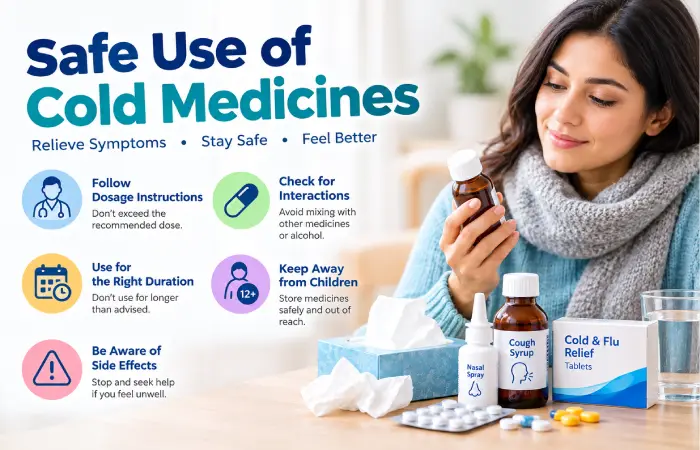
Keep to these general principles:
- Remember to look at the active ingredient ( not just the brand name).
- Always follow the instructions for the medicine from the package or patient information leaflet.
- Do not take two or more medicines which contain the same active ingredient ( check patient information leaf).
- Ask your pharmacist if your new medicine is likely to interact with the prescribed medicine(s).
- It is rarely correct to use a medicine intended for adult for children.
- Remember to dose children appropriately for their age.
- Antibiotics are unnecessary for uncomplicated colds.
- Discontinue a medicine and obtain advice if you experience disturbing or worrying side effect.
Children require particular caution. The FDA advises against OTC cough and cold products containing decongestants or antihistamines for children younger than 2, and manufacturers label many products “do not use” under age 4.
If you already take other medicines, check for potential medication interactions before using a new cold medicine.
Medication Interactions
Cold medicines can interact with prescription medicines, other OTC products and supplements.
Potential concerns include:
- Decongestants + certain blood-pressure conditions or medicines
- Dextromethorphan + certain antidepressants/MAO inhibitors
- Multiple acetaminophen-containing products
- Multiple sedating medicines + nighttime cold medicines
- NSAIDs + medicines or conditions that increase bleeding/kidney risks
When to Contact a Healthcare Professional
A normal cold will get better over time. The CDC suggests seeing a doctor if you have trouble breathing or signs of dehydration; you have a fever of 100.4 °F or higher that lasts more than four days, symptoms that don’t start getting better within 10 days, or if your symptoms were getting better, then became worse or came back more severe.
You should also get prompt medical advice if symptoms feel abnormally severe, if you have severe chest pain, or if you fear your illness is actually flu or COVID-19. The distinction is important as both elderly patients and certain younger, higher-risk patients are eligible for antiviral therapy-which is most effective when treatment is begun early.
Final Takeaway
With drugs used for common colds there really is only symptom management-that is what they do. Most patients should determine the symptoms they wish to treat, choose the simplest appropriate drug they need, look at the active ingredients (and ideally avoid combinations) .
This is an issue for us; the FDA, during 2026 will also be having ongoing consideration given regarding oral phenylephrine which evidence suggests doesn’t appear to work as a nasal decongestant when taken orally.
Afiya Jafar is a fitness and wellness writer who focuses on making health, exercise, and healthy lifestyle information simple and practical. Her work covers workouts, fitness motivation, strength training, nutrition, weight management, stress management, mindfulness, and everyday wellness.
Read Full Bio of Afiya Jafar →
Sameena Begum reviews selected health, wellness, fitness, and digital content for clarity, factual presentation, consistency, and reader usefulness. Her review work helps maintain clear and responsible editorial standards across PhysicalFitt content.
Read Full Bio of Sameena Begum →
Dr. Khizrana Begum is a qualified medical professional with MBBS and MD qualifications and 5+ years of experience in the medical field. She works as a General Physician and Dermatologist, with expertise in general medicine, dermatology, preventive healthcare, and skin health.
Read Full Bio of Dr. Khizrana Begum →