
 Afiya Jafar
Fitness & Wellness Writer
Afiya Jafar is a fitness and wellness writer who focuses on making health, exercise, and healthy lifestyle information simple and practical.
Read Full Bio of Author →
Afiya Jafar
Fitness & Wellness Writer
Afiya Jafar is a fitness and wellness writer who focuses on making health, exercise, and healthy lifestyle information simple and practical.
Read Full Bio of Author →
 Sameena Begum
Health, Fitness & Digital Content Reviewer
Sameena reviews selected health, wellness, fitness, and digital content for clarity, factual presentation, and reader usefulness.
Read Full Bio of Reviewer →
Sameena Begum
Health, Fitness & Digital Content Reviewer
Sameena reviews selected health, wellness, fitness, and digital content for clarity, factual presentation, and reader usefulness.
Read Full Bio of Reviewer →
 Dr. Khizrana Begum
General Physician & Dermatologist
Dr. Khizrana Begum is a General Physician and Dermatologist with MBBS and MD qualifications and 5+ years of experience in the medical field.
Read Full Bio of Medical Reviewer →
Dr. Khizrana Begum
General Physician & Dermatologist
Dr. Khizrana Begum is a General Physician and Dermatologist with MBBS and MD qualifications and 5+ years of experience in the medical field.
Read Full Bio of Medical Reviewer →
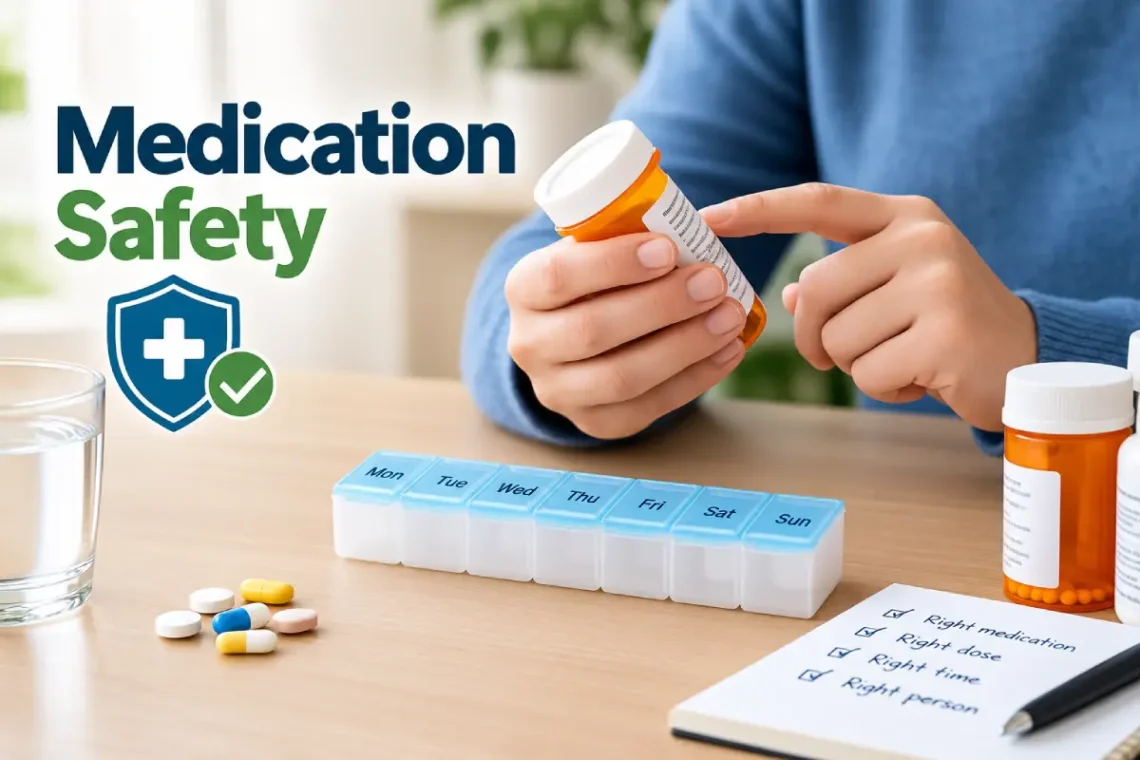
Medication safety means the practice of medicine with measures designed to optimize benefits and prevent harm related to drugs-including prescription and non-prescription medicines, vitamins, food supplements, and drugs-and even those dispensed to and monitored in children and the elderly.
While most drugs are safely ingested by humans, some errors do occur along a medications many stages, from prescription and dispensing to storage, taking and monitoring. Adverse drug events, in particular-medication errors, side effects, and allergic reactions and over-medication,-are considered by the CDC to be a critical, preventable patient safety concern.
WHO reports that almost 50 percent of preventable harm in health care is caused by medication-related harm, which helps put the practice of safe medication practices into perspective even outside clinical settings.
Understanding how to use common medications correctly is an important part of maintaining medication safety.
❝
This article is a part of
Medicines Hub
What Is Medication Safety?
Medication safety is those measures taken to avoid unintended medication errors and related harm.
A medication error can include any mistake in taking the wrong medicine, dose, route, timing or length of therapy or simply the wrong way. They can be down to confusing labels, look and sound-alike medicines, bad storage and lack of adequate medication information/communication.
Medication safety is everybody’s job- patients, family, doctors, pharmacists, all health care workers.
Safe Medication Use
Before taking a medicine, know what it is, why you are taking it, how much to take, when to take it and how long to take it.
Follow these basic rules:
- Take prescription medicines exactly as directed.
- Read the OTC label before every new medicine.
- Don’t take someone else’s prescription medicine.
- Don’t change your dose or stop a prescribed medicine without professional advice.
- Tell your doctor or pharmacist about other medicines, vitamins and supplements you use.
- Ask about possible food, alcohol or drug interactions.
- Keep an updated list of your medicines.
WHO recommends actively involving patients in medication safety and encourages people to “Know. Check. Ask.” when using medicines.
Understanding Medication Labels
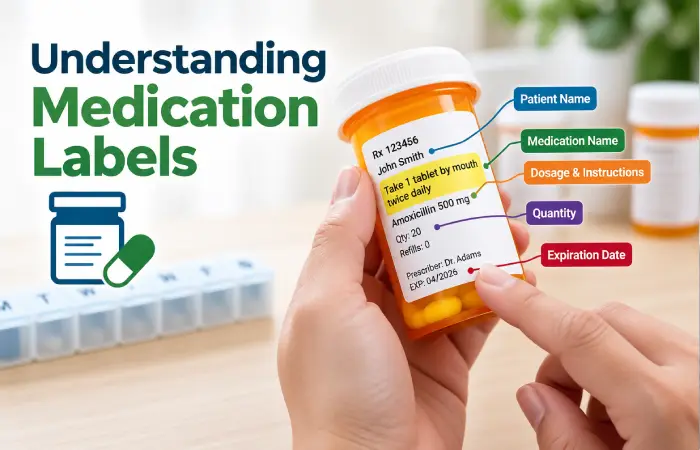
When using allergy medications, follow the recommended dosage and check the label for possible warnings or precautions.
Medication labels contain information that helps you use a medicine correctly.
Look for:
- Medicine name
- Strength
- Dose
- Directions
- Frequency
- Route of administration
- Warnings
- Possible interactions
- Storage instructions
- Expiration date
Don’t think all medicines with different brand names has different drugs in it. Looking at the active ingredients will help you avoid double dipping and taking both.
For liquid medicines, use the medicine cup or other medicine measuring device provided with the medicine instead of a kitchen spoon. The CDC especially advocates use of milliliters(mL) for liquid dosage of medicines so dosing errors can be minimized.
Correct Dosage and Timing
Taking too little may reduce the medicine’s effectiveness, while taking too much can increase the risk of adverse effects or overdose.
Create a simple medication routine:
Read → Measure → Take → Record
For medicines taken regularly, a medication chart, reminder or pill organizer may help—but keep the original labeled containers available so you can verify the medicine, strength and instructions.
People using cold medications should avoid taking multiple products with the same active ingredients unless advised by a healthcare professional.
Skipped a dose, don’t automatically double up on your next. Look at the medication insert or ask a pharmacist or other health care provider; what you do depends on the medication.
Preventing Medication Errors
This types of medication errors may also be very common. For example:
Wrong medication
Wrong dosage
Wrong frequency (too soon or too late)
Using duplicate of an active ingredient medicine
Taking other person’s medication
Reading liquid measure incorrectly
Similar looking/sounding medicines mixing them up
Not telling a healthcare professional about another medicine
WHO’s LASA (look-alike, sound-alike) drugs are the recognized medication errors source.
Helpful in-home checklist for checking medications is:
Right medicine + right person + right dosage + right frequency + right administration method
For children this is particularly sensitive because the dose might need to be based on age and/or weight. 2025 patient-safety guidance issued by WHO points child dosing and available medication devices specifically.
Medication Storage
Store medicines as you have been instructed.
Always take prescription medications exactly as directed and avoid sharing them with other people.
In general:
- Store medicines in their original containers.
- Store at the prescribed temperatures, even if the label doesn’t specifically mention them.
- Store all medicines away from dampness and high heat.
- Store and keep all medicines in a place where it is unlikely that children will get to them.
- Do not leave medicines in extremely hot or cold places, like in your car or on the windowsill if it is already hot outside.
- Store chilled medicines at the required temperature when not being used.
According to The U.S Food and Drug Administration (FDA), even if a medicine is not past its expiry date, it can become inactive if it is not stored at the correct temperature.
Knowing the medication uses and side effects can help you recognize when a medicine may not be appropriate for you.
A safer home medication setup
| Storage practice | Better choice |
| Kitchen counter | Closed, appropriate storage area |
| Bathroom cabinet | Cool, dry location unless the label says otherwise |
| Child-accessible shelf | High, secure location |
| Loose tablets | Original labeled container |
| Refrigerated medicine | Refrigerator if specifically instructed |
| Unidentified pills | Don’t use until identified |
Medication Expiration Dates
Make it a habit to always look at the expiry date before taking a medicine.
Some expired medicines may be less effective or may not conform to quality standards that are expected of them. Poor storage of medicines might also lead to loss of quality.
Do not store vast amounts of “just-in-case” medicines. Go through your medicine chest from time to time and segregate medicines that should not be taken or stored.
According to FDA, one should always check their medication for expiration and be mindful of ways to properly dispose of them.
Safe Medication Disposal
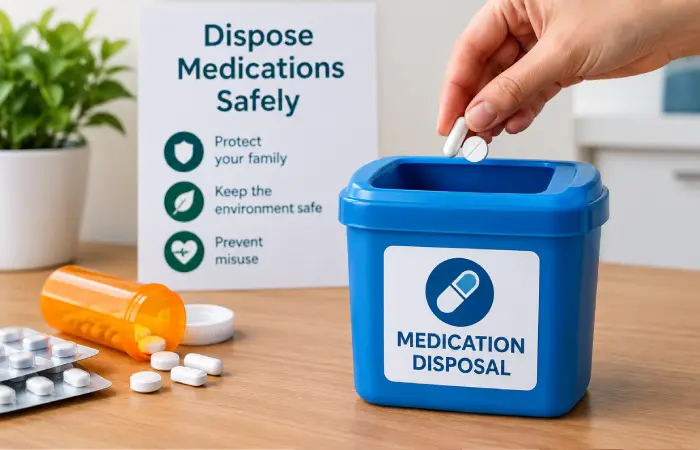
Do not flush or trash medicines. There are different guidelines for different drugs and situations.
If a drug has gone expired or is unused:
- Look for directions about what to do with the drug on the package.
- Consult a pharmacist for the best course of action.
- Use authorized medicine take-back programs if one is present near you.
- Follow special directions if disposal guidelines exist specifically for the drug.
For readers in India, the procedures will vary by area so a local pharmacist or medical facility will provide helpful information.
Medication Safety for Children and Older Adults
Children
Especially vulnerable to medication errors are young children who are weighed to calculate their dose. A danger arises as well if children ingest medicine by accident. To prevent this, always put medicines out of children’s sight and reach immediately after use, and never refer to them as “candy” to entice a child to drink them.
The Centers for Disease Control and Prevention has launched its protect initiative to promote locked medicine cabinets, child-resistant packaging and improved dosing device accuracy.
Checking for medication interactions is particularly important when taking several medicines, supplements, or herbal products.
Older adults
Older adults, taking multiple Rx meds, OTC products and/or dietary supplements can be susceptible to drug interactions or even inadvertent doubling of doses or to making medication errors. Such as the other groups mentioned, age itself- with age related changes in liver and kidney function that may influence the metabolism or removal of drugs-may lead to some medicines impacting older patients more or less depending on the medication.
Older adults are urged by the FDA to speak with their provider about their medications and not alter doses or cease to take Rx medications without the aid of their medical professional.
When to Ask a Healthcare Professional
Ask a doctor or pharmacist if:
- You’re unsure how much medicine to take.
- You don’t understand the label.
- You accidentally took too much.
- You missed a dose and don’t know what to do.
- You’re taking several medicines.
- You’re pregnant or breastfeeding.
- You experience a new or severe side effect.
- You develop symptoms of a possible allergic reaction.
- You aren’t sure whether two medicines can be taken together.
- You don’t know how to store or dispose of a medicine.
Seek urgent medical help for a suspected overdose, severe allergic reaction, difficulty breathing, loss of consciousness, seizure, severe confusion, or other potentially life-threatening symptoms.
Final Takeaway
Medication safety is far more than simply remembering to take a pill. It includes not just the taking of the medicine but the processes of selecting, prescribing, labeling, measuring the appropriate dose, time of administration and even storage and disposal of the medication.
In essence, the approach can be summarized as; Know. Check. Ask.
Maintain the most current list of medications.
Don’t be afraid to ask a pharmacist or doctor questions, and proceed cautiously when administering to a child or caring for an elderly person with numerous medications.
Afiya Jafar is a fitness and wellness writer who focuses on making health, exercise, and healthy lifestyle information simple and practical. Her work covers workouts, fitness motivation, strength training, nutrition, weight management, stress management, mindfulness, and everyday wellness.
Read Full Bio of Afiya Jafar →
Sameena Begum reviews selected health, wellness, fitness, and digital content for clarity, factual presentation, consistency, and reader usefulness. Her review work helps maintain clear and responsible editorial standards across PhysicalFitt content.
Read Full Bio of Sameena Begum →
Dr. Khizrana Begum is a qualified medical professional with MBBS and MD qualifications and 5+ years of experience in the medical field. She works as a General Physician and Dermatologist, with expertise in general medicine, dermatology, preventive healthcare, and skin health.
Read Full Bio of Dr. Khizrana Begum →