
 Afiya Jafar
Fitness & Wellness Writer
Afiya Jafar is a fitness and wellness writer who focuses on making health, exercise, and healthy lifestyle information simple and practical.
Read Full Bio of Author →
Afiya Jafar
Fitness & Wellness Writer
Afiya Jafar is a fitness and wellness writer who focuses on making health, exercise, and healthy lifestyle information simple and practical.
Read Full Bio of Author →
 Sameena Begum
Health, Fitness & Digital Content Reviewer
Sameena reviews selected health, wellness, fitness, and digital content for clarity, factual presentation, and reader usefulness.
Read Full Bio of Reviewer →
Sameena Begum
Health, Fitness & Digital Content Reviewer
Sameena reviews selected health, wellness, fitness, and digital content for clarity, factual presentation, and reader usefulness.
Read Full Bio of Reviewer →
 Dr. Khizrana Begum
General Physician & Dermatologist
Dr. Khizrana Begum is a General Physician and Dermatologist with MBBS and MD qualifications and 5+ years of experience in the medical field.
Read Full Bio of Medical Reviewer →
Dr. Khizrana Begum
General Physician & Dermatologist
Dr. Khizrana Begum is a General Physician and Dermatologist with MBBS and MD qualifications and 5+ years of experience in the medical field.
Read Full Bio of Medical Reviewer →
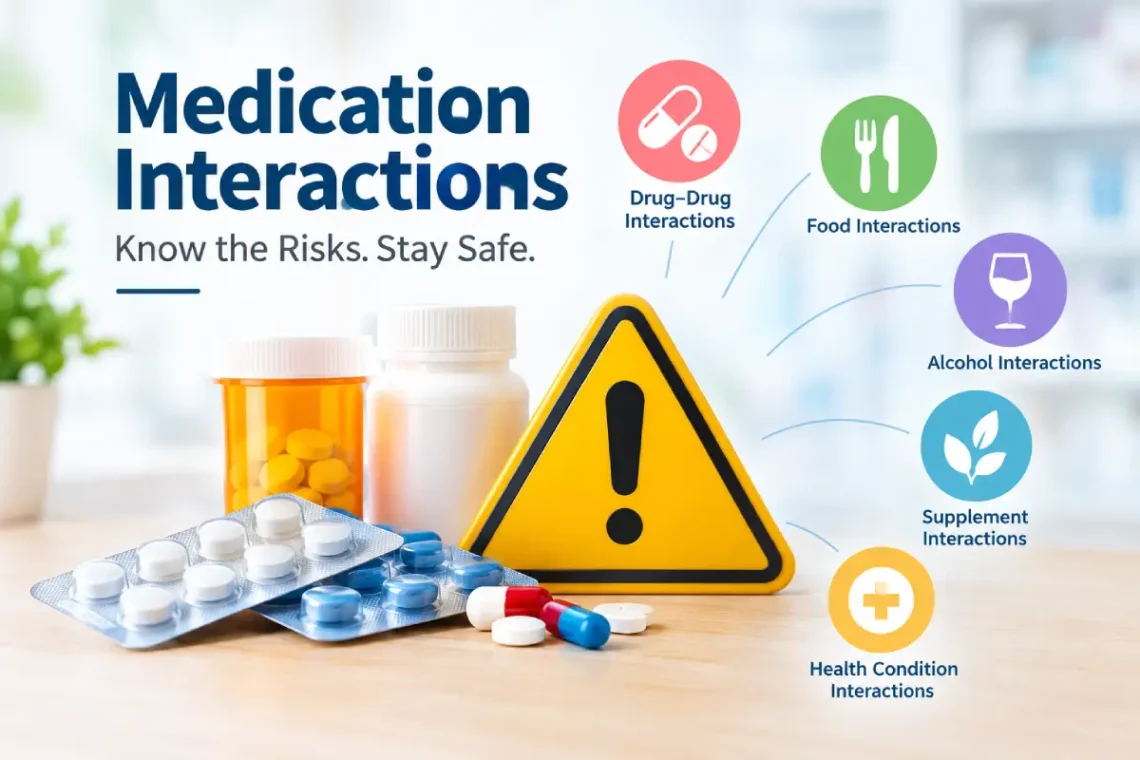
Medication interactions-when another drug, food, beverage, supplement or health condition affects how a medication works. This may decrease effectiveness, augment effects, and/or potentiate the risk of a medication’s side effects. This applieswhether you take prescription drugs, OTC drugs, or even just vitamins and/or herbal medications.
Food-and drink-interactions and existing medical conditions can all effect drug interactions.
Luckily, the FDA points out that medication interactions can be prevented with appropriate use and recording of medications.
❝
This article is a part of
Medicines Hub
What Are Medication Interactions?
A drug interaction is the result of another drug or disease state changing the way a medication works.
Understanding potential interactions is an important part of using common medications safely and appropriately.
For instance, a drug interaction might mean two drugs combine to produce a similar side effect, increasing its strength. A further drug may affect the rate that the drug is absorbed or eliminated by the body, alternatively an interactoin might include effects of food, alcohol or supplement substances on how a particular medicine acts.
Interactions can potentially:
- Increase medication side effects
- Make a medicine less effective
- Increase the amount of a drug in the body
- Reduce the amount of a drug in the body
- Increase the risk of toxicity or other serious complications
Not all interactions are risky. No interaction necessarily requires a drug to be stopped. It really depends on the particular drug combination, dose and timing, as well as the individual’s health.
Types of Drug Interactions
Some allergy medications can interact with other prescription or over-the-counter medicines, so check with a healthcare professional before combining treatments.
Medication interactions generally fall into several categories.
| Interaction type | What happens | Common example |
| Medication-to-medication | One medicine changes another medicine’s effects | Blood thinner + certain pain relievers |
| Medication-food/beverage | Food or drinks affect absorption or drug activity | Grapefruit + certain medicines |
| Medication-alcohol | Alcohol changes or increases medication effects | Alcohol + sedating medicines |
| Medication-supplement | Vitamins or herbal products affect medicines | St. John’s wort + certain medicines |
| Medication-condition | A health condition makes a medicine riskier | Decongestant + high blood pressure |
The FDA broadly identifies drug-drug, drug-food/beverage and drug-condition interactions, while clinical resources also commonly distinguish drug-supplement interactions.
Medication-to-Medication Interactions
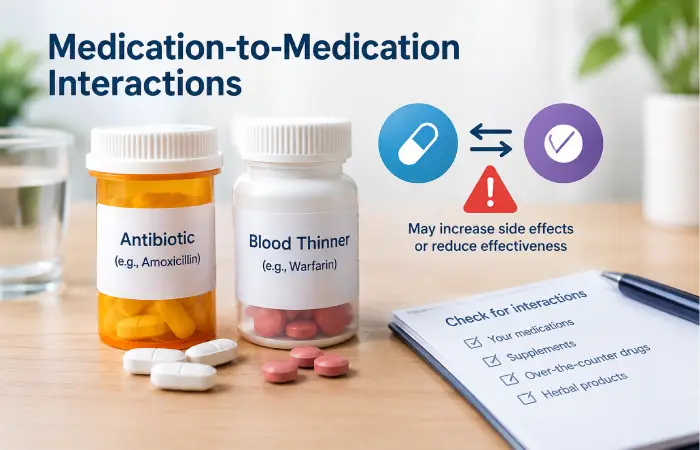
Taking multiple cold medications at the same time may increase the risk of receiving duplicate active ingredients or unwanted drug interactions.
Drug-drug interactions occur when two or more medicines affect one another.
They can happen between:
- Two prescription medicines
- A prescription medicine and an OTC medicine
- Two OTC medicines
- A medicine and a vitamin or supplement
One important example is combining a blood thinner with certain NSAID pain relievers. This can increase bleeding risk.
The use of several sedating drugs is another potential concern, can cause heightened feelings of drowsiness and lethargy.
Pay attention to what active ingredient(s) are contained in OTC products. You could take two different brand names of medication with the same active ingredient and effectively double-dose yourself.
Medication and Food Interactions
A number of foods can interact with the absorption, metabolism, or actions of the drug. Grapefruit & grapefruit juice has a quite well know interaction where they inhibit certain enzymes which are responsible for metabolizing a number of drugs causing levels to be different. Grapefruit doesn’t interact with all drugs though.
Vit k-rich foods in patients on warfarin.
Certain mineral supplements may inhibit drug absorption.
There is no need for undue food restrictions; it is safer to consult the pharmacist to see if you need them!
Medication and Alcohol Interactions
Alcohol can interact with both prescription and OTC medicines.
People taking prescription medications should tell their healthcare provider about all other medicines, supplements, and herbal products they use.
Depending on the medication, combining alcohol with a drug may cause:
- Increased drowsiness
- Dizziness
- Poor coordination
- Fainting
- Breathing problems
- Changes in blood pressure
- Increased risk of bleeding
Interactions can occur even when alcohol and the medicine you are taking have not been taken together directly at the same time.
Medicines more likely to have precautions concerning alcohol: Antihistamines (including sedating non-prescription types, certain prescription ones), sleeping aids, anti-anxiety medicines, pain killing medication and other drugs that affect the brain.
If unsure if your medicine interacts with alcohol and intend to drink then you must ask your pharmacist or health care professional for advice.
Prescription and OTC Interactions
It’s not only prescription drugs that are involved in interactions. Other products on the shelf, such as OTC pain relievers, cough and cold remedies, antihistamines, antacids and sleep preparations, may be using ingredients that interact with prescription drugs. Using various products with similar active ingredients unintentionally increases your total dose.
The FDA advises that you always read labels of your OTC products and talk to your doctor or other health care provider if you have any doubt or concern.
It becomes even more crucial when seeing numerous health care providers because one may not necessarily be aware of the all the medications and supplements you are taking.
How Medication Interactions Occur
Knowing the medication uses and side effects can make it easier to recognize whether a new symptom may be related to a medicine.
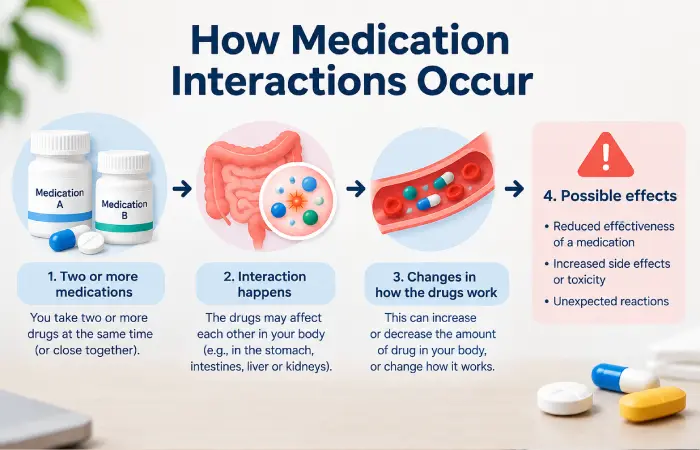
Medication interactions can happen through several mechanisms.
Absorption
One substance can prevent another medicine from being absorbed properly. Certain minerals and supplements can interfere with absorption of some medications.
Metabolism
The body uses enzymes and other processes to break down many medicines. Another drug or food can speed up or slow down these processes, changing medication levels in the body.
Duplicate effects
Two medicines may have similar effects. Taking them together can amplify side effects such as drowsiness, bleeding or low blood pressure.
Reduced effectiveness
An interaction can sometimes make a medicine work less effectively, potentially reducing the benefit of treatment.
Common Warning Signs
There is no single symptom that proves an interaction is occurring. Symptoms depend on the medicines involved.
Following basic medication safety practices can help reduce the risks associated with incorrect dosing and potentially harmful combinations.
Potential warning signs include:
- Unusual or worsening side effects
- Severe dizziness or confusion
- Excessive sleepiness
- Unexpected bleeding or bruising
- Changes in heart rate
- Breathing difficulty
- Fainting
- A medication suddenly seeming less effective
Some interactions cause no obvious symptoms, which is why medication reviews are important.
Seek urgent medical attention for severe breathing difficulty, loss of consciousness, severe allergic symptoms, serious bleeding or other potentially life-threatening symptoms.
How to Prevent Drug Interactions
Use this simple medication-safety checklist:
- Keep an updated medication list.
Include prescription medicines, OTC products, vitamins and herbal supplements. - Check active ingredients.
This is particularly important when using multiple OTC products. - Tell every healthcare professional what you take.
Do not assume your doctor or pharmacist already has your complete list. - Ask before starting a new supplement.
“Natural” does not automatically mean interaction-free. - Check food and alcohol warnings.
Read the medication label and ask whether there are dietary restrictions. - Use an interaction checker when appropriate.
Online tools can help identify potential interactions, but they should not replace professional medical advice. - Do not stop a prescription medicine on your own.
If you discover a possible interaction, contact your doctor or pharmacist before changing your treatment.
Questions to Ask a Healthcare Professional
What questions could you think to ask before beginning taking a new medicine?
-Can I take this medicine with the ones I’m currently on?
-Do it have any side effects with vitamins or supplements?
-Is there anything I can’t eat or drink?
-Can I have alcohol with this medicine?
-How will my present state of health affect this new medicine?
-What side effects are you concerned about, while I’m using this medicine?
-What will I have to do if I take the medicines which interact with each other by mistake?
-Must I take them at different intervals?
You may consider a pharmacist for help if reviewing your entire list of medication for possible interactions.
The Bottom Line
The risk of medication interactions is not confined to only two prescription medicines. How a medicine is prescribed depends on not just what it is, and the doses being taken of other prescribed medicines, but also the consumer products, such as OTC and herbal medicines and food items being consumed, the amount of alcohol that is taken and, whether there are other illnesses present.
The simplest and most efficient form of preventive therapy consist in compiling a complete medication record, label reading, examination of medication interactions before each introduction of a new consumer product and the query to a chemist or other healthcare practitioner, whenever there is any doubt. In serious and/or unexpected manifestations get the appropriate medical help, do not self-medicate on the assumption that it is due to an interaction between a prescription and a non-prescription formulation.
Afiya Jafar is a fitness and wellness writer who focuses on making health, exercise, and healthy lifestyle information simple and practical. Her work covers workouts, fitness motivation, strength training, nutrition, weight management, stress management, mindfulness, and everyday wellness.
Read Full Bio of Afiya Jafar →
Sameena Begum reviews selected health, wellness, fitness, and digital content for clarity, factual presentation, consistency, and reader usefulness. Her review work helps maintain clear and responsible editorial standards across PhysicalFitt content.
Read Full Bio of Sameena Begum →
Dr. Khizrana Begum is a qualified medical professional with MBBS and MD qualifications and 5+ years of experience in the medical field. She works as a General Physician and Dermatologist, with expertise in general medicine, dermatology, preventive healthcare, and skin health.
Read Full Bio of Dr. Khizrana Begum →