

Last Updated: September 16, 2026
When searching for ways to improve sleep quality, think about more than just sleep duration. Sleep quality is good, where you are not waking frequently in the middle of the night and you wake up feeling rested and reasonably restored.
There are several factors that can help to improve sleep including: a stable sleep schedule, comfortable sleeping surroundings, daily exercise, limiting alcohol/caffeine, and exposure to screens prior to sleep as well as good stress management. Normal healthy sleep does not include waking up feeling exhausted, inability to fall asleep, waking up several times during the night, or an extreme daily desire to sleep.1 There are certain sleep problems that are associated with many conditions including: Insomnia, sleep apnea, sleep disorders, depression, medications, shift work, and others.
Here is the step by step guide to improving your sleep naturally this article outlines the steps to take during the day, preparing for sleep, in the bedroom, and when to see your doctor.
What Is Sleep Quality?
Restorative sleep is about the quality of your sleep and how good or refreshing it is. It doesn‘t refer to how much time you are actually in bed.
For instance, two people can be in bed for eight hours but one sleeps undisturbed and awakes refreshed whereas the other takes a long time to fall asleep, wakes many times during the night and awakes feeling exhausted.
According to the CDC, quality sleep is that which is uninterrupted and refreshing; it is clear that quality sleep is not merely a function of hours slept.
Signs of good sleep quality
Good sleep commonly involves:
- Falling asleep within a reasonable amount of time
- Staying asleep for most of the night
- Limited or brief nighttime awakenings
- Waking at a consistent time
- Feeling reasonably refreshed after waking
- Having adequate daytime energy
- Being able to concentrate and function normally
Signs your sleep quality may be poor
You may need to examine your sleep habits if you regularly:
- Lie awake for long periods
- Wake several times during the night
- Wake much earlier than intended
- Feel tired despite spending enough time in bed
- Need excessive caffeine to function
- Feel sleepy during the day
- Have difficulty concentrating
- Snore loudly or wake gasping
- Experience morning headaches
- Depend on irregular sleep-ins to compensate for poor weekday sleep
Sleep quality and sleep quantity are connected, but they are not identical. Most adults need at least seven hours of sleep regularly, while individual needs vary.
Sleep quality vs. sleep quantity
| Factor | Why it matters | What it means |
| Sleep quantity | Insufficient sleep can impair health and daytime functioning | How much time you sleep |
| Sleep continuity | Frequent awakenings can make sleep less restorative | How uninterrupted your sleep is |
| Sleep timing | Regular timing supports your body’s sleep-wake rhythm | When you sleep |
| Sleep efficiency | Excessive time awake in bed can indicate a sleep problem | How much of your time in bed is spent asleep |
| Morning restoration | Persistent exhaustion may signal inadequate or disrupted sleep | How you feel after sleeping |
The goal isn’t to chase a perfect sleep score. Instead, focus on consistent habits that make naturally restorative sleep more likely.
How to Improve Sleep Quality Naturally
Typically the best initial intervention is not an herbal or costly sleep aid; it is a recipe of timing, duration, environment, daytime activities, and ritual.
The Center for Disease Control (CDC) suggests some good basic habits: same time to go to bed and wake up, have bedroom that is cool and quiet, turn off computers, electronics and TV before sleep, avoid large heavy meals and alcohol consumption before sleep, not to drink coffee late in the day, and exercise.
The highest-value habits to start with
| Habit | Priority | Practical action |
| Consistent schedule | Very high | Keep bedtime and wake time stable |
| Enough sleep opportunity | Very high | Allow adequate time for sleep |
| Bedroom environment | High | Keep the room comfortable, quiet and dark |
| Morning/daylight exposure | High | Get natural light during the day |
| Exercise | High | Be physically active regularly |
| Caffeine timing | High | Reduce late-day caffeine |
| Evening routine | High | Create a predictable wind-down period |
| Screen reduction | Moderate–high | Reduce stimulating screen use before bed |
| Stress management | Moderate–high | Use relaxation techniques |
| Meal timing | Moderate | Avoid heavy meals close to bedtime |
You do not need to change everything on the same night.
A better strategy is to choose two or three changes, follow them consistently, and observe what happens.
Create a Consistent Sleep Schedule
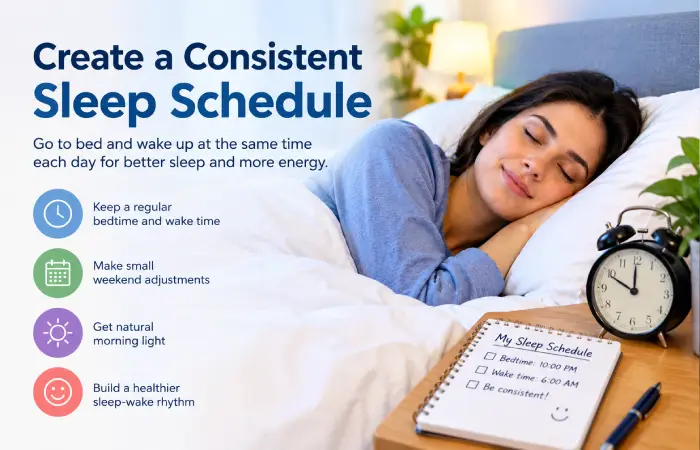
Another simple strategy for getting better sleep is to have a regular rhythm to your sleep and wake routine.
Your circadian rhythm, one of the body‘s internal clocks, can be responsible for perfecting your sleep/wake cycle. When you don‘t have a regular schedule, your body can‘t get used to knowing when to be sleepy.
The NHLBI recommends that you go to sleep and wake up at the same time every day and that your weekend differences are relatively small.
How to build a consistent sleep schedule
Start with your wake time.
For example:
- Wake at 7:00 a.m. most days.
- Work backward to determine a suitable bedtime.
- Keep the schedule reasonably consistent on weekends.
- Avoid repeatedly shifting your schedule by several hours.
- Give yourself enough time in bed rather than trying to function on too little sleep.
If your current schedule is very irregular, do not expect perfection immediately.
Move toward a more consistent schedule gradually.
Why wake time matters
A fixed wake time gives your day a stable starting point and can help anchor your sleep-wake rhythm.
Morning light also plays an important role in circadian timing. Daylight exposure helps signal that it is time to be alert, while darkness later in the day helps prepare the body for sleep.
What about weekends?
Sleeping substantially later on weekends may feel helpful after a tiring week, but large schedule changes can make Sunday night sleep more difficult.
A practical goal is to keep your weekend schedule reasonably close to your weekday schedule.
Improve Your Sleep Environment
Your bedroom should make sleeping easier rather than keeping your brain alert.
The CDC recommends keeping the bedroom quiet, relaxing and cool.
Optimize these five factors
- Temperature
A bedroom that feels excessively warm can make it harder to settle comfortably.
Aim for a temperature that feels comfortably cool to you rather than obsessing over one exact number.
- Light
Keep the sleeping environment as dark as practical.
Consider:
- Blackout curtains
- An eye mask
- Covering bright indicator lights
- Turning off unnecessary lamps
- Keeping phones away from the bed
- Noise
If outside noise interrupts your sleep, consider:
- Earplugs
- White noise
- A fan
- Soundproofing improvements
- Closing windows when appropriate
- Mattress and pillow
Your mattress and pillow should provide comfortable support without causing pain or pressure.
You do not automatically need the most expensive mattress.
The right choice depends on factors such as:
- Sleeping position
- Body size
- Personal comfort
- Temperature preference
- Whether you sleep alone or with a partner
- Bedroom distractions
Ideally, the bedroom should be strongly associated with sleep and relaxation.
If possible, move workstations, gaming equipment and unnecessary screens away from the bed.
Bedroom setup comparison
| Problem | Possible solution | Best for |
| Morning sunlight wakes you early | Blackout curtains/eye mask | Light-sensitive sleepers |
| Traffic or neighborhood noise | Earplugs/white noise | Noise-sensitive sleepers |
| Room feels hot | Fan/cooling adjustment | Hot sleepers |
| Phone keeps you awake | Charge it outside reach | Habitual nighttime scrolling |
| Uncomfortable pillow | Replace with appropriate support | Neck discomfort |
| Partner has different temperature preference | Individual bedding layers | Couples |
The objective is simple: make the environment boring, comfortable and predictable.
Build a Healthy Bedtime Routine
Your brain should not have to switch instantly from work, social media, gaming or stressful conversations into sleep mode.
A consistent wind-down routine creates a transition between daytime activity and sleep.
A useful routine might begin 30–60 minutes before bedtime.
Example bedtime routine
60 minutes before bed
- Finish demanding work
- Reduce stimulating activities
- Dim bright lights
45 minutes before bed
- Take a shower or bath
- Prepare clothes for tomorrow
- Tidy the bedroom
30 minutes before bed
- Read a physical book
- Listen to calm audio
- Practice gentle stretching or breathing
At bedtime
- Keep the room dark and comfortable
- Put the phone away
- Go to bed when sleepy
Relaxation procedures, including breathing exercises, meditation, and progressive muscle relaxation, may be included as part of a sleep routine. The evidence for relaxation techniques alone for the treatment of chronic insomnia is limited and cognitive behavioral therapy for insomnia (CBT-I) is still the most firmly endorsed treatment for this disorder.
Do not turn bedtime into a performance test
A common mistake is becoming anxious about sleep.
If you repeatedly think:
“I have to fall asleep right now.”
you may become more alert.
Instead, think of your routine as an opportunity to reduce stimulation and create favorable conditions for sleep.
Improve Sleep Through Better Daily Habits
Sleep quality is influenced by what you do throughout the day, not only during the hour before bed.
Get daytime light
Natural daylight helps regulate your circadian rhythm.
Try:
- Going outside in the morning
- Walking outdoors
- Opening curtains after waking
- Spending time outside during daylight hours
Morning light is particularly useful for anchoring the sleep-wake cycle.
Stay physically active
Engaging in physical activity on a regular basis is good for your health and may promote sleep.
You don‘t have to get an intense workout plan.
Walking, cycling, swimming, lifting weights or other activities that you like doing may be helpful.
If heavy physical activity before sleeping keeps you awake, do it well in advance of retiring.
Manage naps
Naps should not be read as a negative comment on naps.
In however, the effect of naps is to accumulate sleep pressure and that late or long naps may hinder sleep at night.
If you have trouble sleeping at night you may need to try shorter or earlier naps.
According to MedlinePlus people sleeping at night should not nap later than 3 p.m.
Avoid using the bed as an office
Working/studying/watching disturbing stuff and wasting time in bed can diminish the mental link between bed and sleep.
Use the bed primarily for sleeping and related activities whenever possible.
Exercise and Sleep Quality
Physical activity may also promote sleep through a variety of different mechanisms such as helping to regulate daily requirements for energy, mood and circadian phase.
Getting regular exercise is suggested by the CDC and NHLBI among other as a healthy sleep practice.
How much exercise is needed?
You don’t need to become an athlete to potentially benefit.
A realistic routine might include:
- Walking most days
- Strength training several times a week
- Cycling
- Swimming
- Recreational sports
- Yoga or mobility work
Consistency is generally more important than finding a “perfect” sleep workout.
Can exercise before bed hurt sleep?
It depends on the person and intensity.
Some people can exercise in the evening without problems. Others find intense late-night exercise stimulating.
If you notice that late workouts delay sleep, move vigorous exercise earlier and reserve the evening for gentle stretching or relaxation.
Nutrition and Sleep Quality
Food and drink can influence how comfortable you feel at bedtime.
The CDC suggests that one avoid large meals and alcohol prior to sleeping and avoid caffeine during the afternoon or evening.
Caffeine
Caffeine is active up to several hours.
If you are caffeine sensitive, try stopping even earlier during the day.
Remember that caffeine can appear in:
- Coffee
- Tea
- Energy Drinks
- Cola
- Chocolate
- Certain medications and supplements
If you often have trouble sleeping, pay more attention to the timing not just how much.:
Alcohol
Alcohol may cause some people to initially feel sleepy, but that does not mean they are actually getting good restorative sleep.
Don‘t go to sleep quickly on alcohol; it will hinder you from (relaxing enough) to get that bedtime tea down! Don‘t drink alcohol to sleep.
Big, filling meals
For some, a large or oversize meal too soon prior to bedtime can disrupt sleep.
If it seems to be the late meals that are causing problem or reflux, it might be worth eating at an earlier time of evening or changing the evening meal to a smaller size.
Is it advised to take supplements?
Have a mind to be wary.
Natural is not synonymous with safe or effective.
Evidence has been found to differ greatly between the various complementary approaches, and it is suggested that areas where melatonin has proven specific benefit, for example jet lag or some shift-work problems, should not lead to all chronic insomnia being addressed with this intervention.
If you take medication or have a health condition, consult your health practitioner.
Stress Management for Better Sleep

One of the main reasons people find it difficult to relax at night is stress.
Your body might be exhausted while your brain is a live and kicking.
Try a “worry list”
Before bed, write down:
- What is worrying you
- What needs to be done tomorrow
- One practical next step for each problem
This can reduce the temptation to mentally rehearse tomorrow’s tasks while lying in bed.
Try controlled breathing
You can include a straightforward breathing exercise as you ease yourself into bed.
For example:
- Breathe in slowly.
- Take a deep breath and let it out very slowly.
- Loosen up.
- Continue repeatedly for a period of time.
- Let all thoughts pass through your mind without trying to remove them.
Other interventions for relaxation are Meditation, Guided imagery and Progressive muscle relaxation.
Don’t chase perfect relaxation
If meditation makes you more frustrated, try reading, gentle stretching, calm music or another quiet activity.
The best routine is one you can actually maintain.
Screen Time and Sleep Quality
Phones, tablets, computers and televisions can make bedtime more stimulating.
The issue is not only blue light.
A phone can also expose you to:
- Work messages
- Social media
- News
- Games
- Emotional conversations
- Endless scrolling
The CDC recommends turning off electronic devices at least 30 minutes before bedtime.
Some sleep experts recommend an even longer screen-free wind-down period when practical.
Common Habits That Reduce Sleep Quality
Occasionally, it‘s not so much about adopting a new habit but rather about eliminating something that is preventing the quality of your sleep.
Common sleep disruptors
| Habit | How it may affect sleep |
| Irregular bedtime | Makes sleep timing less predictable |
| Sleeping in very late | Can shift your schedule |
| Late caffeine | May delay sleep |
| Alcohol before bed | Can interfere with sleep quality |
| Heavy late meals | May cause discomfort |
| Long late naps | Can reduce nighttime sleepiness |
| Intense late exercise | May feel stimulating for some people |
| Phone in bed | Encourages prolonged wakefulness |
| Work in bed | Associates bed with alertness/stress |
| Bright evening light | Can interfere with normal sleep timing |
| Uncomfortable room | May cause repeated awakenings |
| Ignoring persistent snoring | Could overlook a sleep disorder |
You do not have to eliminate every item on this list.
Identify the habits that actually apply to you.
How Long Does It Take to Improve Sleep Quality?
There is no universal timeline.
Some modifications can have an impact fairly rapidly, others need repeated practice.
For example:
- A little quieter bedroom may be helpful in the short term.
- Less late caffeine may take a few days for a change to occur.
- Maintaining a regular sleeping schedule might need a lot of tries.
- A regular circadian cycle may be achieved more quickly. An irregular one would take longer to change.
- Proper diagnosis and treatment of an underlying sleep disorder.
- Don‘t base a new schedule on a failed night.
In order to better understand the behavior we observe over such a short period of time, it would be interesting to observe these patterns over several weeks.
Frequently Asked Questions About Improving Sleep Quality
How improve my natural sleep quality?
Have a fixed sleep schedule, enough sleep opportunity, Regular daytime activity outside natural light, a comfortable bedroom, avoid caffeine in late part of day, avoid alcohol consumption too close to bedtime, and following a relaxing pre-bed routine. These pack a punch to the extent that major health organizations commonly recommend these habits.
How can we improve sleeping conditions?
There is no one “quickest” method that works for all. An easy entry point is to get the wake time consistent; optimize your bedroom environment; cut back on late caffeine; and implement a reliable pre-sleep routine.
The number of hours of sleep adults require.
In general, most adults require a minimum of 7 hours sleeping time on a consistent basis, however sleep requirements are highly individual. The “quality” of sleep also counts, for example, 8 hours of disrupted sleep may be less beneficial than 8 hours of continuous sleep.
Can improvement in sleep with exercise?
Exercise – can promote healthier sleep, and is included as a plan for healthy sleep habits. With the exception of engaging in exercise that causes the body to feel energized late into the night.
Is screen time responsible for sleep?
Using screens in the evening can also make it difficult to relax in preparation for sleep and can also involve exposure to bright screen light and engaging content. The CDC recommends shutting off electronic devices 30 minutes before bed.
Is sleeping in on the weekend bad?
If you have significant variations in schedule between weekdays and weekends your sleep-wake schedule maybe more variable. It‘s generally advised to keep the schedule relatively consistent.
Food and sleep: can food improve sleep?
General good health is promoted by a balanced diet but no one food will ensure high quality sleep. Take special note of caffeine, alcohol and large meals near bedtime.
Do I need to take melatonin?
Melatonin is not a “one-stop-shop” for sleep issues. The evidence and recommendation vary based on the sleep problem. According to NCCIH, it may be helpful in some cases, such as some types of jet-lag and shift-work, but there isn‘t evidence to advocate use of it as a general treatment for chronic insomnia.
What to do if I can‘t get to sleep?
Don‘t lie in bed waiting to become more and more frustrated. If you can‘t sleep, get up and do something low-key and relaxing until you feel sleepy, then go back to bed.
How long improves the quality of sleep?
It depends. For example, some changes to the environment may help and others to irregular schedule can affect quickly, but it takes real discipline to change an irregular schedule. Keep track of your sleep patterns for several weeks rather than compare one night to a previous one.
Can a better mattress improve sleep quality?
A comfortable, supportive mattress can help if your current mattress causes discomfort or disrupts sleep. However, a mattress cannot compensate for an irregular schedule, excessive caffeine, untreated sleep apnea or chronic insomnia.
The Bottom Line
If you want better sleep, get back to basics before trying complicated sleep hacks.
The biggest take away is that better sleep is almost always better achieved through consistency rather than through any one magic trick.
You don‘t require a spotless room, high-end wearable or an overly complex supplement combination. Begin with the practices that are most firmly anchored in existing sleep advice, implement one or two modifications at once, and allow your body to adjust.
If your sleep continues to be poor in spite of good sleep habits, or if you snore loudly, have apneas or breathing pauses, are very sleepy during the day or can‘t sleep at night, don‘t assume you only need to improve sleep habits. You could have a sleep disorder or other health problem.