

 Afiya Jafar
Fitness & Wellness Writer
Afiya Jafar is a fitness and wellness writer who focuses on making health, exercise, and healthy lifestyle information simple and practical.
Read Full Bio of Author →
Afiya Jafar
Fitness & Wellness Writer
Afiya Jafar is a fitness and wellness writer who focuses on making health, exercise, and healthy lifestyle information simple and practical.
Read Full Bio of Author →
 Sameena Begum
Health, Fitness & Digital Content Reviewer
Sameena reviews selected health, wellness, fitness, and digital content for clarity, factual presentation, and reader usefulness.
Read Full Bio of Reviewer →
Sameena Begum
Health, Fitness & Digital Content Reviewer
Sameena reviews selected health, wellness, fitness, and digital content for clarity, factual presentation, and reader usefulness.
Read Full Bio of Reviewer →
 Dr. Khizrana Begum
General Physician & Dermatologist
Dr. Khizrana Begum is a General Physician and Dermatologist with MBBS and MD qualifications and 5+ years of experience in the medical field.
Read Full Bio of Medical Reviewer →
Dr. Khizrana Begum
General Physician & Dermatologist
Dr. Khizrana Begum is a General Physician and Dermatologist with MBBS and MD qualifications and 5+ years of experience in the medical field.
Read Full Bio of Medical Reviewer →
Using a Weight Loss Journal Here’s how to best utilize your weight loss journal, which is one of the best ways to gain control of what you eat, maintain control of what you do and turn into a healthy lifestyle that you can’t turn off: Whether you decide to track with a blank book, pre-printed sheets or a downloadable mobile phone application, tracking your food and daily life can keep you in check and allow you to learn the patterns of why you over or undereat.
The weight loss journal makes the tracking easier than you ever imagined. Your record of the foods you eat will now be recorded so that the diet you want to change, your workouts, and your daily behaviors may be changed at a measurable rate. Many diet professionals continue to insist on self-monitoring because tracking your eating and activity patterns assists the people doing so learn their behavior patterns, build reasonable expectations, and establish healthy practices.
❝
This article is a part of
Weight Loss Motivation Hub
Benefits of Journaling
A weight loss journal is much more than a calorie tracker. It becomes your personal health coach.
A journal is one of the best tools for staying accountable. Explore our complete weight loss motivation guide for more strategies to stay consistent.
It Creates Accountability
As soon as you’re able to log every single thing that you’re eating and every snack and every exercise, you just automatically second guess everything that you’re doing, and it makes sense that if you’re going to track your food, that is going to encourage you to have a long time, to develop long term healthy eating habits.
It Reveals Hidden Patterns
You may discover:
- Late-night snacking
- Emotional eating
- Weekend overeating
- Low water intake
- Skipped meals
These insights are difficult to notice without written records.
It Improves Motivation
Small wins become visible.
Instead of focusing only on the scale, you’ll notice improvements like:
- Better energy
- Improved sleep
- Increased workouts
- Healthier meals
- Better consistency
2026 Research Snapshot
| Habit Tracked | Benefit |
| Daily meals | Better calorie awareness |
| Workouts | Improved exercise consistency |
| Weekly weight | Easier trend analysis |
| Mood | Identifies emotional eating |
| Sleep | Better recovery and appetite control |
Use your journal to monitor progress toward your realistic weight loss goals and celebrate small achievements along the way.
Based on recommendations from major health organizations and recent behavior-change research. (Mayo Clinic)
Tracking Meals
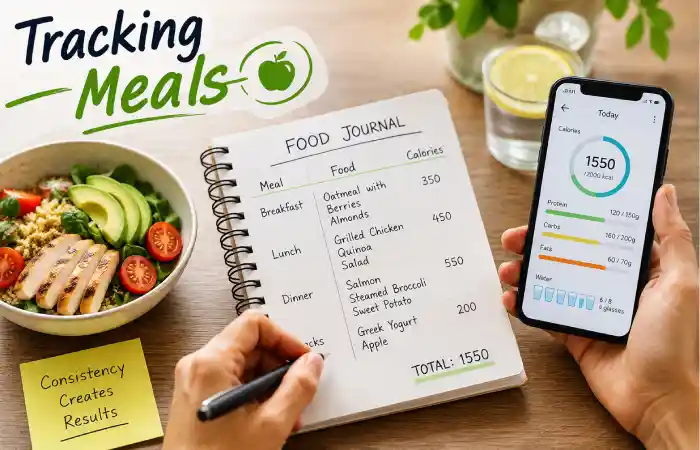
Meal tracking is usually the most valuable section of a weight loss journal.
Instead of writing only calories, include details that explain why you ate.
Record:
- Breakfast
- Lunch
- Dinner
- Snacks
- Drinks
- Portion sizes
- Hunger level
- Mood before eating
- Time of meal
Example:
| Time | Meal | Hunger (1-10) | Mood |
| 8:00 AM | Oatmeal + berries | 8 | Energetic |
| 1:00 PM | Grilled chicken salad | 7 | Relaxed |
| 8:30 PM | Ice cream | 3 | Stressed |
Writing down your thoughts and progress can strengthen your weight loss mindset and help you stay focused on long-term success.
Recording Workouts
Exercise tracking helps measure consistency—not perfection.
Include:
- Workout type
- Duration
- Intensity
- Calories burned (optional)
- Energy level
- Recovery
Example:
| Workout | Duration | Intensity | Notes |
| Walking | 45 min | Moderate | Felt energized |
| Strength Training | 40 min | High | Increased weights |
| Yoga | 30 min | Light | Improved flexibility |
Tracking meals, exercise, and sleep makes it easier to build healthy habits for weight loss that last.
Monitoring Progress
Many people only track body weight.
A better journal measures multiple forms of progress.
Track:
- Weight
- Waist circumference
- Hip measurements
- Progress photos
- Strength gains
- Step count
- Energy
- Sleep quality
Weekly Progress Table
| Week | Weight | Average Sleep | Waist | Workouts |
| Week 1 | 82 kg | 6.5 hrs | 98 cm | 3 |
| Week 2 | 81.5 kg | 7 hrs | 97 cm | 4 |
| Week 3 | 81 kg | 7.2 hrs | 96 cm | 5 |
Reviewing your journal entries can reveal patterns that help you overcome a weight loss plateau more effectively.
Reflecting on Challenges

The real behavior change happens during Reflection.
At the end of each week, answer questions like:
- What went well?
- What caused setbacks?
- Which meals kept me full?
- When did I feel most motivated?
- What can I improve next week?
Common challenges include:
- Stress eating
- Busy schedules
- Restaurant meals
- Travel
- Holidays
- Poor sleep
Instead of seeing setbacks as failures, use them as information for better planning.
Building Long-Term Habits
The most significant benefit to learning to keep a weight loss journal is its ability to make short term behavior the foundations of the rest of your life. A lot of people can diet for a week or two and workout for one to two months. Long term consistency to the habit is the true path to long term success and that is why a weight loss journal is the one sure way to help bring you greater awareness, discipline and consistency.
Why Habits Matter More Than Motivation
Motivation ebb and flows. There’ll be days that you wake up excited about eating and moving your body and then there’ll be days that even going to the kitchen is a struggle. Habits are an absolute fix to the problem of lack of motivation. Once healthy eating and exercising are habits, you no longer need motivation when you’re stressed, tired, unmotivated etc. A journal reinforces good habits through journaling daily about the following things such as:
- Drinking enough water
- Eating balanced meals
- Hitting protein goals
- Completing workouts
- Getting quality sleep
- Managing stress levels
The weight loss, like the other health benefits, builds incrementally over time with these tiny habits.
Use a Daily Habit Tracker
A simple habit tracker inside your journal makes it easy to monitor consistency.
| Mon | Tue | Wed | Thu | Fri | Sat | Sun | Habit |
| ✓ | ✓ | ✓ | ✓ | ✓ | ✓ | ✓ | Water Goal |
| ✓ | ✓ | ✗ | ✓ | ✓ | ✓ | ✗ | Workout |
| ✓ | ✓ | ✓ | ✗ | ✓ | ✓ | ✓ | Protein Goal |
| ✓ | ✓ | ✓ | ✓ | ✓ | ✓ | ✓ | Food Journal |
| ✗ | ✓ | ✓ | ✓ | ✗ | ✓ | ✓ | Sleep 7+ Hours |
Even a quick glance at this table can reveal patterns that need improvement.
Review Your Progress Weekly
The building of long-term habits demands reflection. Review your journal at the close of each week and answer;
- Which habits were easiest to maintain?
- Where did I struggle?
- What obstacles got in my way?
- What can I improve next week?
- Which healthy habits are becoming automatic?
This weekly review turns your journal into a personal coaching tool rather than just a record of meals and workouts.
Focus on Consistency, Not Perfection
This can happen if you miss an workout or even a poor meal choice. Real weight loss is attained on a consistency basis, not on a perferct basis. In writing on your food diary; your goal ought to be to acknowledge growth, not to punish setbacks.
My rule of thumb is the 80/20 rule:
“Make good choices 80% of the time”
“Allow for flexibility for occasions”
“Be prepared to slip up, learn and get back on track, Don’t give up.”
“Get back to routine as soon as possible.”
Build a Sustainable Lifestyle
Using your journal to monitor the habits you are making, seeing what is happening as a result, and being able to evaluate the struggles that appear in the journey is going to lead you down a road to lasting healthy lifestyle changes and weight management, as well as great emotional and physical well being. Your journal will be a road map to a permanent outcome and not just temporary.
Paper Journal vs Digital App
| Paper Journal | Feature | Digital App |
| ✅ | Easy to personalize | Limited |
| ❌ | Automatic calorie tracking | ✅ |
| Manual | Progress charts | Automatic |
| Limited | Photo storage | Easy |
| ✅ | Offline use | Depends |
| ❌ | Reminders | ✅ |
| ⭐⭐⭐⭐⭐ | Best for mindfulness | ⭐⭐⭐⭐ |
| ⭐⭐⭐ | Best for convenience | ⭐⭐⭐⭐⭐ |
Troubleshooting Common Problems
| Problem | Solution |
| Forgetting to log meals | Set phone reminders after each meal |
| Losing motivation | Focus on habits instead of scale weight |
| Inconsistent entries | Start with one meal per day and build gradually |
| Feeling overwhelmed | Track only meals, water, and exercise initially |
| Emotional eating | Add a mood column before each meal |
FAQ
How often should I update a weight loss journal?
Keeping daily entries helps with insights. Analyzing weekly entries help with discovering patterns and modifying your plan.
What details should I track in a weight loss journal?
Log each of your meals and drinks, exercise session, body measurements, sleep time, moods, energy levels, and weekly journal reflection.
Should I use a paper journal or an app?
Both are valuable tools. A paper journal aids with mindfulness, while a weight loss tracking app will provide an easier time keeping up with calories and other data, along with visual progress updates.
Can journaling help with emotional eating?
It absolutely can! If you’re emotionally triggered, your thoughts and feelings prior to meals can illuminate them, which allows you to work on alternative ways to cope.
Stay inspired by reading weight loss success stories from people who achieved lasting results through consistency.
How long do I need to keep an weight loss journal?
It is best to journal your eating and other efforts for about 8-12 weeks, at a minimum, in order to form habits. Once you’ve mastered a few healthy behaviors, you might only need aSimplified form of tracking for ongoing success.
Conclusion
One of the best and most concrete things that you can do for weight loss is to learn how to use a weight loss journal. When you document your meals, exercise routine, progress and journal about how you are feeling about it all, you are building your awareness, building habits that you want to create, and most importantly, holding yourself accountable. You don’t need anything more fancy than a notepad and a pen to do this effectively and I will give you more guidance later in the post. Your weight loss journal is really about giving you the knowledge and information you need to make smarter choices instead of just guessing.
Afiya Jafar is a fitness and wellness writer who focuses on making health, exercise, and healthy lifestyle information simple and practical. Her work covers workouts, fitness motivation, strength training, nutrition, weight management, stress management, mindfulness, and everyday wellness.
Read Full Bio of Afiya Jafar →
Sameena Begum reviews selected health, wellness, fitness, and digital content for clarity, factual presentation, consistency, and reader usefulness. Her review work helps maintain clear and responsible editorial standards across PhysicalFitt content.
Read Full Bio of Sameena Begum →
Dr. Khizrana Begum is a qualified medical professional with MBBS and MD qualifications and 5+ years of experience in the medical field. She works as a General Physician and Dermatologist, with expertise in general medicine, dermatology, preventive healthcare, and skin health.
Read Full Bio of Dr. Khizrana Begum →