
You can incorporate a HIIT training plan for weight loss for women to help you get leaner, burn more calories and shed excess body fat in much less time than doing it any other way. When you put this into practice, HIIT workout in combination with lifting weights, moving more, eating well and adequate recovery can create an accelerated path to dropping excess body fat and optimizing physical and mental health.
❝
This article is a part of
Weight Loss Hub
What Is HIIT?
HIIT means High-Intensity Interval Training. An exercise session generally includes:
Thirty second recovery with rest. I always try one of a few exercises that can I do on HIIT days include burpees and high knee sprints with two burpees every set.
For example:
- 30 seconds: fast bodyweight squats
- 30 seconds: easy recovery
- 30 seconds: mountain climbers
- 30 seconds: recovery
- Repeat for several rounds
What ‘high intensity’ means is that intensity is high. You don’t have to be moving in an all out sprint. If you have had little or no exercise experience, use a strong but controlled form (such as ‘hard’ jogging). ‘Hard jogging will become easy, in which case you can intensify the movements by bringing in new elements – then we look at the ‘real’ high intensity interval.
High-intensity work outs ‘are for beginners women are often better off using some sort of step element where the repeated foot strikes don’t jolt them all over,’ advise the creators of BodyAttack class . ‘Step-ups, incline walks, fast marching, stationary punches, squats are good starts’.
Women over 40 may need to adjust HIIT intensity and recovery, so a workout plan for women over 40 can help you choose a sustainable approach.
Benefits for Weight Loss
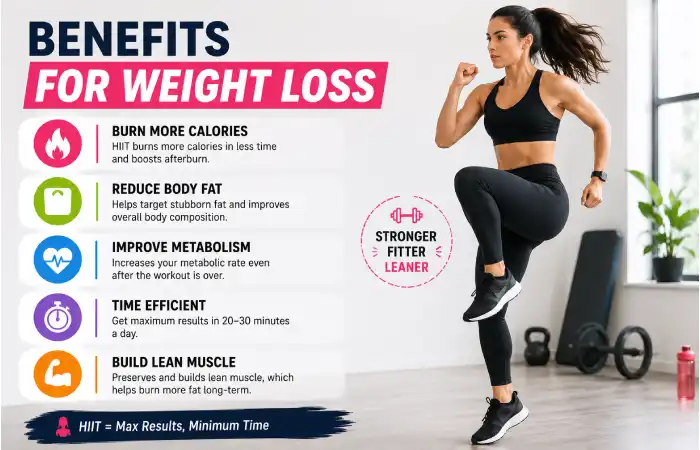
It’s a perfect option if time isn’t on your side. You can put together a quick session designed to put your heart and muscles to the test and to boost exercise tolerance. A study in recreationally active women showed a greater improvement in cardiorespiratory fitness in aHIIT group but did not demonstrate any changes in body mass or fat mass – that is not how fat is reduced.
HIIT can be one component of a balanced workout plan for female weight loss, alongside strength training, lower-intensity cardio, and recovery.
HIIT vs. Traditional Cardio
| Moderate Cardio | Factor | HIIT |
| Usually longer | Workout duration | Usually shorter |
| Moderate and steady | Intensity | High during work intervals |
| Lower | Recovery requirement | Higher |
| Yes | Beginner-friendly | Yes, when modified |
| Usually optional | Equipment | Optional |
| Useful as part of a calorie-controlled lifestyle | Fat-loss potential | Useful as part of a calorie-controlled lifestyle |
| Easier to perform frequently | Best advantage | Time efficiency |
The best choice is the one you can perform consistently.
Beginner HIIT Routine
Start with 20 seconds of work followed by 40 seconds of recovery. Complete 2–3 rounds.
- Bodyweight Squats
With legs hip-width apart, push hips back, knee and return to standing.
- Fast Marching
March in place while moving your arms. Increase the pace without losing control.
- Incline Push-Ups
Perform push-ups while resting on an elevated surface of appropriate strength. The lower it is, the more the work requires.
- Reverse Lunges
Step one foot backward, lower under control, then return to standing. Alternate sides.
- Standing Mountain Climbers
Place your hands on a sturdy surface and drive one knee toward your chest at a time.
Beginner session:
5 exercises × 20 seconds work + 40 seconds recovery × 2–3 rounds.
Begin each workout routine with 5 minutes of warm up exercises. You need 5 minutes of cooling down after your last exercise.
Weekly HIIT Schedule
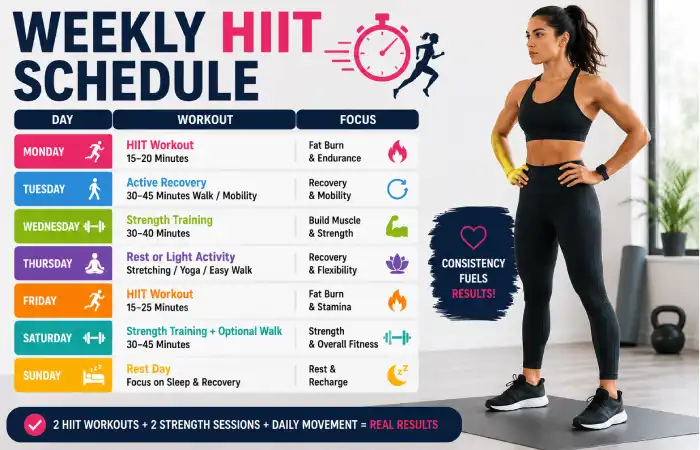
You don’t need HIIT every day to make progress.
A practical beginner schedule could look like this:
| Day | Workout |
| Monday | Beginner HIIT – 15–20 minutes |
| Tuesday | Walking + mobility |
| Wednesday | Full-body strength training |
| Thursday | Rest or easy walking |
| Friday | HIIT – 15–25 minutes |
| Saturday | Strength training + optional walk |
| Sunday | Rest |
As your fitness develops you can increase intensity of workout either as duration, resistance or interval type or frequency.
On days when HIIT isn’t appropriate, a full-body workout for female weight loss can provide an effective alternative for training multiple muscle groups.
The current recommendations for activity for adults suggest at least 75 mins of vigourous cardio and 150 mins of moderate aerobic exercise, plus strength exercise on 2 days or more per week.
If you want to combine HIIT with strength and recovery days, a 7-day workout plan for female weight loss can help you organize your weekly training.
Don’t Ignore Strength Training
If weight loss is the primary fitness objective then HIIT may be able to supplement but not take the place of strength training. Work out for muscle and not lose while losing body mass with squats, presses, rows, deadlift variation,lunges, etc.
Pairing HIIT with strength training for female weight loss can create a more balanced routine that develops muscular fitness alongside cardiovascular conditioning.
Safety Tips
HIIT is demanding, so progress gradually.
Warm up first. Spend around 5–10 minutes performing easy movement and dynamic exercises before hard intervals.
Start with low impact. If jumping causes discomfort, replace jumping jacks with step jacks and running with fast marching or incline walking.
Prioritize technique. Poor form becomes more likely when you’re exhausted. Slow down when necessary.
Allow recovery. Avoid turning every workout into a maximum-effort session.
Pay attention to signals. If you have any chest pains (other than a very normal training feeling), have a feeling of impending death, are going crazy with dizziness, or can barely breathe from exertion and cannot get breathing back normal, quit training and get to a doctors.
Have you just made a new commitment to exercising again, have just entered into pregnancy, have chronic illness or a disease, or you worried you’ll have problems doing that type of heavy exercise? Then, first check in with an exercise qualified, medical professional for personal guidance prior to starting HIIT training.
HIIT Equipment: What Do You Actually Need?
You can perform beginner HIIT with no equipment.
| Equipment | Useful for | Beginner priority |
| Exercise mat | Floor exercises and comfort | High |
| Interval timer | Work/rest tracking | High |
| Resistance bands | Strength-focused intervals | Medium |
| Dumbbells | Squats, presses, rows and lunges | Medium |
| Treadmill | Walking/running intervals | Optional |
| Exercise bike | Low-impact intervals | Optional |
Don’t buy equipment simply because a workout advertises it as essential. A mat and timer are enough to start. (PubMed)
Troubleshooting: Why Isn’t HIIT Helping With Fat Loss?
“I’m doing HIIT but my weight isn’t changing.”
Exercise does not always put a calorie into the deficit. You want to look at all of what you’re eating in one day, exercise throughout the day, sleep patterns, and also the consistency with it instead of immediately jumping into even more HIIT training.
“HIIT feels too difficult.”
Take short work intervals, extra long rest between intervals and easy-pace exercises. You should exercise to build fitness gradually rather than copy a super challenging drill.
“My joints hurt when I jump.”
Remove jumping movements. Try marching, step-ups, cycling, or incline walking instead.
“Can I do HIIT every day?”
Most beginners don’t need daily HIIT. Recovery is part of the program. Two well-executed sessions per week can be a much more sustainable starting point.
FAQs
Is HIIT good for female fat loss?
Yes.HIIT can be effective at aiding fat loss and improving cardiovascular fitness along with an adequate diet and activity. Research in recreationally active women indicated reductions in body fat percentage though effects differ.
Can you do 2 days of HIIT per week in women?
A safe starting point for beginners is 2 days. Advanced exercisers may respond well to more but rest and strength training should still be included.
Can HIIT be done at home?
Yes, you absolutely can.
Squats, lunges, march on the spot, step-ups, incline press ups, standing mountain climbers.
An all you need to set up is one chair; you do not need expensive equipment.
HIIT doesn’t always require gym equipment. You can incorporate interval training into a home workout plan for female weight loss using bodyweight exercises.
Is 20 mins HIIT sufficient?
Possibly yes, a 15-20min intense session will do the trick when performed on regular days but remember more isn’t always better.
Will HIIT burn belly fat?
The use of HIIT is beneficial in losing overall body fat but it does not allow the individual to pick their destination for weight loss; the journey requires diet, sleep and physical training to reduce fat in areas of the body rather than focusing too specifically on areas like our belly.
Is HIIT better than a walk for fat loss?
No – neither better than the other.
A HIIT workout saves on time and makes significant contributions to fitness. Walking offers more frequency and requires less recovery and combines really well with HIIT.
The Bottom Line
Why wasn’t this “max intensity” workout plan I found online that makes you want to quit before you finish, on the list above? Well, a HIIT workout plan for female fat loss really isn’t the plan with the most intense exercises on earth. Instead, it’s going to be a workout plan where you actually recover from the workout sessions.
Fat loss and sustainability and go together with a properly programmed work out plan.
Here is the best way to build up to two HIIT workouts a week that allow you to recover, include strength training, get you moving the rest of the week (walking is key), fuel your efforts and ultimately allow you to keep getting the results you want. Just don’t attempt max intensity everything from the start.
5 steps to make sustainable fitness stick Fat loss takes time, but the time you invest into yourself and your health will extend far beyond just the decrease of your number on the scale – it’s going to positively impact all aspects of your well-being.

Afiya Jafar
Afiya Jafar is a fitness and wellness writer who focuses on making health, exercise, and healthy lifestyle information simple and practical. Her work covers workouts, fitness motivation, strength training, nutrition, weight management, stress management, mindfulness, and everyday wellness.
Read full bio of Afiya Jafar