
Last Updated: July 8, 2026
Whether you’re looking to blast fat, improve heart fitness, boost exercise overall and also if you are starting for the first time time in the gym then cardio training will benefit you the many from a structured program cardio routine exercise routine workout and also if you want to elevate performance you can then certainly reach a next degree.
Cardio exercises within the exercise has gotten down to just how exercise to drop weight as well as enhance cardiovascular health and fitness fitness. The following workout will include every thing you’ll require – from basics cardio workouts to extra advanced ones- via genuine gym methods, understanding to cardio.
❝
This article is a part of
Cardio Hub
What Is Cardio Exercise in Gym?
Cardio cardio means any type of movement that is exercise-like and helps make your lungs and heart operate better, more efficient, while increasing heart rate. In the gym context, this usually means equipment, organized movements that ensure that the movements that follow will never cease!
Basic Gym- Cardio Exercises are:
- Treadmill/walking on the mill
- Running on the treadmill
- Cycling at the static bike
- The Rowmachine
- Stair Climbing Machine
Through cardio you get increased consumption of oxygen and with that an increased circulation of blood and an increased rate of calorie combustion of fat.
Benefits of Cardio Workouts
Benefits That Go Way Beyond a Burning Tummy – We all know cardio’s primary benefit is to incinerate calories (because the beach doesn’t swim itself), but the truth is, when done consistently, it helps improve several systems within the body that boost metabolism, heart-health and athletic potential. Here’s a breakdown of the key cardo-benefit pay-offs in a real-world, gym-inspired, fashion:
-
Improves Heart Health and Circulation
Enhances the capacity of the cardiovascular system Cardiovascular system, specifically, the cardio has proven to make a stronger muscle with capacity to increase blood flow to the whole body, that consequently causes reduce in resting heart rate and provides better movement to oxygen.
This would eventually result to reduction of the danger related to hypertensive disease. Increases the day-to-day expense regarding overall calories Burning too much calories would require building muscle and can even contribute to better metabolism.
-
Accelerates Fat Loss
Cardio exercise helps the body consume an extra day-to-day caloric expense through burning extra fats. High, moderate-intensity exercises stimulate body and the metabolism will likely improve even when at relax.
Practical Insight: If fat is your objective then doing inclined walking as well as HIIT could prove best since each and every minute used will be a lot more efficient for burning energy.
-
Enhances Lung Capacity and Oxygen Utilization
May increase your stamina If you desire to improve your endurance or have long periods of activity then doing cardio will increase VO max (maximum oxygen Uptake) of our own body. This indicates that an body would efficiently use oxygen while working out with lesser breath required.
-
Builds Endurance and Stamina
This can improve your perseverance. Trains you’ll slow-twitch muscle cells Cardio improves both slow-twitch fibers. They’re used in activities that persist a longer time, not rapid but consistent moves, thus allowing you to achieve exercise plans more efficient. Helps with managing mood swings The cardio workout stimulates the delivery of serotonin and endorphins throughout the system.
-
Supports Mental Health and Stress Reduction
Serotonin and endorphins act as your body’s internal natural anti-depressants that not only aid in boosting your spirits, but also can manage tension and anxieties. A cardio session 20-30 minutes is adequate for lifting a temperaments.
-
Improves Metabolic Function
Cardio builds insulin sensitivity to improve your body’s blood sugar response. This can aid weight control long-term, which directly contributes to a stable energy reserve.
-
Aids Recovery and Active Rest
A brisk cardio exercise will increase your muscle blood flow, which flush out metabolic waste to ease delayed muscle soreness. It means that such moderate cardio helps as recovery tool.
-
Supports Overall Fitness and Longevity
According to study-backed 2026 physical activity guidelines: the adults those undergo 150-300 min cardio each week get reduced risks of serious illness, are more flexible over age and live higher quality life
Summary
| Benefit Category | Key Outcome |
| Cardiovascular | Better circulation, Stronger heart |
| Fat Loss | Higher calorie burn |
| Endurance | Increased stamina |
| Mental Health | Improved mood, Reduced stress |
| Metabolism | Better insulin sensitivity |
| Recovery | Faster muscle repair |
Best Cardio Machines in the Gym
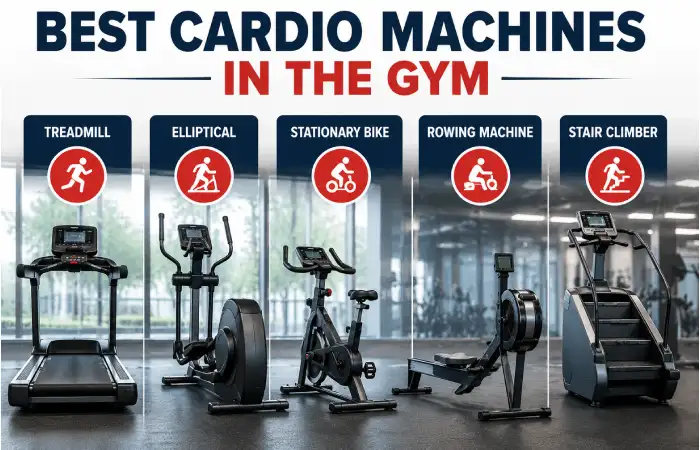
The best cardio machine for the gym is determined by the results you’re seeking: fat loss, stamina, low impact workout on joints, or conditioning. Every machine varies on the level of biomechanics, muscles that get used, number of calories burnt and how easy it is to learn to use. In this document you can find an organized guide based on evidence to take up your decision.
-
Treadmill (Best for Fat Loss & Natural Movement)
Treadmill: the most obvious choice for cardio walking/jogging/running. Machine cardio machines are a classic but they are arguably the most straightforward machines for exercise, given that walking on a treadmill is no different from running or walking outdoors.
Key Advantages:
- High calorie burn due to weight-bearing movement
- Adjustable incline for intensity progression
- Supports HIIT and steady-state training
Limitations:
- Impact at joints can increase, particularly if users are heavy, or the sport has recently changed in nature for beginners.
Best Use Case: Fat loss, endurance building, interval training
Prefer indoor training? Our treadmill cardio workout guide includes walking, running, incline, and HIIT routines.
-
Elliptical Trainer (Best Low-Impact Cardio)
It offers a gentle stride to protect joints while providing a fluid, continuous movement.
Key Advantages:
- Low-impact, joint-friendly
- Engages both upper and lower body
- Suitable for long-duration sessions
Limitations:
- Slightly lower calorie burn associated to treadmill at same effort
Best Use Case: Beginners, injury healing, lengthy steady cardio
-
Stationary Bike
Available in standing and recumbent formats, the bike is simple to use and highly mountable.
Key benfits:
- Very low joint stress
- Easy resistance control
- Ideal for interval cycling (spin-style workouts)
Limitations:
- Limited upper-body engagement
Best Use Case: Beginners, rehab training, moderate calorie burn
-
Rowing Machine (Best Full-Body Cardio)
The rowing machine is one of the most useful cardio tools, connecting multiple muscle groups concurrently.
Key Advantages:
- Full-body activation (legs, back, core, arms)
- High calorie burn efficiency
- Improves strength + endurance together
Limitations:
- Requires proper technique to avoid injury
- Learning curve for beginners
Best Use Case: Functional fitness, strength-endurance training
-
Stair Climber (Best for Lower Body Strength & Intensity)
This machine models climbing stairs constantly, initiating high muscular and cardiovascular mandate.
Key Advantages:
- High calorie burn in shorter duration
- Strong glute and leg activation
- Excellent for fat loss
Limitations:
- Physically demanding; not beginner-friendly
Best Use Case: Advanced users, fat loss, lower-body conditioning
Machine Comparison Table
| Machine | Difficulty Level | Calories Burned (30 min)* | Muscle Engagement | Impact Level |
| Treadmill | Easy–Moderate | 250–400 | Lower body dominant | High |
| Elliptical | Easy | 200–350 | Full body (moderate) | Low |
| Stationary Bike | Easy | 200–300 | Lower body | Very Low |
| Rowing Machine | Moderate | 250–350 | Full body (high) | Medium |
| Stair Climber | Hard | 300–450 | Lower body (intense) | High |
*Calories vary based on weight, intensity, and duration.
How to Select the Right Machine
Fat Loss:
→ Treadmill (incline) + Stair Climber
Beginners:
→ Stationary Bike or Elliptical
Joint Safety:
→ Elliptical or Recumbent Bike
Full-Body Training:
→ Rowing Machine
Short, Intense Workouts:
→ Stair Climber or HIIT on Treadmill
Beginner Cardio Workout Plan
The goal when you start off any beginner cardio workout routine is low injury, consistent workout and easy to learn steps. When beginning, the first 4 to 6 weeks’ objective isn’t to burn as many calories as possible but to increase strength, build resistance, efficiency of movement, and adherence to training.
New to exercising? Follow our beginner cardio workout plan to safely build endurance and improve cardiovascular fitness.
Core Principles for Beginners
- Go Low, slow it up: don’t go hardcore in your first 2 weeks
- More about time not speed: Be consistent
- Intensity: Medium at ~60-70% MHR
- Recovery/Days off: Take advantage
7-Day Beginner Cardio Plan (Week 1–2)
| Day | Workout Type | Duration | Intensity Level |
| Day 1 | Treadmill Walking | 15 min | Low |
| Day 2 | Rest / Light Activity | — | — |
| Day 3 | Stationary Bike | 20 min | Low–Moderate |
| Day 4 | Rest | — | — |
| Day 5 | Elliptical | 15–20 min | Low |
| Day 6 | Light Walking (Outdoor/Gym) | 20 min | Low |
| Day 7 | Rest | — | — |
Week 3–4 Progression Plan
Once your body adapts, gradually increase workload.
- Increase session duration to 20–30 minutes
- Add slight incline on treadmill (2–5%)
- Introduce short intervals (optional):
- 1 min faster pace + 2 min normal pace
Simple Cardio Progression Formula
- Week 1–2 → Build habit (low intensity)
- Week 3–4 → Increase duration
- Week 5–6 → Add intensity (intervals or incline)
This phased method reduces burnout and increases long-term adherence.
Sample Beginner Cardio Session (Step-by-Step)
Machine: Treadmill
Total Time: 20 minutes
- Warm-up → 5 min slow walk
- Main workout → 10 min brisk walk
- Cool-down → 5 min slow pace
Goal: Slightly elevated breathing, but still able to talk.
Heart Rate Guidelines (Beginner Safe Zone)
| Level | % of Max Heart Rate | Feeling |
| Low | 50–60% | Very comfortable |
| Moderate | 60–70% | Slightly breathless |
| High (Avoid) | 70%+ | Difficult for beginners |
Common Beginner Mistakes
- Starting with high-intensity workouts too early
- Skipping warm-up and cool-down
- Holding treadmill rails (reduces effectiveness)
- Doing cardio daily without rest
- Ignoring proper posture and form
Cardio for Weight Loss
For a variety of reasons (explained below), the cornerstone of losing fat weight consists of cardio, which burns a lot of calories and so puts the body in calorie debt that must be filled for you to successfully lose fat. However, as mentioned earlier, not all types of training cardio are created equal when you consider that they have to match certain physical needs and are not the best for everybody or all forms.
How Cardio Supports Weight Loss
Weight loss occurs when:
Calories Burned > Calories Consumed
Cardio accelerates this process by:
- Increasing daily calorie burn
- Enhancing fat oxidation
- Improving metabolic rate
- Supporting hormonal balance (fat-loss hormones like adrenaline)
If your goal is burning calories efficiently, our guide on cardio for weight loss explains the best workouts, intensity levels, and weekly plans.
Best Types of Cardio for Fat Loss
- High-Intensity Interval Training (HIIT)
Short bursts of intense activity followed by rest times.
Example:
- 30 sec sprint → 1 min walk (repeat 10–15 times)
Works:
- Triggers afterburn effect (EPOC)
- Burns more calories in less time
- Preserves muscle mass better than long cardio
- Incline Walking (Treadmill)
Walking at a 5–12% incline increases effort without requesting to run.
Benefits:
- High calorie burn with low injury risk
- Targets glutes and hamstrings
- Beginner-friendly fat loss method
- Stair Climber Workouts
One of the most intense steady-state cardio choices.
Benefits:
- Burns significant calories quickly
- Builds lower body strength
- Ideal for small, effective sessions
- Steady-State Cardio (LISS)
Low-intensity continuous cardio (e.g., cycling, walking).
Best For:
- Beginners
- Longer sessions (30–60 minutes)
- Active recovery days
Choosing the right cardio method can improve results. Learn which exercises work best for cardio for fat loss based on your fitness goals.
2026 Fat Loss Cardio Comparison
| Cardio Type | Duration | Calories Burned* | Fat Loss Efficiency | Difficulty |
| HIIT | 15–25 min | High | Very High | Hard |
| Incline Walking | 30–45 min | Moderate–High | High | Easy |
| Stair Climber | 20–30 min | Very High | Very High | Hard |
| Cycling (LISS) | 30–60 min | Moderate | Moderate | Easy |
*Varies by weight and intensity
Weekly Cardio Plan for Weight Loss
Goal: 300–400 minutes per week
- Day 1 → HIIT (20 min)
- Day 2 → Incline Walk (30 min)
- Day 3 → Rest or Light Cardio
- Day 4 → Stair Climber (20 min)
- Day 5 → Cycling (40 min)
- Day 6 → HIIT (15–20 min)
- Day 7 → Rest
Key Strategy for Maximum Fat Loss
- Combine Cardio + Diet
Cardio alone is not sufficient. A calorie-controlled diet is fundamental.
- Prioritize Consistency Over Intensity
Systematic moderate workouts outperform random intense sessions.
- Mix Cardio Types
Avoid stages by rotating between HIIT, steady-state, and slope training.
- Track Progress
Monitor:
- Body weight
- Waist measurement
- Workout duration/intensity
Cardio for Muscle Building Support
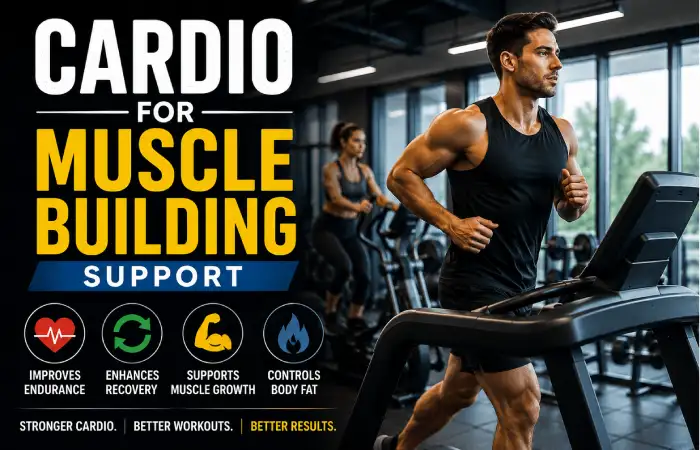
Provided your cardio training is planned with in an appropriate manner, then it is a supporting activity in muscle growth and not counter productive. Commonly perceived as the muscle wasting activity, excessive amounts of cardio or a poorly placed cardio workout typically give rise to this thought process. In a properly structured workout plan, a bit of moderate cardio has a favorable impact on your training and recovery.
Increased Recovery
The most ignored impact of cardio workouts is the fact that cardio enhances your recovery. During the post workout, it increases the blood flow to your muscles thus making their nutrient supply efficient and increasing the rate of removal of metabolic waste from your muscles.
Thus you can avoid heavy soreness and train on alternate days with good recuperation. Over a course of time, you would observe that your strength training is much more efficient than it could be if cardio is omitted.
Enhancing Training Performance
A higher degree of cardiovascular fitness will help you not only endure more during workouts, but also enable you train better and with the higher possible effort. This, along with the improvement in form and form will certainly aid in giving a great muscle stimulus.
Managing Fat Gain During Muscle Building
During the bulk stage, the gaining of some amount of body fat is somewhat inevitable. So doing some low or moderate level cardio exercises would aid in burning up the calories to regulate the body fat in your body during the bulking period, thus keeping the gain of body fat to a manageable level.
Best Approach to Combine Cardio and Weights
Low impact and steady State cardio forms such as walking, running and biking and elliptical sessions would be the best forms to consider. High intensity intervals training should be used sparingly as it can be counterproductive if done after weight training or during a phase of mass gaining with an increased training volume. Ideally, cardio should be included either after your weight training session or on non strength training days.
This way, most of your training energy will be dedicated to the lifting part which contributes to the growth of muscles.
Timing your workouts matters. Read whether you should do cardio before or after weights depending on fat loss or muscle-building goals.
HIIT vs Steady-State Cardio
When it comes to doing cardio in the gym there are two main categories that come up time and time again; HIIT (high-intensity interval training) and steady state cardio. They both have their own unique benefits regarding calorie burn and health, however the nature of each training style differs somewhat drastically from both one another.
In order to know what type of cardio you want to focus on, consider the following aspects of fitness you want to hit, your fitness level, and how quickly you’ll be bouncing back from it all.
Looking to maximize calorie burn in less time? Explore our complete guide to HIIT cardio workouts for beginners and advanced fitness enthusiasts.
What Is HIIT Cardio?
HIIT is defined as working at maximum or close to maximum effort for extremely short periods of time, interspersed with small recovery gaps (e.g., sprinting hard for 20–30 seconds, walking briskly for 60–90 seconds, then repeating for 15 to 25 minutes). It works both your anaerobic and your aerobic systems making it an ideal fat burning workout which burns maximum calories per session and maximizes after-burn effect.
AfterBURN Effect: With HIIT cardio you benefit from increased oxygen consumption during recovery, which means that your body keeps on working harder to return to your normal rate, and keeps burning calories for up to 24–48 hours post-workout.
What Is Steady-State Cardio?
Steady state cardio is a form of cardio that can sustain a moderate pace for longer periods of time, from 30 minutes to up to an hour.
Examples of this kind of training are walking, jogging or running on a treadmill at a set intensity, or cycling with a consistent rhythm, for example. This type of cardio works mainly your aerobic system and is easier for people to recover from.
Key Differences That Matter
| Factor | HIIT | Steady-State Cardio |
| Intensity | Very High | Moderate |
| Duration | Short (15–25 min) | Long (30–60 min) |
| Calorie Burn | High (time-efficient) | Moderate (over longer time) |
| Afterburn Effect | Significant | Minimal |
| Fat Loss Efficiency | High | Consistent |
| Beginner Friendly | No | Yes |
| Recovery Demand | High | Low |
Which One Is Better for Your Goal?
FAT LOSS HIIT is effective if you have limited time – the higher intensity coupled with the post workout burn ensures maximum calorie burn for your effort, but be prepared to recover and allow your body a few days to rest.
Endurance building – If you’re just starting out, have an endurance goal in mind, or are recovering from a tough workout, steady state will be far more enjoyable and suitable, as it is lower impact on the joints and a greater range of intensity is tolerated.
Best Strategy: Combine Both
Combining the Two In an ideal world, you would combine the two. Two or three moderate sessions a week combined with a session or two of high intensity is likely to be the sweet spot for overall fitness improvement and calorie expenditure. For optimal and fastest results while not compromising muscle mass or leading to overtraining. It all depends. For a beginner, 30-60 minutes might be the most appropriate.
How Long Should You Do Cardio?
The following durations ensure adequate stimulus for your cardiorespiratory system without compromising your overall recovery, so to start: Short bursts are the right way for new exercisers.
General Duration Guidelines
For most individuals, cardio duration should fall within these ranges:
- Beginners: 15–25 minutes per session
- Intermediate: 25–40 minutes
- Advanced: 30–60 minutes
If you want to run, jog, swim,cycle (or simply walk briskly!) 1-2 minutes per 20-25 minutes of total exercise. Longer. It appears there are no real benefits from exercise sessions lasting for a length much longer than an hour – instead, 45-60 minutes appears to be optimal. Longer session / higher intensity. There are numerous examples; for instance, running/jogs/jogs in the park; cyclists ride on a stationary stationary stationary bicycle/road bike (or spin).
Based on Your Fitness Goal
Your goal significantly influences how long you should perform cardio.
For Fat Loss:
HIIT is defined as workouts. 2-20 minutes to reap advantages. In between 20 and 25 minutes for an additional push!
For Endurance:
Steady-state cardio for 40–60 minutes improves build aerobic power and stamina over period.
For Muscle Support:
Shorter sessions of 15–30 minutes are ideal to avoid interfering with strength training and recovery.
Intensity vs Duration Relationship
It all comes down to how intense your workout is going to be. Higher intensity workouts can be shorter whilst you still achieve more calories burned that with moderate intensity for 2-3x as long. Too little cardio will make no impact to body fat loss and endurance gains, too much cardio will reduce endurance to the power of that!
For example:
- HIIT → Short duration, high effort
- Steady-state → Longer duration, moderate effort
Balancing these two variables is answer to optimizing solutions.
Weekly Cardio Recommendations
Fitness guidelines recommend:
- Minimum: 150 minutes of moderate-intensity cardio per week
- Optimal Range: 150–300 minutes per week
- For Fat Loss: 300+ minutes (combined intensity levels)
These totals can be distributed across 3–6 sessions depending on your schedule and recovery ability.
Signs You’re Doing Too Much or Too Little
You will get more tired, more often. Your goal when programming cardio will be to feel worked but also not absolutely wiped.
Common Cardio Workout Mistakes
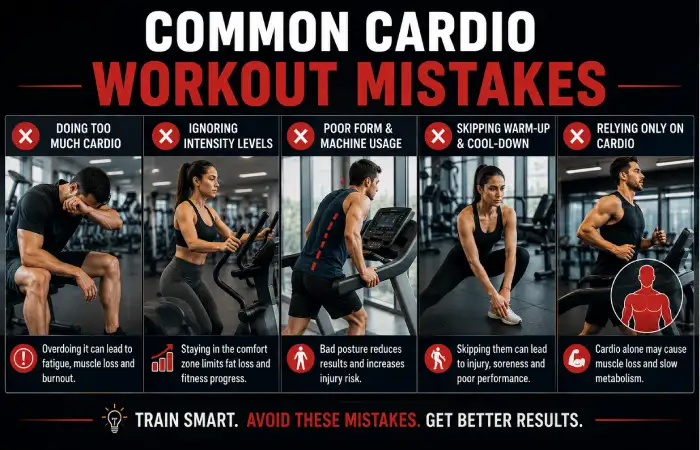
You get how cardio basically works but most people-especially the beginners-make some sort of mistakes which results in the inefficiency of the exercises, delayed results, and in some cases, higher risks of injuries. Avoid making such mistakes if you plan on benefiting more in the cardio routine:
Doing Too Much Cardio
Just because you’re Adding cardio more often (e.g. Everyday for an hour or so) isn’t a “quick fix” to lose some fat faster. Too much cardio may lead to loss of muscle mass, fatigue, and decrease in strength during lifting workouts.
Having reasonable goals for cardio (a number that is do-able consistently for long term-progress) as compared to achieving it without any other options will surely provide an optimum results.
Ignoring Intensity Levels
No Intensity levels are considered Everyone goes at a relaxed pace with cardio workouts without trying their level- best during those 20–30 minutes. When cardio gets done in a monotonous way with little intensity variation or intervals, it will make fat loss inefficient compared to alternating high intensity cardio intervals (HIIT) and steady pace cardio.
Poor Form and Machine Usage
When working out on elliptical or treadmill, most people either hug the handrails of the treadmill, slouch posture when on elliptical and etc,which lowers the caloriesburned and notengages targetmuscles,which is the primarypurposeof cardiovascularworkout to take over. Make sure you’re working with correct form.
Skipping Warm-Up and Cool-Down
When a person dives in to their cardio phase head on without any proper Warm Up (e.g. 5–10 minutes on treadmill, light workout before diving in), then it leads to better rate of injuries. Correspondingly, a correct cool-down period (again 5-10 minutes light pace on treadmill, followed by stretching) will grant the body to settle down gracefully and to stop dizziness/stiffness.
Relying Only on Cardio for Fat Loss
If you are trying to lose some fat in the gym and solely rely on cardio to help you shed off fat, then that may lead to loss of muscle mass as compared to just fat in some cases. Henceforth combine your cardio sessions with your strength training sessions if you are looking for optimum fat Loss in conjunction with maintaining of Lean Mass
Not Tracking Progress
Some individuals just end up doing same cardio routine for some weeks and months, without logging the miles/time/resistance level/calories spent. The progress will Plateau so slowly that you’ll barely realize what is going on and how to move up to that challenge ahead of you. Progress is the essential part, not just repeating thesame routine 20 or so times.
Troubleshooting Cardio Issues
Problem: Not Losing Weight
Likely cause: calorie surplus
Solution: adjust diet + increase intensity
Problem: Getting Bored
Solution: switch machines, try HIIT
Problem: Joint Pain
Solution: shift to low-impact cardio (elliptical, cycling)
Frequently Asked Questions About Gym Cardio
- Is cardio necessary for fat loss?
Yes, it helps create calorie deficit and improves metabolism.
- Can I do cardio every day?
Yes, but vary intensity to avoid overtraining.
- Best time for cardio?
Morning (fasted) or post-workout—depends on preference.
- Does cardio burn belly fat?
It reduces overall body fat, including belly fat.
- Which machine is best for beginners?
Stationary bike or elliptical.
Final Thoughts
Gym-based cardio training isn’t only effective for weight management but crucial for your long-term physical condition. By implementing it the right way cardio workout has a positive impact on cardiovascular condition, strengthens the endurance capabilities, facilitates fat loss and supports muscle building. You don’t have to seek the one and only workout: the goal is to combine the activities to reach specific objectives according to your actual fitness level.
What really helps is constancy.
Long-term progress is the result of regular exercise rather than maximum effort. Regardless of whether you decide to opt for long workouts at a consistent heart rate or to short bursts of higher-intensity intervals (HIIT training), it’s important to remain consistent over time. The combination of cardio, strength training, nutrition and proper recovery creates a stable and successful system. If we’re speaking practically – stick to constant progress, take care of the common mistakes not to do and update your training plan regularly as you’re improving.
Cardio exercise has to go along with you – start it simple, improve the intensity gradually and in the end integrate it into your total workout system.
A properly tailored cardio plan isn’t only about quick gains, but about gaining health and improving the quality of your life long-term.