
Last Updated: August 6, 2026
In 2026 strength training for female weight loss is becoming the most popular form of exercise available. Forget hours on the treadmill; women are now using weights to melt pounds, retain lean muscle mass, increase metabolism, and get a firm, toned body. Studies by leading sports medicine organizations continue to prove that female fat loss increases by combining resistance training with calorie restrictions in moderation versus diet alone.
More muscle also results in a higher metabolism through an increase in caloric expenditure.
Whether you’re just starting lifting and want to gain an understanding, you haven’t lifted in a few months or years and need a refresher-read this to show you how to assemble an effective routine, select the best exercises, recover properly, and keep progressing through your journey without sustaining injuries.
❝
This article is a part of
Weight Loss Hub
Why Women Should Lift Weights
As for that fear of getting too manly – as any women that lifts weights to become bulkier for years may quickly reveal – many require consistent and extreme effort in terms of calories, heavy weight lifting, as well as your natural genetic frame to have truly impressive and the “large” muscle amount needed. For mostwomenthat result in muscle lift or use often ends in loss of body fat, firm as well as sleek muscle.
Women over 40 may benefit from adjusting exercise selection, intensity, and recovery, making a workout plan for women over 40 a useful resource.
Benefits of Strength Training
- Burns calories during and after workouts
- Preserves muscle during fat loss
- Improves body composition
- Increases resting metabolic rate
- Strengthens bones
- Improves posture
- Enhances insulin sensitivity
- Supports healthy aging
- Boosts confidence
Strength Training vs Cardio
| Factor | Strength Training | Cardio |
| Fat Loss | Excellent | Good |
| Muscle Preservation | Excellent | Low |
| Metabolism Boost | High | Moderate |
| Bone Health | Excellent | Moderate |
| Long-Term Results | Excellent | Good |
Fitness professionals most often suggests both, but strength train really as the corner stone to an effective fat loss program should.
Strength training can also be paired with short cardio sessions. A HIIT workout plan for female fat loss can add variety and increase the cardiovascular challenge of your weekly routine.
Full-Body Strength Routine
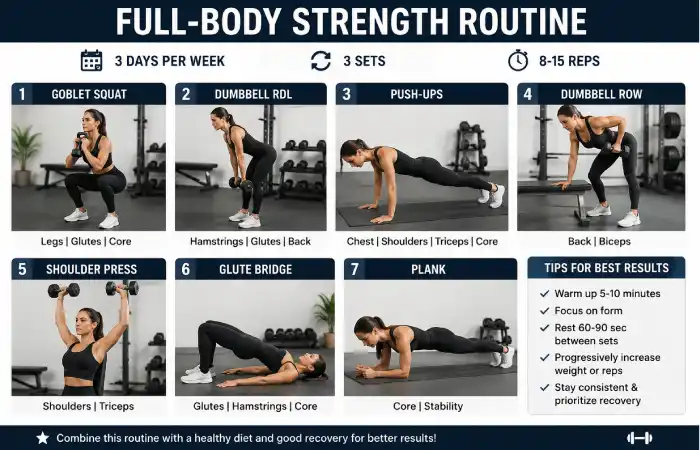
If you are novice start with total body work-outs occasions per week with one particular rest day among trainings.
If you want to train several major muscle groups in one session, a full-body workout for female weight loss can be an efficient option.
Sample Beginner Routine
| Reps | Exercise | Sets |
| 10–12 | Goblet Squat | 3 |
| 10 | Dumbbell Romanian Deadlift | 3 |
| 8–12 | Push-Ups (Modified if Needed) | 3 |
| 10 | Dumbbell Row | 3 |
| 10 | Shoulder Press | 3 |
| 15 | Glute Bridge | 3 |
| 30–45 sec | Plank | 3 |
Rest 60–90 seconds between sets.
As strength improves, gradually increase weights instead of endlessly increasing repetitions. If you want to combine strength sessions with cardio and recovery days, follow a structured 7-day workout plan for female weight loss.
Compound Exercises
Compound movements work several muscles simultaneously, making them the most efficient exercises for fat loss.
Best Compound Exercises
Squats
Targets:
- Glutes
- Quadriceps
- Hamstrings
- Core
Deadlifts
One of the highest calorie-burning lifts because it recruits nearly every major muscle group.
Lunges
Improve balance while strengthening:
- Legs
- Glutes
- Core
Push-Ups
Develop:
- Chest
- Shoulders
- Arms
- Core
Bent-Over Rows
Strengthen:
- Upper back
- Lats
- Rear shoulders
- Biceps
Overhead Press
Excellent for upper-body strength while improving shoulder stability.
Compound vs Isolation Exercises
| Compound | Isolation |
| Multiple muscles | Single muscle |
| Burns more calories | Burns fewer calories |
| Better for beginners | Better for advanced lifters |
| Improves coordination | Builds individual muscles |
A beginner should spend around 80% of training time on compound lifts.
Progressive Overload
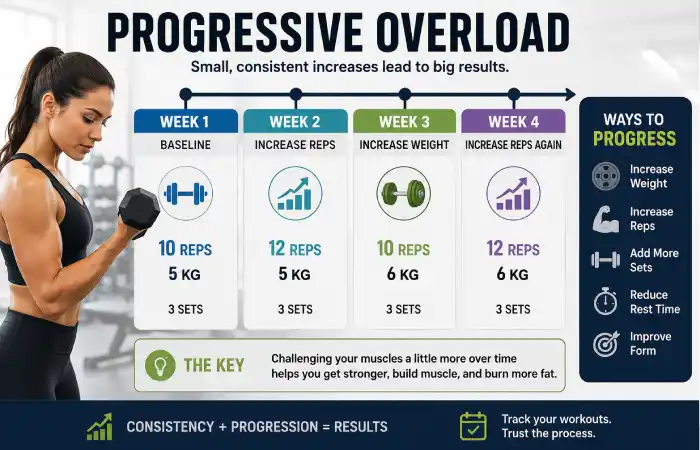
Top causes women stop progress is doing a similar program consistently, month out right after month.
Progressive overload simply means gradually making workouts more challenging.
You can increase difficulty by:
- Adding more weight
- Performing more repetitions
- Increasing sets
- Improving exercise technique
- Reducing rest periods
- Increasing workout frequency appropriately
Example Progression
| Week | Weight | Reps |
| Week 1 | 5 kg | 10 |
| Week 2 | 5 kg | 12 |
| Week 3 | 6 kg | 10 |
| Week 4 | 6 kg | 12 |
Small improvements each week lead to significant long-term results. (WHO)
Recovery and Muscle Growth
Muscles grow while recovering—not during workouts.
Overlooking recovery causes you to to feel drained, recover to slowly and also can bring about the chance of injury.
Recovery Checklist
Sleep 7–9 hours
Eat enough protein
Stay hydrated
Stretch after workouts
Include rest days
Manage stress
Strength training works best as part of a balanced workout plan for female weight loss that combines resistance training, cardio, recovery, and progressive overload.
Protein Recommendations
Current recommendations for protein intake in a day is around 1.2–2.0g/kgBW for physically active people and protein intakes may be even higher in a deficit calorie.
| Weight | Daily Protein |
| 55 kg | 66–110 g |
| 65 kg | 78–130 g |
| 75 kg | 90–150 g |
2026 Research Snapshot
| Training Variable | Recommended Range |
| Weekly Strength Sessions | 2–4 |
| Weekly Cardio | 75–150 min vigorous or 150–300 min moderate |
| Sets per Exercise | 2–4 |
| Repetitions | 8–12 |
| Rest Between Sets | 60–90 sec |
| Sleep | 7–9 hrs |
| Protein Intake | 1.2–2.0 g/kg/day |
These recommendations align with guidance from leading sports medicine and public health organizations through 2026.
Common Mistakes Beginners Make
- Using weights that are too light
- Skipping warm-ups
- Doing only cardio
- Ignoring protein intake
- Changing workouts every week
- Avoiding compound lifts
- Training every day without recovery
- Focusing only on the scale instead of body composition
Products That Can Support Training
While supplements are optional, some may help support overall nutrition and training goals.
| Product Type | Best For | Purpose |
| Whey or Plant Protein | Recovery and muscle maintenance | Helps meet protein needs |
| Creatine Monohydrate | Progressive overload | Supports strength and high-intensity performance |
| Resistance Bands | Beginners | Home workouts |
| Adjustable Dumbbells | Home gyms | Progressive loading |
| Lifting Shoes | Squats and lower-body training | Stability |
Select products that meet your personal requirements rather than believing they may substitute the effort and consistency put in with training and nutrition.
You don’t necessarily need a gym to build strength. A home workout plan for female weight loss can include bodyweight movements, resistance bands, and dumbbells.
FAQ
Is strength training better than Cardio for Females for weight loss?
Strength training assists with maintaining muscle mass, while targeting fat loss. Combining strength, cardio and a low calorie diet will usually provide the most desired results.
How many times per week should Females be weight training?
Ideally 2 to 4 per week depending on recovery and current ability level.
Will lifting weights make you bulky?
No. Most women will appear more toned as men do not generally possess a hormonal composition needed to achieve mass without a very specific training and diet regimen.
Can beginners lose weight with Strength Training alone?
Yes but a low calorie diet and frequent exercise is likely to work better.
How quickly can I see changes?
Most beginners will see strength improvements within a few weeks.
Visual changes in the bodies’ composition (Fat loss to the visible loss of the physique) would usually occur 8 to 12 weeks in.
Conclusion
Weight training for female fat loss is one of the most effective and efficient and sustainable methods for fat loss, building lean muscle and optimizing health. With this training method the goal is to preserve muscle during caloric restriction, the results of which is a boosted metabolism, and ultimately a stronger and leaner body composition. The focus of strength training for weight loss is consistency, compound exercises, progressive overload, recovery, balanced nutrition and protein intake.
There are no quick fixes. Progress is made with each workout that strength trains and with each workout completed increases confidence. It is essential to look past just the scale, and monitor strength progress, energy levels, measurements and measurements of how your clothing is fitting. Through a solid strength training program and a healthy lifestyle, women can achieve long-term weight loss and optimum health for years.