
 Afiya Jafar
Fitness & Wellness Writer
Afiya Jafar is a fitness and wellness writer who focuses on making health, exercise, and healthy lifestyle information simple and practical.
Read Full Bio of Author →
Afiya Jafar
Fitness & Wellness Writer
Afiya Jafar is a fitness and wellness writer who focuses on making health, exercise, and healthy lifestyle information simple and practical.
Read Full Bio of Author →
 Sameena Begum
Health, Fitness & Digital Content Reviewer
Sameena reviews selected health, wellness, fitness, and digital content for clarity, factual presentation, and reader usefulness.
Read Full Bio of Reviewer →
Sameena Begum
Health, Fitness & Digital Content Reviewer
Sameena reviews selected health, wellness, fitness, and digital content for clarity, factual presentation, and reader usefulness.
Read Full Bio of Reviewer →
 Dr. Khizrana Begum
General Physician & Dermatologist
Dr. Khizrana Begum is a General Physician and Dermatologist with MBBS and MD qualifications and 5+ years of experience in the medical field.
Read Full Bio of Medical Reviewer →
Dr. Khizrana Begum
General Physician & Dermatologist
Dr. Khizrana Begum is a General Physician and Dermatologist with MBBS and MD qualifications and 5+ years of experience in the medical field.
Read Full Bio of Medical Reviewer →
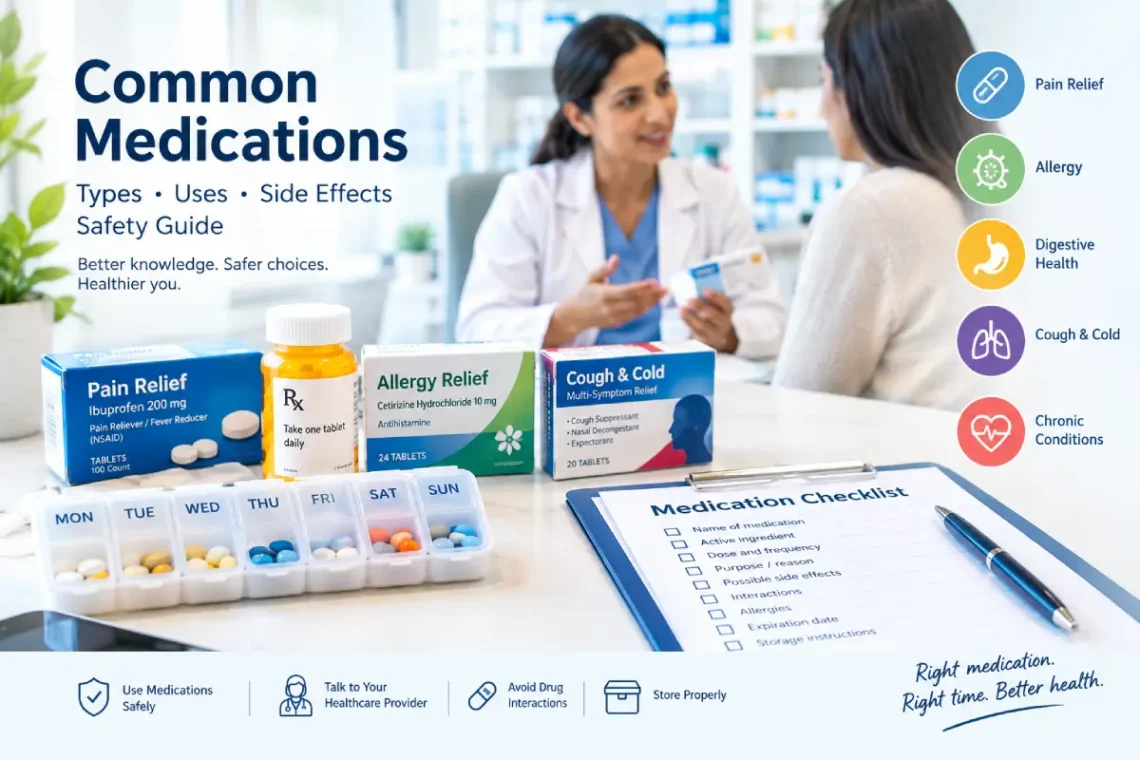
What drugs can be taken is of the largest categories of all the over-the-counter and prescription medicines used for ameliorating signs and symptoms, treating disease and indispositions, managing lifelong conditions and maintaining preventions from certain dangers or impairments. What they are and how they help manage such varying elements from simple symptoms, pain to high blood pressure, diabetes, cholesterol and even indigestion: the drugs taken are vital for their own part in our present living.
However, not every “common” drug is either right or safe for an individual taking it. An individual should always select the right medicine according to the diagnosis of health complications, age group, allergic properties, medications presently undergoing, pregnancy situations as well as the function of his or her kidneys and liver, body physical state.
For seasonal allergies and related symptoms, learn more about common allergy medications, including their uses and potential side effects.
This article guide offers you more about the chief drug groups, the generally acknowledged reasons behind such drugs and the distinctions between over-the-counter and prescription medicines as well as common hazards and important medication safely precautions.
Legal & Ethical consideration: The content from this piece should only act as a general guidance and can’t replace a consultation with your physician on possible and alternative solutions, medical diagnosis or proper treatment in order to gain access to professional advices for any given personal conditions. Never fail to comply with instruction set on each label. Never administer to start, stop, or change doses of prescription medicines without the recommendation of your doctors.
❝
This article is a part of
Medicines Hub
What Are Common Medications?
The medicines that are common are often those medicines used to treat/ prevent/ control many common problems and are classified depending upon use. They may also be classified depending on which part of the body they are treating and which action they perform.
A drug might be considered common because a lot of them are prescribed/ available/ regularly used for common symptoms/ on a routine basis.
The concept of common isn’t to say that everyone should take this medicine. So with pain relief and inflammation there is ibuprofen, and it’s right that it would only be prescribed for individuals when it is deemed appropriate, some drugs e.g. Antihistamines for their associated symptoms will cause individuals to become drowsy and some will have potential reactions when taken alongside other things (eg drugs, supplements, alcohol etc). (MedlinePlus)
When dealing with congestion, cough, or a runny nose, medications for cold symptoms may help provide temporary relief.
Generic names vs brand names
A medication may have:
-
- A generic name, which identifies its active ingredient
- A brand name, which is the name used by a manufacturer
The active ingredient in a brand name, for example Tylenol, is the same active ingredient contained in the generic medication, a different brand name used as well.
Types of Common Medications
The following table provides a beginner-friendly overview.
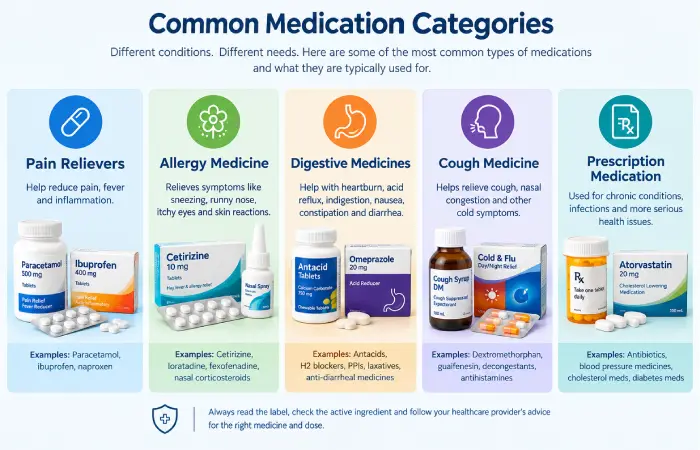
| Medication category | General purpose | Common examples |
| Pain relievers | Pain and fever; some also reduce inflammation | Acetaminophen/paracetamol, ibuprofen, naproxen |
| Antihistamines | Allergy symptoms | Cetirizine, loratadine, fexofenadine |
| Antacids | Occasional heartburn and acid-related symptoms | Calcium carbonate and other antacid ingredients |
| Acid-reducing medicines | Certain acid-related digestive conditions | Famotidine, omeprazole |
| Cough medicines | Selected cough symptoms | Dextromethorphan, expectorant products |
| Decongestants | Nasal congestion | Certain nasal or oral decongestants |
| Antibiotics | Certain bacterial infections | Amoxicillin and others |
| Antihypertensives | High blood pressure and related conditions | ACE inhibitors, ARBs, beta blockers, calcium-channel blockers |
| Statins | Lowering LDL cholesterol | Atorvastatin, rosuvastatin |
| Diabetes medicines | Blood glucose management | Metformin, insulin, SGLT2 inhibitors, GLP-1 medicines |
| Antidepressants | Depression and selected other conditions | SSRIs, SNRIs and others |
| Anticoagulants | Preventing or treating certain blood clots | Warfarin, apixaban and others |
This table is intentionally general. The same medication can have several medical uses, and the most appropriate drug depends on the diagnosis and patient.
Common Medications for Pain Relief
One of the commonest group of drugs are pain relievers. Pain relief may be indicated in headaches, muscle pain, pain occurring at menstrual times, dental pain, simple injuries, fever and various other painful conditions.
Over-the-counter orally administered pain-relief drugs are mainly divided in two types: Non-NSAIDs (acetaminophen/paracetamol) and NSAIDs(examples include: Ibuprofen, Naproxen)
Acetaminophen or paracetamol
Acetaminophen/paracetamol relief pain and reduce fever.
It is present in many different combination products of single ingredients over the counter. For example, some cold and flu product contain Paracetamol or other active ingredient and there is risk in using such drug because without warning about active ingredient of combination products, it is very likely to consume too much active ingredients and getting poisoning through accidental overdose.
Some conditions require treatment with prescription medications, which should be used according to a healthcare professional’s instructions.
Combination product should always have active ingredient printed clearly on package, just in case to check if it is a same active ingredient contained in different medicine.
Ibuprofen
Ibuprofen is an NSAID. NSAID are good in reducing pain, inflammation, fever. But, Some group of people should or should not use NSAIDs due to risk for certain Kidney disorders or problems, bleeding problems, GI and Cardiovascular problems, and with interactions in medicine.
Naproxen
Naproxen is another NSAID used for pain and inflammation.
Like other NSAIDs, it can have important adverse effects and drug interactions. More medication is not necessarily better medication.
Pain medication comparison
| Medicine/group | Important consideration | Common purpose |
| Acetaminophen/paracetamol | Watch for duplicate ingredients in combination products | Pain and fever |
| Ibuprofen | Can cause gastrointestinal and other adverse effects | Pain, fever and inflammation |
| Naproxen | Longer-acting NSAID; interactions and contraindications matter | Pain and inflammation |
| Prescription pain medicines | Require individualized medical guidance | Moderate/severe or specific pain conditions |
Common Medications for Allergies
Allergy medicines are used to relieve symptoms such as sneezing, itching, runny nose, watery eyes and certain skin symptoms.
Antihistamines
Antihistamines work by blocking the effects of histamine, a chemical involved in allergic reactions.
Common examples include:
-
- Cetirizine
- Loratadine
- Fexofenadine
- Levocetirizine
- Diphenhydramine
- Chlorpheniramine
First-generation antihistamines can be more sedating, while many second-generation antihistamines are less likely to cause drowsiness.
Before taking any medicine, it is important to understand its medication uses and side effects.
Nasal corticosteroids
You could use nasal corticosteroid sprays for your symptoms of allergic rhinitis and nasal allergies.
Oral corticosteroids can have an effect throughout the body whereas nasal steroid sprays only have effect locally and should be taken as directed or instructed by a healthcare professional.
Allergy medicine comparison
| Potential issue | Medication type | Main use |
| Drowsiness and impaired alertness | First-generation antihistamines | Allergy symptoms |
| Generally less sedating, although drowsiness can still occur | Second-generation antihistamines | Allergy symptoms |
| Proper technique and consistent use matter | Nasal corticosteroids | Nasal allergy symptoms |
| Intended primarily for ocular symptoms | Allergy eye drops | Eye allergy symptoms |
Do not assume a medicine is non-sedating simply because it is sold without a prescription.
Common Medications for Digestive Problems
Digestive complaints can include heartburn, acid reflux, indigestion, constipation, diarrhea and nausea.
Following basic medication safety guidelines can help reduce the risk of incorrect dosing, adverse reactions, and other problems.
Different symptoms require different approaches.
Antacids
Antacids can provide short-term relief from occasional heartburn by neutralizing stomach acid.
Examples include products containing ingredients such as:
-
- Calcium carbonate
- Magnesium compounds
- Aluminum compounds
H2 blockers
H2-receptor blockers reduce stomach acid production.
Famotidine is one commonly recognized example.
Proton pump inhibitors
Proton pump inhibitors (PPIs), such as omeprazole, reduce stomach acid production more strongly than traditional antacids.
They are used for several acid-related conditions but should not automatically be used indefinitely without appropriate medical advice.
Laxatives
All types of laxatives act on the bowels in different ways:Some can increase the amount of water in the stool, some make the stool softer, others stimulate the bowel to move. Chronic or recurring constipation should be investigated instead of treating it over and over without determining its origin.
Anti-diarrheal medicines
There are medicines for reducing diarrhea but they will not suit every case.
Refer to a doctor with regard to the treatments of blood in stool, high level dehydration, continuing/excessive diarrhea, diarrhea following with severe illness.
Common Medications for Coughs and Colds
Cold medicines are generally designed to manage symptoms rather than cure the viral infection itself.
Some medicines can affect how other drugs work, making it important to check for potential medication interactions.
Common products may contain:
-
- Pain or fever reducers
- Antihistamines
- Decongestants
- Cough suppressants
- Expectorants
- Throat-soothing ingredients
Many cough and cold products contain multiple active ingredients.
This creates one of the most common medication-safety problems: accidentally taking two products with overlapping ingredients.
Do antibiotics treat the common cold?
Usually, no.
The common cold is generally caused by viruses, while antibiotics treat susceptible bacterial infections. Antibiotics should not be taken simply because someone has a cold.
Unnecessary antibiotic use can contribute to antimicrobial resistance.
Cough and cold medicine safety
Read the complete label before combining products.
Pay particular attention to:
-
- Active ingredients
- Warnings
- Age restrictions
- Drug interactions
- Duplicate ingredients
- Recommended use
Children require particular caution because some medications that are appropriate for adults are not appropriate for young children.
Common Medications for Chronic Conditions
Common medications are not limited to temporary symptoms. Millions of people use medicines every day to manage chronic conditions.
High blood pressure
Common classes include:
-
- ACE inhibitors
- Angiotensin receptor blockers (ARBs)
- Calcium-channel blockers
- Beta blockers
- Diuretics
These medicines work in different ways to reduce blood pressure and cardiovascular risk.
The appropriate medicine depends on factors such as age, other health conditions, kidney function, cardiovascular history and other medications.
High cholesterol
Statins are among the most commonly prescribed cholesterol-lowering medicines.
Examples include:
-
- Atorvastatin
- Rosuvastatin
- Simvastatin
Statins reduce LDL cholesterol and can reduce cardiovascular risk in appropriate patients. Other medications may be used when statins are insufficient or unsuitable.
Diabetes
Diabetes treatment varies substantially by type of diabetes and individual circumstances.
Common medication categories include:
-
- Metformin
- Insulin
- SGLT2 inhibitors
- GLP-1 receptor agonists
- Other glucose-lowering medicines
Increasingly, modern diabetes management employs drug treatments that have efficacy beyond the normalization of blood glucose levels in selected patients; nonetheless the treatment approach must be tailored to each individual.
Asthma
Asthma medicines may include:
-
- Inhaled corticosteroids
- Bronchodilators
- Combination inhalers
- Other controller medicines
A persons treatment plan for asthma depends on their symptoms, the things that trigger asthma attacks, the frequency of attacks, how they respond to treatment.
Mental health conditions
Common medication groups include:
-
- Antidepressants
- Anti-anxiety medicines
- Mood stabilizers
- Antipsychotic medicines
Examples of frequently prescribed classes of antidepressants are SSRIs, SNRIs and NDRIs.
It’s best not to start, stop or alter the dose of any medications such as those listed above unless under supervision from a healthcare professional.
Prescription vs Over-the-Counter Medications
One approach to understanding commonly used medications in easy steps would be through two divisions: prescription and nonprescription drugs.
| Feature | OTC medicine | Prescription medicine |
| Prescription required | Usually no | Yes |
| Typical use | Minor/common symptoms | Diagnosed conditions requiring professional management |
| Professional assessment | May not be required | Usually involved |
| Strength/formulation | Varies | Often includes higher-risk or specialized medicines |
| Monitoring | Depends on medicine | Frequently required for higher-risk treatments |
| Examples | Some pain relievers and antihistamines | Many antibiotics, blood-pressure drugs and diabetes medicines |
However, OTC does not mean risk-free.
A nonprescription medicine can still cause side effects, interact with another medication, worsen an existing condition or cause harm when taken incorrectly.
Prescription medicines also differ greatly in their risks. Some require routine blood tests or other monitoring.
Every medication has potential benefits and potential risks.
A medicine’s side effects can depend on:
-
- The medication
- Dose
- Duration of treatment
- Age
- Other medications
- Kidney function
- Liver function
- Existing medical conditions
- Individual sensitivity
Common side effects can include:
-
- Nausea
- Stomach discomfort
- Headache
- Dizziness
- Fatigue
- Drowsiness
- Constipation or diarrhea
More serious reactions can also occur.
Take, for instance, medication allergies-they may result in anything from a relatively minor rash on the skin to anaphylaxis, a severe condition. Cleveland Clinic names certain groups of drugs like antibiotics and NSAIDs as some medication to watch out for.
Medication Uses and Side Effects
Seek urgent medical attention for symptoms such as:
-
- Difficulty breathing
- Swelling of the tongue or throat
- Severe confusion
- Loss of consciousness
- Severe chest pain
- Signs of a severe allergic reaction
- Severe or unexplained bleeding
Do not assume that every new symptom is a normal medication side effect.
Medication Safety and Precautions
Medication safety is one of the most important parts of using common medications.
-
- Know the active ingredient
Do not rely only on the brand name.
Check the active ingredients, particularly when taking multiple products.
-
- Tell your doctor about all medications
Maintain a current list containing:
-
- Prescription medicines
- OTC medicines
- Vitamins
- Herbal products
- Supplements
Some supplements can interact with medications.
-
- Check for duplicate ingredients
This is particularly important with:
-
- Cold medicines
- Flu medicines
- Pain relievers
- Combination allergy products
Taking several products with the same active ingredient can unintentionally increase exposure.
-
- Don’t share prescription medication
This drug prescribed for someone may not be suitable and potentially harmful to another person.
-
- Don’t use leftover antibiotics
Prescribe antibiotics when needed and for each infection and according to directions. Leftover antibiotics used to treat a later illness will likely offer no advantage and encourage inappropriate antibiotic use.
-
- Don’t abruptly stop certain medicines
Some medicines may cause significant issues when suddenly withdrawn. If wishing to cease a regular medication, it should be questioned with your health professional whether the dose needs to be slowly reduced.
How to Take Medications Safely
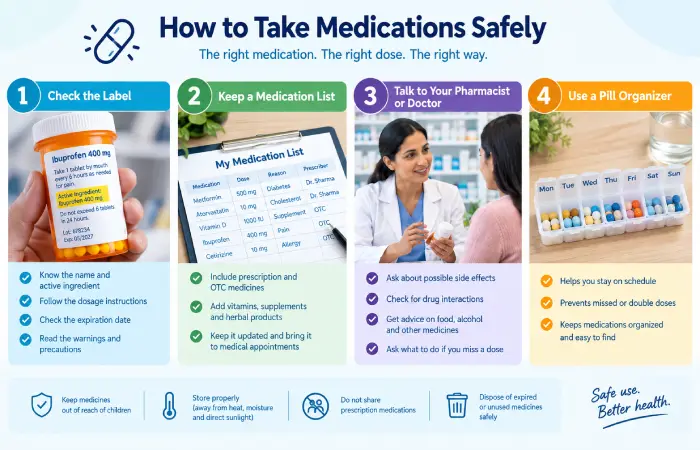
Use these practical steps whenever you take a medication.
Before taking it
Check:
-
- Name of the medication
- Active ingredient
- Why you are taking it
- Directions
- Warnings
- Allergies
- Potential interactions
- Expiration date
While taking it
Follow the instructions exactly.
Don’t think that an extra dose will make your medication work quicker, or that it will be a better treatment.
If you miss a dose, find out what you should do (refer to the medication’s instruction leaflet or ask a pharmacist) instead of automatically doubling up the next dose.
Keep a medication list
A simple medication list can contain:
| Information | Example |
| Medication | Generic name |
| Strength | As written on the label |
| Schedule | As prescribed |
| Reason | Condition/symptom |
| Prescriber | Doctor/clinic |
| Notes | Important precautions |
This becomes especially valuable when seeing multiple healthcare professionals.
Medication Safety for Older Adults
Older adults may take several medications simultaneously, increasing the possibility of drug interactions and cumulative side effects.
This is sometimes called polypharmacy.
Multiple medications can increase the likelihood of:
-
- Dizziness
- Confusion
- Falls
- Low blood pressure
- Drug interactions
- Duplicate therapy
Taking five or more drugs every day can raise your risk of having a fall; according to the Cleveland Clinic this could be due to medication effects being additive.
Taking time for a regular medicine review appointment with your health care practitioner is able to ascertain if you are taking every medication which is really needed.
Common Medication Errors To Sidestep
A number of the most predictable medication problems result from simple errors.
Error 1: Taking two items made with the very same ingredient
Check up active ingredients.
Error 2: Over-the-counter equate to safe
Review labels carefully, or ask your pharmacist.
Error 3: Utilizing someone else’s prescription
Use drugs only for your purpose.
Error 4: Using antibiotics for viral infections
Ask your medical doctor or health treatment company about the need for antibiotics.
Error 5: Disregarding negative effects
Record troublesome side effects.
Error 6: Missing out on supplements Ask health care staff about any herbal products and vitamins you consider along with any prescription or OTC drugs.
Error 7: Keep lapsed medications as well as medications with unknown contents
Utilize appropriate medication-disposal programs or locations to remove medications, if available.
How to Store Medications Properly
This will maintain good quality and minimize any possibility of accidental ingestion. Recommendations generally include:
- Medicines should be kept in their original containers where possible.
- Medications should be kept in accordance with the directions on the label
- Keep medicines away from children
- Store medicine away from hot or humid conditions unless instructions on label specify a different environment
- Don not allow temperature controlled drugs to remain outside this environment
- Keep your medicines clearly labeled.
- Avoid storing your drugs in the bathroom cabinet in areas that are humid, if stated so on the labeling.
- Some drugs need to be stored and transported in refrigerated or cooled conditions; this should be followed always.
Frequently Asked Questions About Common Medications
Which are the common medications?
The common medications are pain relievers, antihistamines, medicines used for digestion problems, for cough and cold, antibiotics, medicines for blood-pressure, cholesterol medicines and diabetes medicines. Which drugs are the most commonly used will differ from country, age groups and condition of health.
Which is the most common pain medicine?
Paracetemol/Acetaminophen, Nonsteroidal Anti-Inflammatories (NSAIDs) such as Ibuprofen and many other are some of the most common pain-relief medicines. Use will vary between cultures and countries.
Are the common medications safe?
A drug can be safe for use in one set of circumstances and detrimental in another set of circumstances according to correct use. Safety depends on the drug, dose rate, condition, other drugs and other circumstances.
What is the difference between a prescription drug and an over the counter (OTC) drug?
The prescription drugs needs a prescripion form from an appropriate health-care professional before the person concerned can have it whereas you can get OTC drugs without need of prescription. But this vary by country with its own regulations.
Can I take 2 common drugs together?
Sometimes, but not always. Drugs interact together in ways; while others might be having very similar chemical substance. Seek advice from a pharmacist or an appropriate health care professional before taking more drugs together when in uncertainty.
Can I take an OTC drug with prescription drugs?
Possibly, but depending on what the drugs are you are taking and you will need to ensure that the drugs will not affect or cause an adverse drug interaction and even more so with other prescription drugs.
Are common drugs for antibiotic?
Antibiotics are over-used prescription medicines and the correct used will benefit bacteria infections as other infections to which they were prescribed but are of no use with ordinary viral colds.
Can common drugs cause an allergic reaction?
Yes it can and are any drugs for that matter. Some of the well known are: antibiotic drugs,NSAIDs, other medicine groups can affect the human being with an allergic response such as asthma, swelling of throat requires urgent attention.
Why do some drugs cause drowsiness?
Some drugs can interfere with pathways of the nervous system or chemicals that regulate vigilance of alertness. Drugs like certain painkillers, first generation antihistamines and sleep-inducing drugs and certain anti-anxiety agents.
Should I stop taking my medicine if I feel better?
Not always, will depend on the particular condition and drugs being used. Certain drugs are short term while there are others that are meant for a long term period use and still continue once symptoms alleviate. You will need to keep following the treatment plan given unless advised otherwise by a healthcare professional who prescribe the drugs to stop taking them.
Should I store my medicine?
Follow instructions in your drugs packet or patient instructions that the pharmacist provide, and store the drugs away from children and animals, most drugs needs storing away from direct heat and light and moisture. While there are others that needs to be kept under cold and special temperature condition.
What should I do if I took to much of my medicine?
Do not wait for the symptoms of over dosage, ring your local poison-control centre immediately or call emergency medical service or an appropriate health-care professional for correct action to remain performed as your health would be more vital. Try to get your drug container with the medicine strength and package.
The Bottom Line
Common drugs include every day analgesics and allergy medications to medications for chronic disease, mental illness and other disorders, including cholesterol lowering medications, drugs for high blood pressure and diabetes, and psychotropic drugs.
The most significant thing to note is that drugs that are “common” are by no means common for you.
Before starting any medication you need to know: what it contains; why it works; how to take it; what warnings are particularly relevant to you-especially, if using many over-the-counter medications with another over-the-counter drugs-check for ingredients added so that there is duplicity; for any contra-indications or interactions, or allergies; and for existing health conditions.
Keeping a comprehensive up-to-date record of your medications and taking it with your doctor and pharmacist at your medication review appointment makes everyday drug use infinitely safer. Drugs shouldn’t be seen as an alternative to medical assessment if the symptoms you are experiencing are severe, long term, unusual or changing for the worse.
Afiya Jafar is a fitness and wellness writer who focuses on making health, exercise, and healthy lifestyle information simple and practical. Her work covers workouts, fitness motivation, strength training, nutrition, weight management, stress management, mindfulness, and everyday wellness.
Read Full Bio of Afiya Jafar →
Sameena Begum reviews selected health, wellness, fitness, and digital content for clarity, factual presentation, consistency, and reader usefulness. Her review work helps maintain clear and responsible editorial standards across PhysicalFitt content.
Read Full Bio of Sameena Begum →
Dr. Khizrana Begum is a qualified medical professional with MBBS and MD qualifications and 5+ years of experience in the medical field. She works as a General Physician and Dermatologist, with expertise in general medicine, dermatology, preventive healthcare, and skin health.
Read Full Bio of Dr. Khizrana Begum →