
 Afiya Jafar
Fitness & Wellness Writer
Afiya Jafar is a fitness and wellness writer who focuses on making health, exercise, and healthy lifestyle information simple and practical.
Read Full Bio of Author →
Afiya Jafar
Fitness & Wellness Writer
Afiya Jafar is a fitness and wellness writer who focuses on making health, exercise, and healthy lifestyle information simple and practical.
Read Full Bio of Author →
 Sameena Begum
Health, Fitness & Digital Content Reviewer
Sameena reviews selected health, wellness, fitness, and digital content for clarity, factual presentation, and reader usefulness.
Read Full Bio of Reviewer →
Sameena Begum
Health, Fitness & Digital Content Reviewer
Sameena reviews selected health, wellness, fitness, and digital content for clarity, factual presentation, and reader usefulness.
Read Full Bio of Reviewer →
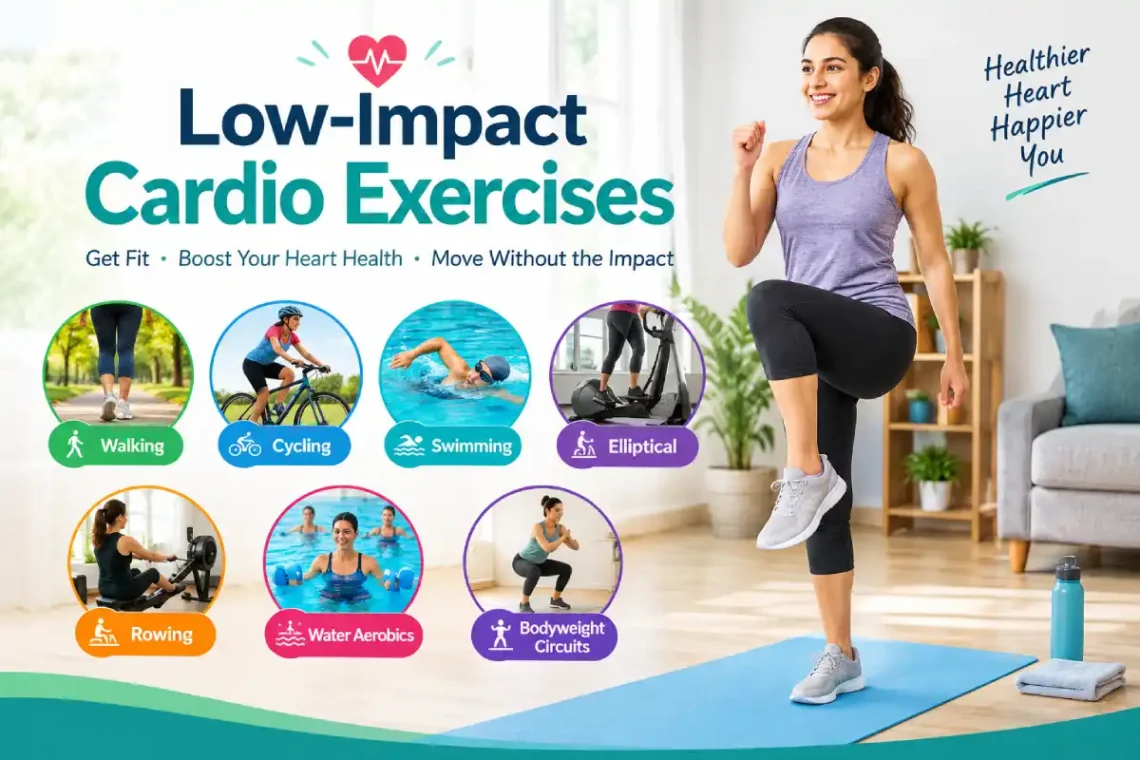
Calisthenics are the best low-impact cardio exercises you can do, whether you want to increase your heart rate, get fitter, or just stay active without all of the pounding that you get with running and jumping. Walks, cycles, swims, rows, elliptical trainer, and various bodyweight movements.
The key is that low impact does not mean low intensity. Several of these exercises can be made more difficult by increasing speed, resistance, incline or time spent exercising. A similar differentiation exists between joint impact and cardiac intensity, according to Cleveland Clinic specialists.
What Is Low-Impact Cardio?
Cardio that makes less of an impact on the joints or has less impact per repeat of the motion. Running creates a pounding on your joints, but walking still puts your feet on the ground so it has less impact, and swimming has little impact at all because the water takes your weight. Other options include cycling, rowing and the elliptical.This makes low-impact cardio useful for:
-
- Beginners getting started with exercise
- People returning to exercise after a break
- People who prefer joint-friendly workouts
- Older adults
- Athletes using cardio for cross-training
- People looking for alternatives to running and jumping
Based on the injury, longer term condition or major joint symptoms, the suitable type and how hard you exercise may be different. Because of a chronic condition or disability, speak to your health care provider about your physical activity.
7 Best Low-Impact Cardio Exercises
Brisk Walking
Walkindo so are among the easiest ways to do low-impact cardio since you need minimal or no equipment.
Begin at a slow speed and build up from there. You can also walk up a hill or use a treadmill with an incline.
Best for: Beginners, outdoor workouts, everyday fitness.
Cycling
Cycling can be done indoor on a stationary bike, or outside. Both offer the benefit of raising your heart rate, and in addition to that benefit, when on a bike, the lower joints don’t have to absorb the constant impact of landing each stride.
Best for: Home cardio, endurance training, and anyone who loves to use equipment.
Swimming
Because water supports your body during exercise, it can be a good joint-friendly cardio exercise option. Each stroke can also give you a workout for your entire body.
Who it’s best for: Individuals who prefer water exercise and seek least amount of joint stress.
Elliptical Training
Instead of having the same foot strikes over and over like running.
You can raise the resistance or speed as you get into better shape.
Hits the spot: You go to the gym but are eager for a more demanding cardio workout (and one that is gentler on the joints).
Rowing
Rowing involves a full body workout with both upper and lower body motion and the seated position. It offers a serious aerobic workout while minimising the impact of repeated running.
Technique: Especially when you begin using higher resistance levels or spend more time working out.
Best for: Full body cardio and those who are OK using equipment at the gym.
Water Aerobics
What it is: Water aerobics is the use of aerobic exercise in the water. This exercise is usually in a pool and one can vary intensity and is an alternative to high-impact exercise.
Who it’s good for: Beginners, seniors, and anyone that gets bored in the gym.
Low-Impact Bodyweight Circuits
You don’t necessarily need a machine for effective low-impact cardio.
Exercises such as:
-
- Step jacks
- Squat-to-reaches
- Standing knee drives
- Squat taps
- Marching in place
- Alternating punches
can be performed continuously to raise your heart rate.
A couple of recent articles from 2026 fitness sites including Healthline and SELF have called out bodyweight circuits as good low-impact cardio options without any jumping.
Low-Impact Cardio Exercise Comparison
| Exercise | Joint Impact | Equipment | Cardio Potential | Beginner Friendly |
| Walking | Low | None | Moderate–High | ★★★★★ |
| Cycling | Very low | Bike | Moderate–High | ★★★★★ |
| Swimming | Very low | Pool | Moderate–High | ★★★★☆ |
| Elliptical | Very low | Machine | High | ★★★★☆ |
| Rowing | Very low | Rower | High | ★★★☆☆ |
| Water aerobics | Very low | Pool | Moderate | ★★★★★ |
| Bodyweight circuit | Low | None | Moderate–High | ★★★★☆ |
These are helpful relative comparisons, not clinical measurements. Your true intensity and load on the joints depend on your technique, fitness level, speed, resistance, terrain, and your personal situation.
How Much Low-Impact Cardio Should You Do?
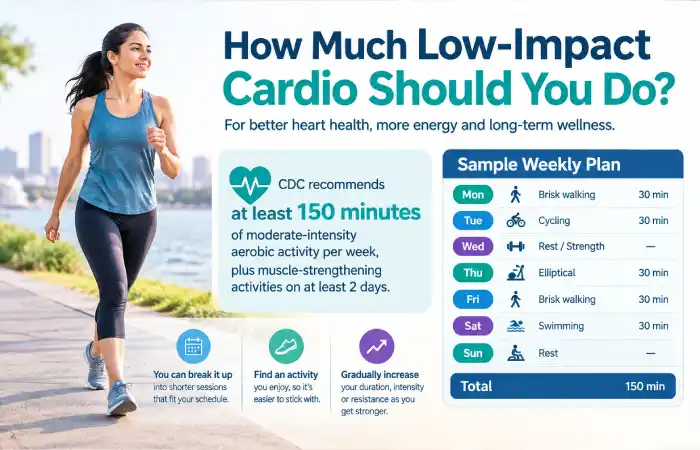
For all adults, CDC recommends at least 150 minutes of moderate-intensity aerobic activity, such as brisk walking, or at least two days of muscle-strengthening activities a week. You can spread out those minutes throughout the week instead of doing them all at once. For example:
| Day | Time | Activity |
| Monday | 30 min | Brisk walking |
| Tuesday | 30 min | Cycling |
| Wednesday | — | Rest/strength |
| Thursday | 30 min | Elliptical |
| Friday | 30 min | Brisk walking |
| Saturday | 30 min | Swimming |
| Sunday | — | Rest |
| Total | 150 min | Moderate cardio |
You can also break exercise into shorter sessions that fit your schedule.
How to Make Low-Impact Cardio More Effective
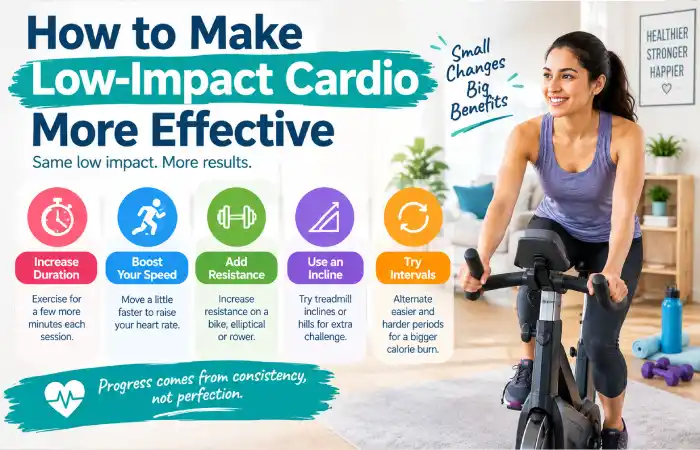
If your workout becomes too easy, you don’t necessarily need to switch to high-impact exercise.
Instead, gradually increase:
Duration: Exercise for a few more minutes.
Speed: Walk or cycle faster.
Resistance: Increase resistance on a bike, elliptical, or rower.
Incline: Add an incline to treadmill walking.
Intervals: Mix some easier periods with more challenging periods.
Basically it’s impact versus intensity. A low-impact exercise can demand a lot from your cardio-respiratory system.
Low-Impact Cardio at Home
You can build an effective home routine without expensive equipment.
Try this beginner circuit:
-
- March in place — 60 seconds
- Step jacks — 45 seconds
- Squat to reach — 45 seconds
- Alternating knee drives — 45 seconds
- Standing punches — 45 seconds
- Rest — 60 seconds
Repeat for 2–3 rounds according to your fitness level.
Keep movements controlled and focus on maintaining good form rather than trying to move as quickly as possible.
Final Takeaway
You can find high-impact and low-impact cardio workouts to help you get your cardiovascular health on par with less pounding on your joints. Activities such as walking, cycling, swimming, elliptical trainer, rowing, water aerobics and low-impact body-weight circuit training are a few of the choices.
Instead of obsessing over the “best” type of exercise, pick an activity that you can do regularly, that you can do all year and that you can increase in intensity slowly. For most beginners, consistency, intensity, technique, and recovery will be more beneficial than trying the newest workout.
Afiya Jafar is a fitness and wellness writer who focuses on making health, exercise, and healthy lifestyle information simple and practical. Her work covers workouts, fitness motivation, strength training, nutrition, weight management, stress management, mindfulness, and everyday wellness.
Read full bio of Afiya Jafar
Sameena reviews selected health, wellness, fitness, and digital content for clarity, factual presentation, and reader usefulness.
Read full bio of Sameena Begum