

 Afiya Jafar
Fitness & Wellness Writer
Afiya Jafar is a fitness and wellness writer who focuses on making health, exercise, and healthy lifestyle information simple and practical.
Read Full Bio of Author →
Afiya Jafar
Fitness & Wellness Writer
Afiya Jafar is a fitness and wellness writer who focuses on making health, exercise, and healthy lifestyle information simple and practical.
Read Full Bio of Author →
 Sameena Begum
Health, Fitness & Digital Content Reviewer
Sameena reviews selected health, wellness, fitness, and digital content for clarity, factual presentation, and reader usefulness.
Read Full Bio of Reviewer →
Sameena Begum
Health, Fitness & Digital Content Reviewer
Sameena reviews selected health, wellness, fitness, and digital content for clarity, factual presentation, and reader usefulness.
Read Full Bio of Reviewer →
If you want to know the best possible time to run a 5K the straightforward answer is that it depends on your age, running background and fitness, the course you‘re running on, weather conditions, and whether this is your first ever race, or you‘re aiming for a personal best. 5K is 5KiloMetres, approximately 3.1miles 5K appeals to complete novices as well as seasoned athletes.
Time-wise, a 5K should take about 30–45 minutes at the bottom end for a beginner. Between 25–35 minutes is typical for an experienced recreational runner and sub 20 minutes is significantly faster for a recreational performance. These are not absolutes more like guidelines, not pass-fail;
What Is a Good Time to Run a 5K?
There is not one number that determines a good 5 K time.
That‘s why the latest running figures are so. PandaRun‘s September, 2026, analysis of 1,878,446 finishers in 5,859 American competitions puts its middle point at 36:12. The 25th percentile is 29:01.
Some other data sources give quicker figures. Runner‘s World reports that in the same period, average Strava marathon uploads worldwide between September 2023 and August 2024 was 28:30 significantly faster than the earlier RunRepeat race-result database, which is 39:02.
2026 5K benchmark guide
| 5K finish | Pace per km | Practical context | Pace per mile |
| 45:00 | 9:00/km | Beginner/run-walk range | 14:29/mi |
| 40:00 | 8:00/km | Solid first-race target | 12:52/mi |
| 35:00 | 7:00/km | Recreational range | 11:16/mi |
| 30:00 | 6:00/km | Popular improvement goal | 9:39/mi |
| 25:00 | 5:00/km | Strong recreational performance | 8:03/mi |
| 20:00 | 4:00/km | Advanced recreational benchmark | 6:26/mi |
| 18:00 | 3:36/km | Highly trained recreational level | 5:48/mi |
These ranges are best used as benchmarks, not rigid classifications.
What Is a Good 5K Time for a Beginner?
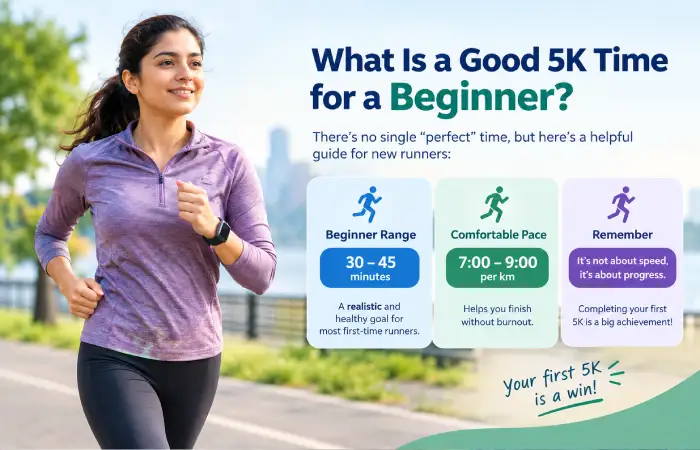
Don‘t define your success by finishing in a time of less than 30 minutes if this is your first 5K.
For a first 5K, 35–45 minutes can be a perfectly reasonable goal. Some runners are just plain fast, while other runners may take 45–60 minutes or break the run into walk-run periods.
According to Runner‘s World, you may want to first simply aim to finish a certain distance for your first race. You may also want to use a mile time trial to create a more individualized goal prior to beginning a training program.
A useful beginner progression is:
Complete 5K → finish comfortably → establish a baseline → improve gradually.
Your second or third 5K is usually a much better time to start chasing a specific performance target.
Average 5K Time by Age
Age can influence running performance, but age alone doesn’t determine what you should be able to run.
NerdRunner’s current race-result analysis shows median 5K times gradually increasing with age:
| Age | Median 5K time* |
| Under 20 | 32:57 |
| 20–29 | 34:08 |
| 30–39 | 35:35 |
| 40–49 | 36:24 |
| 50–59 | 40:01 |
| 60–69 | 44:25 |
| 70+ | 48:59 |
*Includes both males and females in the data set. (these are median values, not recommended targets.)
Different data sets disaggregate by sex, age, so on and gives different numbers. Runked, for instance, gives overall median times around 31:28 for men, 37:28 for women and stress that there are meaningful differences based on experience and age.
Hence it can be unhelpful to compare your 5K your time with other people without knowing what they are about.
5K Pace Chart: What Time Should You Aim For?
Knowing the required pace makes your goal much easier to understand.
| Goal | Required pace/mile | Required pace/km |
| 45 minutes | 14:29 | 9:00 |
| 40 minutes | 12:52 | 8:00 |
| 35 minutes | 11:16 | 7:00 |
| 30 minutes | 9:39 | 6:00 |
| 27:30 | 8:51 | 5:30 |
| 25 minutes | 8:03 | 5:00 |
| 22:30 | 7:15 | 4:30 |
| 20 minutes | 6:26 | 4:00 |
Thus, to complete a 5K in thirty minutes one must run each kilometer about 6:00.
A common mistake beginning runners do is to go through the first kilometer too fast. Negotiating an easy first kilometer should increase your chances of running equally well for the second.
Is a 30-Minute 5K Good?

For many recreational runners, 30 minutes is a useful milestone because it requires holding 6:00/km for the entire race.
It is also easy to measure during training:
- 1 km: 6:00
- 2 km: 12:00
- 3 km: 18:00
- 4 km: 24:00
- 5 km: 30:00
But don’t assume that everyone should reach 30 minutes. A 30-minute 5K can represent a major achievement for one runner and an easy training run for another.
The more meaningful question is:
How does your current 5K compare with your previous 5K?
If you’ve improved from 42 minutes to 36 minutes, that’s significant progress even though you’re still above the 30-minute mark.
Is a 25-Minute 5K Good?
A 25-minute 5K is a pace of exactly 5:00/km, or approximately 8:03/mile.
Which is well above the standard beginner range, and provides a reasonable recreational running standard.
Though it does not specify how many stories Runked uses for broad race populations, the 25-minute mark is roughly the 80 th percentile.
Ok, where do we stand? So was that fast? Let‘s see if we can make some sense out of it. Our normal time ha s a normal 5K time of b 5sec. So is any good? Easy? Anyway, if we go to the calculator, we come across the equation.
A sub-20 5K has to be closer to 4:00/km or 6:26/mile.
That‘s a serious exercise running goal and by and large it takes regular training rather than just giving yourself a hard time on race day.
To put this into context, the current world athletics road 5 km records are significantly quicker then most recreational test levels. They are 12:49 for men and 13:54 for women. The winner of the men‘s 5 km at the 2006 World athletics road running championships ran 12:56.
We therefore should not use world-class performances as a standard for normal runners.
What Affects Your 5K Time?
Your finishing times will vary considerably from race to race.
Training
If you train regularly, your aerobic ability will gradually develop to be able to sustain the pace. Runner‘s World suggest that you should mix regular easy running sessions with speed and tempo sessions, which are in longer durations instead of running races in every workout.
The skills and techniques of the beginning motoring writer evolve constantly. Age and experience play an important part.
Someone who has just started running and someone who has trained for several years systematically should not have the same objective.
Course
A flat and precisely measured golf course can have as big as an effect as the interior route involving twists, turns, and hills.
Weather
Warmth and humidity levels may put more stress on the body when trying to maintain pace during your race. The American College of Sports Medicine suggests decreasing intensity and duration of exercise during abrupt heat exposure and exercising during the cooler times of the day when the environment carries a higher risk of heat impairment.
Pacing
Beginning too quickly sets yourself up for a demise in your finishing minutes. One mistake: finishing your race in the last 1–2 kilometers, because you‘re attempting to run at too high a pace.
The Bottom Line: What Is a Good 5K Time?
The best time to run a 5K is subjective.
A reasonable first-race range would be 35–45 minutes for a beginner. About 30 minutes is a common recreational time, 25 minutes a better recreational time and sub-20 a far more competitive training time.
The best indicator, I think, is your own development, this will be the most reliable measurement.
If your first 5K was 42 minutes and your next 38, you‘re ahead of the game. If you improve to 35, 30 or 25 minutes, those will be new benchmarks, not requirements.
Let population averages guide you through the running maze, but determine what “good” can be, based on your past performances, current training and race conditions.
Afiya Jafar is a fitness and wellness writer who focuses on making health, exercise, and healthy lifestyle information simple and practical. Her work covers workouts, fitness motivation, strength training, nutrition, weight management, stress management, mindfulness, and everyday wellness.
Read full bio of Afiya Jafar
Sameena reviews selected health, wellness, fitness, and digital content for clarity, factual presentation, and reader usefulness.
Read full bio of Sameena Begum