
 Afiya Jafar
Fitness & Wellness Writer
Afiya Jafar is a fitness and wellness writer who focuses on making health, exercise, and healthy lifestyle information simple and practical.
Read Full Bio of Author →
Afiya Jafar
Fitness & Wellness Writer
Afiya Jafar is a fitness and wellness writer who focuses on making health, exercise, and healthy lifestyle information simple and practical.
Read Full Bio of Author →
 Sameena Begum
Health, Fitness & Digital Content Reviewer
Sameena reviews selected health, wellness, fitness, and digital content for clarity, factual presentation, and reader usefulness.
Read Full Bio of Reviewer →
Sameena Begum
Health, Fitness & Digital Content Reviewer
Sameena reviews selected health, wellness, fitness, and digital content for clarity, factual presentation, and reader usefulness.
Read Full Bio of Reviewer →
No gym? No problem! You don’t need gym access or $50K of gear to raise the heart rate. You can go anywhere and do anything – march in place, dance, run up and down the stairs, or do a bodyweight circuit. Your living room can be a bustling area of activity to get your heart into overdrive, boost endurance and stay active.
Just don’t go hard every time. Pick some moves that are appropriate for you and that you can keep at consistently.
What Is Cardio at Home?
Cardio, also known as cardio respiratory exercise, is any exercise that increases your heart rate and works your body’s cardiorespiratory system. Typically, many types of cardio workouts can be performed at home by utilizing bodyweight, running or jogging in place, jump roping, dancing, performing a stair workout or following a workout video.
You might not even require any gear, as most of you can find a variety of them presently: within each room, they require no components to be moved. As recommended by today’s CDC, do at least 150 minutes a week of working out for your personal wellbeing, aside from two or more days of at least some-body weight exercises.
How much cardio should you do?
| Goal | Practical starting point |
| New to exercise | 10–20 minutes, 3 days/week |
| Building consistency | 20–30 minutes, 3–5 days/week |
| General adult activity target | At least 150 minutes moderate activity/week |
| Vigorous alternative | 75 minutes vigorous activity/week |
| Additional fitness | Gradually increase duration or intensity |
This is not an individualised exercise prescription, it is simply a guideline. Remember, CDC has warned that some physical activity is better than no activity.
Best Cardio Exercises at Home
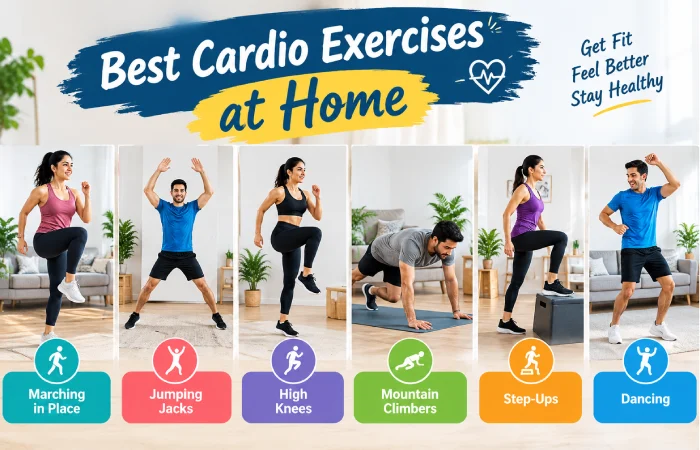
Build an easy-to-follow routine with these simple moves.
Marching in Place
One of the most basic ways to get started – simply stand tall and take comfortable marches with your knees and arm swings. Make it more challenging – speed up or march higher.
Jumping Jacks
Jumping jacks will give your full body a good workout and quickly get your heart rate up.
High Knees
Run or march in place while bringing your knees upward. Beginners can use a slower marching version.
Butt Kicks
Alternate bringing your heels up to your glutes while pumping your arms.
Step-Ups
If you have a solid, secure step or set of stairs to hand, a controlled step up can be a fun, low impact form of cardio challenge. Ensure the surface is solid before beginning.
Dancing can be a low-impact way to make cardio more fun and customizable to just about any ability level.
Mountain Climbers
Begin in a plank position, raise your knees alternately towards the chest (slow it down if necessary) or if you are a beginner, jump onto a raised platform.
Burpees
Many of the types of body-weight movements many health and fitness pros recommend as cardio at home are high knees, jumping, mountain climbers, running in place, and dancing.
A Simple 20-Minute Cardio Workout at Home
If you are looking for something more structured, try this beginner-friendly format:
| Exercise | Time |
| March in place | 2 minutes |
| Step jacks | 45 seconds |
| Rest/easy movement | 15 seconds |
| Bodyweight squats | 45 seconds |
| Rest | 15 seconds |
| High-knee march | 45 seconds |
| Rest | 15 seconds |
| Shadow boxing | 45 seconds |
| Rest | 15 seconds |
| Repeat circuit | 2–3 rounds |
| Easy movement/cool-down | 2–3 minutes |
Keep the intensity moderate enough that you can control your breathing and technique.
For moderate-intensity activity, a useful general indicator is that you can talk but not sing while exercising.
Low-Impact Cardio at Home
Not everyone needs jumping exercises.
If jumping feels uncomfortable, replace high-impact movements with:
- Marching
- Step jacks
- Side steps
- Low-impact high knees
- Walking laps around your home
- Controlled step-ups
- Standing punches
- Dancing without jumps
Low-impact modifications are also commonly provided in established home-workout programs.
This makes home cardio easier to adapt to different fitness levels.
Can You Do Cardio at Home Without Equipment?
Yes. The majority of cardio exercises can be performed with just enough space to move without safety concerns. Equipment is great for variety.
Jumping rope for instance, can ramp up the difficulty. Treadmill or stationary bikes offer predictable cardio. A smart watch or heart-rate monitor can be useful for some but isn’t necessary and doesn’t need to be purchased to begin.
For many beginners, there is time to invest in equipment once you get into a routine.
How to Make Home Cardio More Effective
Use these principles to progress without making every workout harder:
- Start gradually. Increase your workout time as your fitness improves.
- Improve consistency. Regular shorter sessions can be easier to maintain than occasional exhausting workouts.
- Increase intensity slowly. Move faster or choose a harder variation when the current routine becomes comfortable.
- Use intervals. Alternate periods of faster movement with easier recovery.
- Add strength training. Cardio is only one part of a balanced fitness routine.
- Keep exercises varied. Combining movements can make workouts more engaging.
The CDC recommends both aerobic activity and muscle-strengthening activity as part of an adult’s weekly routine.
Cardio at Home: Exercise Comparison
| Exercise | Space needed | Equipment | Impact | Beginner-friendly |
| Marching | Very small | None | Low | Yes |
| Step jacks | Small | None | Low | Yes |
| Dancing | Small–medium | None | Low–moderate | Yes |
| High knees | Small | None | Moderate | Yes, modified |
| Jumping jacks | Small | None | Moderate | Yes, modified |
| Step-ups | Small | Step/stairs | Moderate | Yes |
| Mountain climbers | Small | None | Moderate–high | With modification |
| Burpees | Medium | None | High | Better for experienced users |
| Jump rope | Medium | Rope | Moderate–high | With practice |
Important: Exercise intensity varies by person. A movement that feels moderate to one person may feel vigorous to another.
Common Home Cardio Mistakes
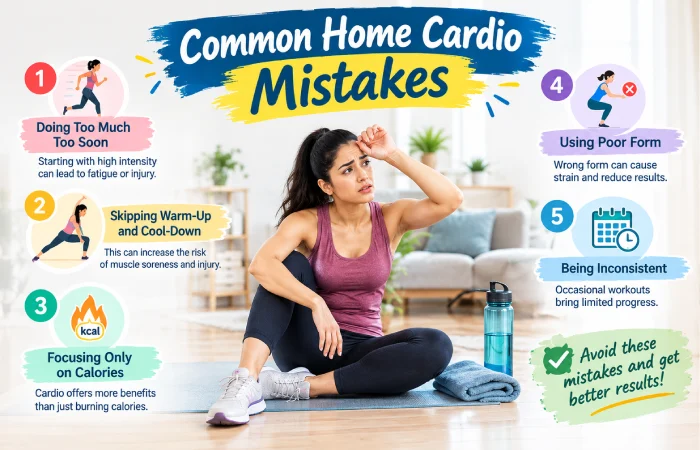
Trying to do too much, too quickly
You don’t have to jump into a 30-minute or 45-minute high-intensity training. Ease into it to make a more maintainable approach.
Forgetting warm-up and cool-down
Spend time warming up before the toughest part of your workout and take time to cool down afterward.
Concentrating exclusively on calories
Cardio can do more than burn calories.
For example, it can also promote cardiovascular and general activity levels.
Moving poorly
Fast movement shouldn’t come at the cost of control.
Slow down when you can’t maintain good technique.
Safety Tips for Cardio at Home
– Remove obstacles from the space where you will exercise, wear supportive shoes if necessary and use a sturdy chair if you plan to do seated step exercises.
– If you are a beginner, select an activity that is right for your current fitness level.
– If you have a chronic condition or disability or if you have concerns about beginning an exercise program, discuss them with your healthcare provider.
(CDC recommends that people with chronic conditions or disabilities talk with their healthcare provider.) If you experience any warning signs – including chest pain, excessive breathlessness and fainting – stop exercising and seek medical help immediately.
Final Takeaway
You can make at-home cardio simple, cheap and versatile. You can begin with no equipment, little room, and a few seconds of movement. Use things like marching, step jacks, dance or high knees, then increase your time or intensity as you get stronger.
In order for this pillar to get the most topical juice, it needs to internally link to all supporting articles related to beginner cardio, low-impact cardio, HIIT, weight loss, weight control, home gym equipment, cardio frequency and home workout safety.
Afiya Jafar is a fitness and wellness writer who focuses on making health, exercise, and healthy lifestyle information simple and practical. Her work covers workouts, fitness motivation, strength training, nutrition, weight management, stress management, mindfulness, and everyday wellness.
Read full bio of Afiya Jafar
Sameena reviews selected health, wellness, fitness, and digital content for clarity, factual presentation, and reader usefulness.
Read full bio of Sameena Begum