
 Afiya Jafar
Fitness & Wellness Writer
Afiya Jafar is a fitness and wellness writer who focuses on making health, exercise, and healthy lifestyle information simple and practical.
Read Full Bio of Author →
Afiya Jafar
Fitness & Wellness Writer
Afiya Jafar is a fitness and wellness writer who focuses on making health, exercise, and healthy lifestyle information simple and practical.
Read Full Bio of Author →
 Sameena Begum
Health, Fitness & Digital Content Reviewer
Sameena reviews selected health, wellness, fitness, and digital content for clarity, factual presentation, and reader usefulness.
Read Full Bio of Reviewer →
Sameena Begum
Health, Fitness & Digital Content Reviewer
Sameena reviews selected health, wellness, fitness, and digital content for clarity, factual presentation, and reader usefulness.
Read Full Bio of Reviewer →
 Dr. Khizrana Begum
General Physician & Dermatologist
Dr. Khizrana Begum is a General Physician and Dermatologist with MBBS and MD qualifications and 5+ years of experience in the medical field.
Read Full Bio of Medical Reviewer →
Dr. Khizrana Begum
General Physician & Dermatologist
Dr. Khizrana Begum is a General Physician and Dermatologist with MBBS and MD qualifications and 5+ years of experience in the medical field.
Read Full Bio of Medical Reviewer →
Mindfulness in relation to anxiety is a practical tool that helps build awareness of what you think, feel, what your body is doing, and your surroundings – not to pass judgment or get carried away, but simply to observe. There’s no expectation to rid oneself of anxious thoughts with this practice; rather, to be able to acknowledge the feelings then gently bring your mind back.1
Studies show that while Mindfulness-based methods can offer up to small or moderate effects on anxiety symptoms, it may not be the be all and end all cure; it’s not a recommended method to practice when experiencing moderate to extreme anxiety, replacing professional help.
When starting out, the practice does not involve ‘clearing’ your mind. All that matters is to be in touch with what is going on around you and bring back the focus as needed.
Mindfulness can be a helpful practice for managing anxious thoughts and becoming more aware of emotions without immediately reacting to them. If you are new to the practice, start with this guide to mindfulness and how it works.
❝
This article is a part of
Mindfulness Hub
Understanding Anxiety
Anxiety is your body’s response to feeling threatened or that your life is uncertain or stressful. Anxiety is a perfectly normal thing to feel every now and again, but an anxiety disorder may lead you to worry too much or all of the time, getting in the way of how you live your life.
Anxiety and stress are often closely connected, and learning to recognize stressful thoughts and physical sensations can be an important part of managing them. Explore mindfulness for stress relief for practical ways to use mindfulness when everyday pressure begins to build.
Common experiences include:
- Racing or repetitive thoughts
- Restlessness
- Muscle tension
- Difficulty concentrating
- Irritability
- Sleep problems
- Rapid heartbeat
- Feeling constantly “on alert”
One way to find that mindfulness can be helpful is that we tend to get stuck at the edges of time. We replay the same event from yesterday over and over in our heads, or we spend our time imagining things that have not yet happened and possibly will not happen. Being with our experience in mindfulness- mindfulness practice helps to bring our attention to the present moment.
According to the National Center for Complementary and Integrative Health “Studies suggest mindfulness and meditation may have small to modest benefits for some anxiety-related symptoms although studies are inconsistent for different types of anxiety disorders.”
How Mindfulness Helps Anxiety
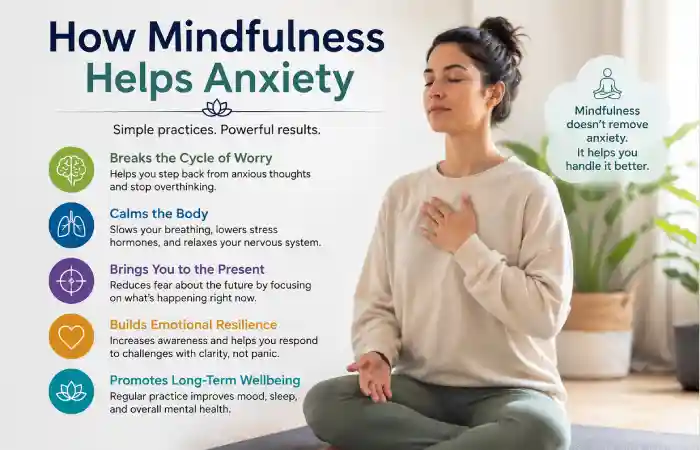
Mindfulness practice actually creates space between you and your anxious thoughts, in a way that allows you to relate to them, rather than get lost in them.
Anxiety can sometimes make it difficult to relax at night or settle a busy mind before bed. Developing a calming mindfulness routine may support relaxation and a healthier bedtime routine. Learn more about mindfulness for better sleep.
- It creates distance from anxious thoughts
Instead of thinking:
“Something terrible is going to happen.”
You learn to recognize:
I feel as though something really bad is going to happen.” That minor change may reduce the tendency to accept anxious thoughts as facts automatically..
- It improves present-moment awareness
Anxiety is a process that typically draws the attention to what might happen in the future. Using the feet, breathing, sounds, or your environment as an anchor for your attention will bring that focus back to the here and now
- It increases awareness of physical tension
When you scan your body for tenseness-such as tight shoulders, clenches jaw or feet, stomach aches or hyper breathing, you catch such sensations earlier-which allows you to address it before the pain becomes overwhelming.
- It encourages a less judgmental response
Anxiety doesn’t mean you tell yourself, “this is okay, and this is fine” it mean acknowledging there is anxiety, that it is here, and not criticizing the anxiety, or yourself for having the anxiety.
Research is continuing to develop for mindfulness-based therapies; studies suggest it the change in the relationship to thought or emotion might reduce the expression of symptoms related to the anxiety.
Grounding Techniques
Grounding is helpful whenever thoughts become over whelming or there is excessive anticipatory anxiety. Instead of seeking an explanation for why you feel this way, the focus is on redirecting the awareness back to your senses and immediate environment.
Breathing can provide a simple focus when anxious thoughts become overwhelming. Bringing your attention to each breath can help you return your focus to the present moment. Try these mindfulness breathing techniques as part of your daily practice.
The 5-4-3-2-1 Technique
Identify:
- 5 things you can see
- 4 things you can physically feel
- 3 things you can hear
- 2 things you can smell
- 1 thing you can taste
Move slowly rather than rushing through the list.
Three-Breath Grounding
Try this simple version:
- Sit or stand comfortably.
- Notice one complete breath.
- Feel your feet against the floor.
- Take another slow breath and notice your shoulders.
- Take a third breath while observing the sounds around you.
- Open your attention to the whole environment.
The objective isn’t to force anxiety to disappear. It is to give your attention somewhere stable to rest.
Guided Mindfulness Exercises
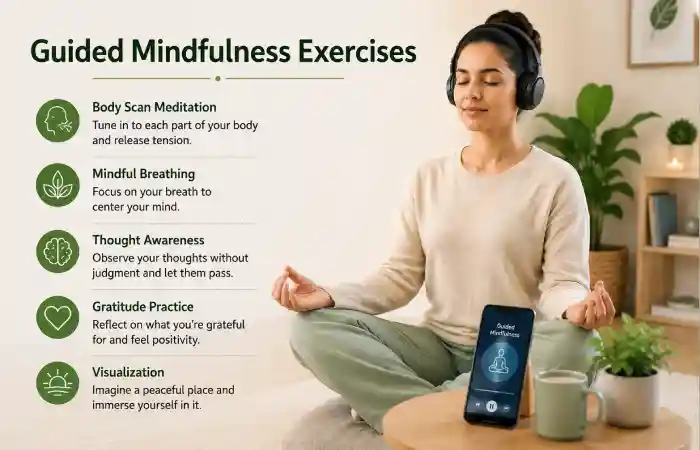
You don’t need a 30-minute meditation session to begin. Short, consistent practices are often easier for beginners to maintain.
1-Minute Mindful Breathing
Sit comfortably and notice your natural breathing.
Don’t try to breathe perfectly.
Simply notice:
Inhale → pause naturally → exhale → repeat.
When your mind wanders, acknowledge it and return to the breath.
5-Minute Body Scan
Start with your feet and slowly move your attention upward.
Notice:
- Pressure
- Warmth or coolness
- Muscle tension
- Tingling
- Heaviness
- Relaxation
You don’t have to change what you notice.
Mindful Walking
Walk slowly for several minutes.
Pay attention to:
- Your feet touching the ground
- The movement of your legs
- Your breathing
- Sounds around you
- Temperature and airflow
For many people, anxiety and stress can also arise during the working day. Practicing mindful awareness while handling tasks, conversations, and workplace pressure can help you respond more intentionally. Discover practical strategies for mindfulness at work.
This can be a good alternative if closing your eyes or sitting still makes you more uncomfortable.
Mindful Thought Labeling
When a thought appears, give it a simple label:
- “Worry”
- “Planning”
- “Remembering”
- “Fear”
- “Judging”
Then return your attention to your chosen anchor.
This technique helps separate the experience of having a thought from automatically following the thought.
A Simple Beginner Routine
| Time | Practice |
| Morning | 2–5 minutes of breathing |
| Afternoon | 1-minute sensory grounding |
| Evening | 5-minute body scan |
| Weekly | One longer guided meditation if comfortable |
NHS guidance also recommends making meditation a regular part of your routine rather than treating it as something you only do during stressful moments.
Mindfulness Apps: What Should You Choose?
Apps can help promote regular mindfulness. But a study on the category of mindfulness apps isn’t a validation of each individual app for anxiety. A 2024 meta-analysis of 45 randomized trials shows overall, modest benefits.
Mindfulness and meditation are related practices, but they are not identical. Understanding the differences can help you decide which approach or combination of practices fits your needs. Read this guide to mindfulness vs. meditation.
| Option | Strength | Good For |
| Headspace | Structured guided programs and short anxiety exercises | Beginners who want a clear pathway |
| Insight Timer | Large library and free meditation resources | People who want lots of choice |
| General meditation timer | Minimal distractions | Experienced users who prefer self-guided practice |
For example, Headspace currently offers anxiety-focused programs and short exercises, while Insight Timer provides a large collection of anxiety-related guided practices.
Best choice: choose the option you can use consistently without feeling pressured or overwhelmed.
Long-Term Benefits
Mindfulness is more useful when treated as a skill rather than an emergency button.
With regular practice, potential benefits include:
- Better awareness of anxious thought patterns
- Improved ability to pause before reacting
- Greater awareness of physical tension
- Better stress-management skills
- Increased present-moment attention
- Improved ability to tolerate uncomfortable emotions
The strongest evidence is for relief from symptom burden and stress, not for permanently eradicating the anxiety. The NCCIH , however, indicates that mindfulness could help as an adjunct, and it explains there is differential evidence for different conditions.
FAQs
Does mindfulness help with anxiety?
You can! There is research showing mindfulness-based approaches may lower symptoms of anxiety and evidence supporting a small to moderate effect of these practices.
These shouldn’t be presented as guaranteed fixes, however.
What do you want me to be mindful about?
For how long do I want to be mindful for anxiety? Start with a 1-5 minute practice session once per day and increase with the duration as you feel more at ease with practicing Mindfulness has better results than psychotherapy for anxiety? There’s no simple “yes” or “no” here, as it varies from person to person.
Evidence-based psychotherapies, such as Cognitive Behavioral Therapy (CBT), have consistently been demonstrated as effective treatments for anxiety disorders.
Mindfulness is a useful supplementary therapy and a very effective tool for patients as self-regulation.
Can mindfulness stops a panic attack?
While mindfulness practices might help some people engage with the physical manifestations of a panic attack differently, mindfulness should never be touted as a definitive stop to a panic attack; in severe distress, professional intervention may be more appropriate in addition to grounding exercises.
What is the easiest way for beginners to be mindful?
You may begin with one minute of natural breath awareness, a 5-4-3-2-1 exercise, or focus on sounds you’re hearing all around you if breath awareness leads to anxiety.
How immediately does Mindfulness working?
Some notice an immediate sense of calm, while others don’t realize the positive results of mindfulness until much later.
These differences can occur.
Final Takeaway
Think of mindfulness as how you react and relates to your anxious thought patterns, emotions and physical symptoms. Instead of each one of these unpleasant experiences feeling like you need to fight it off, it involves learning to notice, ground yourself into the present and select a mindful way of reacting.
The evidence thus far for mindfulness for anxiety as an effective strategy is more convincing for anxiety as a complementary form of treatment and should not serve as substitute for traditional treatment for those suffering with an anxiety disorder.
So for beginners, just keep it simple: Just 1-5 mins a day. 1 technique.
There’s not requirement for this in order for you to feel instantly at peace in your mind.
Afiya Jafar is a fitness and wellness writer who focuses on making health, exercise, and healthy lifestyle information simple and practical. Her work covers workouts, fitness motivation, strength training, nutrition, weight management, stress management, mindfulness, and everyday wellness.
Read Full Bio of Afiya Jafar →
Sameena Begum reviews selected health, wellness, fitness, and digital content for clarity, factual presentation, consistency, and reader usefulness. Her review work helps maintain clear and responsible editorial standards across PhysicalFitt content.
Read Full Bio of Sameena Begum →
Dr. Khizrana Begum is a qualified medical professional with MBBS and MD qualifications and 5+ years of experience in the medical field. She works as a General Physician and Dermatologist, with expertise in general medicine, dermatology, preventive healthcare, and skin health.
Read Full Bio of Dr. Khizrana Begum →