
 Afiya Jafar
Fitness & Wellness Writer
Afiya Jafar is a fitness and wellness writer who focuses on making health, exercise, and healthy lifestyle information simple and practical.
Read Full Bio of Author →
Afiya Jafar
Fitness & Wellness Writer
Afiya Jafar is a fitness and wellness writer who focuses on making health, exercise, and healthy lifestyle information simple and practical.
Read Full Bio of Author →
 Sameena Begum
Health, Fitness & Digital Content Reviewer
Sameena reviews selected health, wellness, fitness, and digital content for clarity, factual presentation, and reader usefulness.
Read Full Bio of Reviewer →
Sameena Begum
Health, Fitness & Digital Content Reviewer
Sameena reviews selected health, wellness, fitness, and digital content for clarity, factual presentation, and reader usefulness.
Read Full Bio of Reviewer →
 Dr. Khizrana Begum
General Physician & Dermatologist
Dr. Khizrana Begum is a General Physician and Dermatologist with MBBS and MD qualifications and 5+ years of experience in the medical field.
Read Full Bio of Medical Reviewer →
Dr. Khizrana Begum
General Physician & Dermatologist
Dr. Khizrana Begum is a General Physician and Dermatologist with MBBS and MD qualifications and 5+ years of experience in the medical field.
Read Full Bio of Medical Reviewer →
Working mindfully means paying attention, and I mean, you know, really paying attention, to the actual work itself. What you’re doing, to what your thoughts and feelings are. You need to pay them no mind, be there but not get too caught up.
You bring yourself back when you get distracted.
You don’t need a meditation room. You don’t need an hour free during your work day. You don’t even need any special stuff.
A mindful work day may be just 3 deep breaths before a meeting, one single task you stick with instead of flitting between tabs, listening fully to a person while you chat, noticing physical tension that rises from your body before it reaches an overwhelming level of stress. It has science to back it up that it’s the next big worker skill according to 113 studies which, and this is great, found positive changes in areas like reduced stress, increased wellbeing, improved resilience but again the caveats came in. That it’s a skill to manage work but not to replace it by working long unreasonable hours, working through breaks and bad bosses or a supported environment.
Mindfulness is a practice that can help you become more aware of your thoughts, emotions, and reactions throughout the day. If you are new to the practice, start by learning how mindfulness works and how it can be incorporated into everyday activities.
❝
This article is a part of
Mindfulness Hub
Benefits of Mindfulness in the Workplace
Work-life where mindfulness can be effective can occur in many aspects. Concentration and self-management of emotions and work to coping with stressors and communication with colleagues are one of the elements it can take effect. The result of many studies, in relation to working and practices that apply mindfulness: in well-being, mental health, stress, physical well-being and also factors of work was very large. Although significant difference has been encountered among studies, this may occur in an individual base.
| Potential benefit | What mindfulness may help with | Evidence perspective |
| Stress management | Recognizing stress before reacting automatically | Stronger evidence |
| Focus | Returning attention to the current task | Promising evidence |
| Emotional regulation | Pausing before reacting to difficult situations | Promising evidence |
| Wellbeing | Supporting a healthier mental state | Moderate evidence |
| Resilience | Responding more effectively to challenges | Promising evidence |
| Sleep | Improving sleep-related outcomes | Moderate evidence |
| Productivity | Supporting some aspects of performance | Evidence is mixed |
The most recent evidence seems especially relevant regarding productivity. In a 2025 meta-analysis, there was a slight improvement over passive controls but no increase with respect to active interventions. Confidence in performance effects was judged as ‘very low’ by the authors.
Workplace pressure can contribute to physical and mental tension, especially when responsibilities and deadlines begin to build up. Practicing mindfulness may help you respond to everyday challenges with greater awareness. Learn more about mindfulness for stress relief and other techniques for managing daily pressure.
Bottom line: mindfulness can help achieve circumstances facilitating productive work, and cannot be sold as the magic pill for increasing productivity.
Staying Focused During the Day
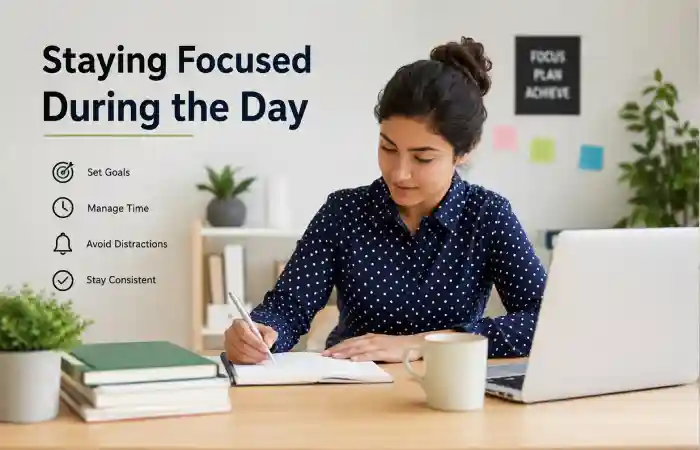
Constant notifications, email, meetings and multitasking can make sustained attention difficult.
Mindfulness does not mean forcing your mind to remain perfectly still. The goal is to notice when your attention has wandered and deliberately bring it back.
Try these techniques:
Use single-tasking
Instead of keeping email, messaging apps, social media and several work documents open simultaneously, choose one priority.
For example:
Unfocused approach:
Email → WhatsApp → spreadsheet → meeting notification → browser → back to email.
Mindful approach:
Choose one task → work on it → finish or reach a planned stopping point → move to the next task.
Try the 3-breath reset
Before opening an email or starting a meeting:
- Breathe in slowly.
- Notice your body.
- Breathe out slowly.
- Repeat three times.
- Then begin.
Use transition moments
Meetings, calls, lunch and walking to another part of the office can become mindfulness cues.
Instead of immediately opening another app after a meeting, take 20–30 seconds to ask:
What am I doing next?
That small pause can reduce automatic task switching.
Managing Workplace Stress
Workplace mindfulness is particularly useful for managing your response to stressful situations.
A 2023 study found that mindfulness was associated with lower work stress partly because people were less likely to appraise work tasks as threats.
A randomized controlled workplace trial also found that a six-week mindfulness program reduced perceived and momentary stress compared with a shorter intervention.
Anxiety can also affect concentration, decision-making, and your ability to stay focused at work. Mindfulness encourages you to notice anxious thoughts without automatically reacting to them. Explore mindfulness for anxiety for practical ways to develop greater awareness and calm.
The STOP technique
When work feels overwhelming:
S — Stop
Pause before immediately reacting.
T — Take a breath
Take one or two slow breaths.
O — Observe
Notice your thoughts, emotions and physical tension.
P — Proceed
Choose the next useful action instead of reacting automatically. (PubMed)
Important limitation
Meditation does not undo massive workloads, or thin staffing and bad leadership, or poisonous workplace cultures. But Workplace Interventions at stress reduction and developing workplace resources (including those based on mindfulness) may be considered but the WHO gives it ‘low’ for evidence certainty. This is an important differentiation: employees shouldn’t feel that they need to meditate themselves out of poor conditions at work.
Mindful Communication
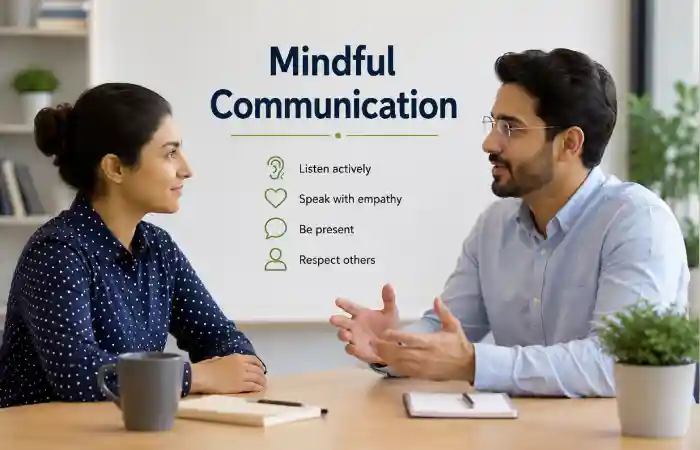
Mindful communication means paying attention to the person, conversation and your own reactions before responding.
It can be particularly useful during disagreements, difficult feedback and stressful meetings.
Practice active listening
Instead of planning your response while someone else is speaking:
- Listen to the complete point.
- Notice your emotional reaction.
- Ask a clarifying question if necessary.
- Summarize what you heard.
- Then respond.
A demanding workday can sometimes make it difficult to switch off when you get home, which may affect your evening routine and sleep. Creating mindful transitions between work and rest may help you unwind. Discover how mindfulness for better sleep can support a relaxing bedtime routine.
For example:
Reactive:
“I already explained that yesterday.”
Mindful:
“I understand the concern. Which part would you like me to clarify?”
The second response doesn’t mean you agree. It simply creates space between the trigger and your reaction.
Mindfulness research also suggests potential benefits for emotional regulation and interpersonal functioning, although communication outcomes should not be presented as guaranteed.
Creating Healthy Work Habits
Mindfulness works best when it becomes part of normal routines rather than another demanding task on your schedule.
Try building these habits:
| Work habit | Mindful version |
| Starting work | Take 1 minute to identify your priority |
| Checking email | Read and respond deliberately rather than continuously |
| Meetings | Put distractions away and listen actively |
| Stressful messages | Pause before replying |
| Lunch | Eat away from your screen when possible |
| Long computer sessions | Notice posture, shoulders and jaw tension |
| End of workday | Write down unfinished tasks before switching off |
| Remote work | Create a clear transition between work and personal time |
You don’t always need a long meditation session to practice mindfulness at work. Simple breathing exercises can be used during short breaks or stressful moments to help you pause and refocus. Try these mindfulness breathing techniques for an accessible way to practice mindful awareness.
A simple daily mindfulness routine
Morning — 2 minutes:
Sit quietly and decide what deserves your attention today.
During work — 30 seconds:
Pause between major tasks and take a few slow breaths.
Before meetings — 30 seconds:
Put away distractions and mentally arrive in the conversation.
After stressful events — 1 minute:
Notice your emotions before taking the next action.
End of work — 2 minutes:
Review what is complete and write down tomorrow’s priorities.
You don’t need to meditate for hours. Consistency is more useful than making the practice unnecessarily complicated.
Mindfulness apps vs guided programs vs self-practice
| Option | Best for | Advantages | Limitation |
| Self-practice | Beginners | Free and flexible | Requires consistency |
| Mindfulness app | People who need reminders | Guided sessions and tracking | Quality and engagement vary |
| Online course | Structured learning | Step-by-step education | Usually requires payment |
| Workplace program | Teams/organizations | Shared structure and instruction | Needs supportive workplace culture |
| Instructor-led program | Deeper practice | Personal guidance | More time and cost |
Evidence suggests that structured workplace programs can be useful, but simply providing a mindfulness program does not guarantee participation or results. A realist review of 75 studies found that employees need a supportive environment and must be able to connect the practice with their existing goals and work routines.
Troubleshooting: Why Mindfulness at Work May Not Be Working
“I don’t have enough time.”
Start with 30–60 seconds rather than a long meditation session.
“My mind keeps wandering.”
That is normal. Noticing the wandering and returning your attention is part of the practice.
“I feel silly doing it at work.”
Use discreet techniques such as mindful breathing, active listening or short body check-ins.
“It isn’t reducing my workload.”
It isn’t supposed to. If workload or workplace conditions are causing significant stress, organizational solutions are also needed.
“I tried it once and felt no difference.”
Mindfulness is a skill developed through repetition. Research does not support treating one short session as a guaranteed solution.
Mindfulness and meditation are closely related, and both can be useful for developing greater focus and awareness. However, they have some important differences. Understanding mindfulness vs. meditation can help you decide which approach fits your workday and personal routine.
Key Takeaway
Mindfulness at work is less about stopping thoughts and more about intentional focus. Even a short moment of thought before sending an email, focus during an meeting or a conscious shift between tasks and over time that will start to shift how we react to a busy day at work. The strongest 2026 evidence would indicate mindfulness is effective for stress, well-being, and resilience although that evidence seems weaker at times for the direct impacts on productivity.
For the employer it is not a replacement for taking care of unmanageable workloads or dysfunctional working cultures.
For the employee it may be one of many tools for effective work boundaries, rest and physical activity alongside the other appropriate help.
Afiya Jafar is a fitness and wellness writer who focuses on making health, exercise, and healthy lifestyle information simple and practical. Her work covers workouts, fitness motivation, strength training, nutrition, weight management, stress management, mindfulness, and everyday wellness.
Read Full Bio of Afiya Jafar →
Sameena Begum reviews selected health, wellness, fitness, and digital content for clarity, factual presentation, consistency, and reader usefulness. Her review work helps maintain clear and responsible editorial standards across PhysicalFitt content.
Read Full Bio of Sameena Begum →
Dr. Khizrana Begum is a qualified medical professional with MBBS and MD qualifications and 5+ years of experience in the medical field. She works as a General Physician and Dermatologist, with expertise in general medicine, dermatology, preventive healthcare, and skin health.
Read Full Bio of Dr. Khizrana Begum →