
 Afiya Jafar
Fitness & Wellness Writer
Afiya Jafar is a fitness and wellness writer who focuses on making health, exercise, and healthy lifestyle information simple and practical.
Read Full Bio of Author →
Afiya Jafar
Fitness & Wellness Writer
Afiya Jafar is a fitness and wellness writer who focuses on making health, exercise, and healthy lifestyle information simple and practical.
Read Full Bio of Author →
 Sameena Begum
Health, Fitness & Digital Content Reviewer
Sameena reviews selected health, wellness, fitness, and digital content for clarity, factual presentation, and reader usefulness.
Read Full Bio of Reviewer →
Sameena Begum
Health, Fitness & Digital Content Reviewer
Sameena reviews selected health, wellness, fitness, and digital content for clarity, factual presentation, and reader usefulness.
Read Full Bio of Reviewer →
 Dr. Khizrana Begum
General Physician & Dermatologist
Dr. Khizrana Begum is a General Physician and Dermatologist with MBBS and MD qualifications and 5+ years of experience in the medical field.
Read Full Bio of Medical Reviewer →
Dr. Khizrana Begum
General Physician & Dermatologist
Dr. Khizrana Begum is a General Physician and Dermatologist with MBBS and MD qualifications and 5+ years of experience in the medical field.
Read Full Bio of Medical Reviewer →
Mindful breathing techniques, as their name suggests, are practices that use our innate breathing mechanism as an anchor of attention. The process doesn’t try to stop your thoughts from flowing, but rather guides your attention to notice the inhalations and exhalations, pulling your attention back each time your mind begins to stray.
The breathing exercises can be performed virtually anywhere – at your desk, during your daily commute, before going to sleep at night, or during moments of acute stress, as well as becoming a tool within a morning meditation practice. According to Mayo Clinic, mindful breathing can also be regarded as one of the simplest methods of beginning the practice of mindfulness.
There is not a correct way of breathing during mindful breathing techniques. The intention is of simply becoming aware of the present moment.
Mindfulness involves paying attention to the present moment with greater awareness and without immediately judging your thoughts or feelings. If you want to understand the broader practice before trying breathing exercises, learn more about mindfulness and how it works.
What Is Mindful Breathing?
The basic concept of mindful breathing is to deliberately turn your focus to your breath without evaluation or attempting to change each one.
Sit in a comfortable place and observe the location in your body where you feel the breath being taken in and out; whether you’re breathing rapidly or slow; the movement of your abdomen or chest, and the temperature of the air as it goes in and out. Observe what happens when your thoughts drift. You don’t have to achieve an empty-minded state.
It’s helpful to understand the differences between breathwork and mindful breathing since the terms aren’t always interchangeable. Mindful breathing can often be just the observation of your existing breath pattern, whereas Breathwork always involves the manipulation of both your inspiration and expiration. A recommended goal of Mayo Clinic is to begin with just a few minutes at a time and to incorporate it into your day.
❝
This article is a part of
Mindfulness Hub
Breathing exercises can be particularly useful when you are experiencing everyday pressure or tension. Combining mindful breathing with other techniques can help you develop a more consistent approach to managing stress. Explore mindfulness for stress relief for additional strategies.
Benefits of Breath Awareness
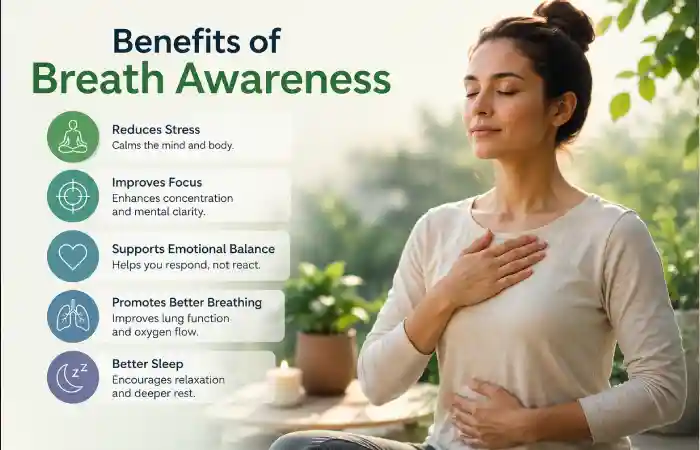
Practicing breath awareness on a consistent basis can support relaxation, concentration and emotional regulation. Mindfulness with the use of breath is a common approach to manage stress, according to most available health information and according to studies that are being continually completed to examine its effects.
Some possible benefits include:
Stress reduction, during your difficult moments can you take a few moments to slow down and take a few deep breaths?
Improving concentration, it helps with focusing your mind by making it aware that the breath is an anchor that thoughts can be redirected to as your mind begins to wander and lose concentration.
Emotional understanding, can bring space to “notice” how emotions feels and instead of responding immediately to difficult feelings can breathe before doing so.
Promoting relaxation, slow breathing processes are thought to have physiological calming effects.
Cultivating an informal mindfulness practice because breath is always with us and it can be a convenient form for all types of users new to meditation tobeginwith.
When anxiety causes your breathing to become rapid or your mind to feel overwhelmed, bringing your attention back to your breath can be a simple way to reconnect with the present moment. You can also learn more about mindfulness for anxiety and other ways to practice mindful awareness.
There are guided practices available from programs that promote mindfulness, such as a Mayo Clinic mindfulness program; a 10-breath program, and a three-minute mindful breath guide to name just a couple.
Simple Breathing Exercises
Different mindful breathing techniques suit different situations.
| Best suited for | Technique | Basic pattern |
| Beginners | Natural breath awareness | Observe without changing |
| Short stressful moments | Box breathing | 4-4-4-4 pattern |
| Relaxation | Diaphragmatic breathing | Gentle abdominal breathing |
| Wind-down routine | 4-7-8 breathing | 4-in, 7-hold, 8-out |
| Quick stress reset | Physiological sigh | Two inhales + long exhale |
- Natural Breath Awareness
Mindful breathing may also be incorporated into a calming bedtime routine. Taking a few minutes to slow down and focus on your breathing can help create a relaxing transition toward sleep. Discover more about mindfulness for better sleep and relaxation practices.
This is the easiest place to start.
Sit comfortably and breathe normally. Notice each inhale and exhale without deliberately making the breath deeper.
When your thoughts wander, return to the next breath.
Try this for 2–5 minutes.
- Box Breathing
Box breathing uses equal-length phases.
- Inhale for 4 seconds.
- Hold for 4 seconds.
- Exhale for 4 seconds.
- Hold for 4 seconds.
- Repeat for several cycles.
Cleveland Clinic recommends gentle, smooth breathing and advises reducing the count if holding the breath becomes uncomfortable.
- Diaphragmatic Breathing
Place one hand on your chest and another below your rib cage.
Breathe slowly through your nose and allow the abdomen to rise. Then exhale gently and allow it to fall.
The hand on your chest should move less than the hand on your abdomen.
Cleveland Clinic recommends this approach as a simple way to combine breath awareness with calmer breathing.
- 4-7-8 Breathing
The commonly taught pattern is:
Inhale 4 → hold 7 → exhale 8
This technique is particularly popular as a relaxation exercise.
If breath holding feels uncomfortable, don’t force the pattern. A gentler breathing rhythm may be more appropriate.
- Physiological Sigh
This pattern involves two inhalations followed by one longer exhalation. It has become popular as a quick breathing exercise for stressful moments.
Mindfulness doesn’t have to be limited to a dedicated practice session. Short breathing exercises can also be used during a busy working day to pause, refocus, and become more aware of your responses to workplace pressure. Learn practical approaches to mindfulness at work.
Because structured breathing can feel different from person to person, focus on comfort rather than trying to achieve a particular sensation.
Using Breathing During Stress
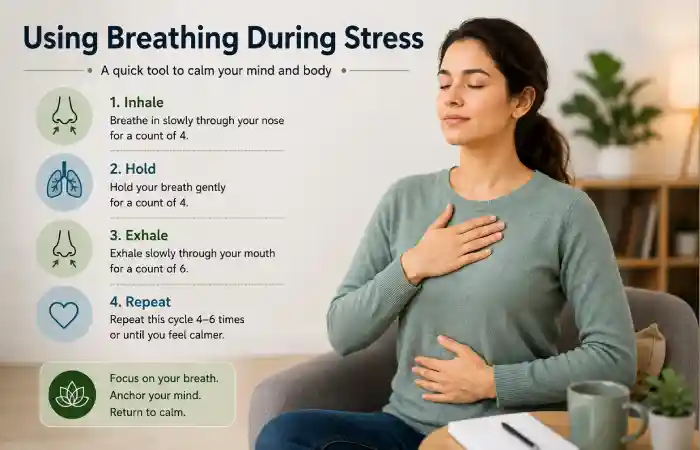
Breathing meditation practices aren’t restricted to the timeframe and duration of a particular session.
Consider taking a 60 second breathing reset:
- Stop Relax shoulders
- Observe the breath
- Take several easeful breaths
- Return to the task at hand.
For instance, you could use a breathing pause before your big meeting before going on to the next task that likely entails opening your laptop, and jumping straight in.
Breathing techniques, mindfulness and meditation are also recognized by the NHS as being helpful for problems when trying to get anxious thoughts under control, and getting the focus back onto present.
There is no intention to remove all of the difficult thoughts within an immediate situation- acute stress reduction. The immediate aim is to develop enough room so that one can respond, rather than reacting instinctively.
Building a Daily Habit
Consistency matters more than long sessions.
A beginner-friendly routine could look like this:
| Time | Practice | Duration |
| Morning | Natural breath awareness | 3 minutes |
| Midday | Slow breathing reset | 1 minute |
| Evening | Diaphragmatic breathing | 5 minutes |
| Before bed | Quiet breath awareness | 2–5 minutes |
Breathing exercises are often included in meditation practices, but mindfulness and meditation are not exactly the same thing. Understanding mindfulness vs. meditation can help you understand where breathing techniques fit into each practice.
Mayo Clinic notes that regular daily mindfulness practice is recommended for experiencing its full benefits, while even short moments of mindfulness can be useful.
Troubleshooting: When Mindful Breathing Feels Difficult
“I can’t stop thinking.”
You don’t need to stop thinking. Notice the thought and return to your breath.
“I feel like I’m forcing my breathing.”
Return to natural breath awareness rather than controlling the breath.
“I get distracted quickly.”
Start with one minute. Gradually increase the duration.
“Holding my breath feels uncomfortable.”
Don’t force breath-holding patterns. Use comfortable, gentle breathing instead.
“I don’t have time to meditate.”
Use three mindful breaths before meals, meetings, workouts or bedtime.
Afiya Jafar is a fitness and wellness writer who focuses on making health, exercise, and healthy lifestyle information simple and practical. Her work covers workouts, fitness motivation, strength training, nutrition, weight management, stress management, mindfulness, and everyday wellness.
Read Full Bio of Afiya Jafar →
Sameena Begum reviews selected health, wellness, fitness, and digital content for clarity, factual presentation, consistency, and reader usefulness. Her review work helps maintain clear and responsible editorial standards across PhysicalFitt content.
Read Full Bio of Sameena Begum →
Dr. Khizrana Begum is a qualified medical professional with MBBS and MD qualifications and 5+ years of experience in the medical field. She works as a General Physician and Dermatologist, with expertise in general medicine, dermatology, preventive healthcare, and skin health.
Read Full Bio of Dr. Khizrana Begum →