
 Afiya Jafar
Fitness & Wellness Writer
Afiya Jafar is a fitness and wellness writer who focuses on making health, exercise, and healthy lifestyle information simple and practical.
Read Full Bio of Author →
Afiya Jafar
Fitness & Wellness Writer
Afiya Jafar is a fitness and wellness writer who focuses on making health, exercise, and healthy lifestyle information simple and practical.
Read Full Bio of Author →
 Sameena Begum
Health, Fitness & Digital Content Reviewer
Sameena reviews selected health, wellness, fitness, and digital content for clarity, factual presentation, and reader usefulness.
Read Full Bio of Reviewer →
Sameena Begum
Health, Fitness & Digital Content Reviewer
Sameena reviews selected health, wellness, fitness, and digital content for clarity, factual presentation, and reader usefulness.
Read Full Bio of Reviewer →
 Dr. Khizrana Begum
General Physician & Dermatologist
Dr. Khizrana Begum is a General Physician and Dermatologist with MBBS and MD qualifications and 5+ years of experience in the medical field.
Read Full Bio of Medical Reviewer →
Dr. Khizrana Begum
General Physician & Dermatologist
Dr. Khizrana Begum is a General Physician and Dermatologist with MBBS and MD qualifications and 5+ years of experience in the medical field.
Read Full Bio of Medical Reviewer →
Stress can make you think, sleep, and focus differently and change how you react to daily life events. Mindfulness is a real world way of how to slow down, notice what is going on around you and not rush to a solution – the ability to be more aware about how to respond to a situation where you feel stressed. There is no special equipment to buy or hundreds of hours to meditate.
Even short daily consistent practices can turn into a habit.
Mindfulness simply means you’re more aware of your feelings, thoughts, bodily sensations, and the world around you without labeling and reacting to them in any way immediately. Studies indicate that these practices help to diminish the feeling of stress, they may also help the anxiety, mood and sleep disorders.
Mindfulness is a useful practice for managing stress because it encourages you to focus on the present moment rather than becoming overwhelmed by stressful thoughts. If you are new to mindfulness, learn more about mindfulness and how it works as a foundation for developing a regular practice.
❝
This article is a part of
Mindfulness Hub
How Stress Affects the Mind and Body
Stress is the body’s reaction to demands. Brief stress responses actually help you alert yourself and perform the necessary function of meeting the challenge. The problem begins when stress is sustained over time or the doses increase.
Common effects can include:
- Racing or repetitive thoughts
- Difficulty concentrating
- Irritability or mood changes
- Muscle tension
- Headaches
- Fatigue
- Sleep problems
- Digestive discomfort
- Increased heart rate
Constant stress can negatively impact physical and mental health, Cleveland Clinic says that ineffective stress management may lead to symptoms including a lack of sleep and energy, headaches, a lot of digestive issues and higher blood pressure. This is where mindfulness might help. In essence the pausing between stressful trigger and your reaction to it helps avoid immediate responses to feelings and thoughts.
How Mindfulness Reduces Stress
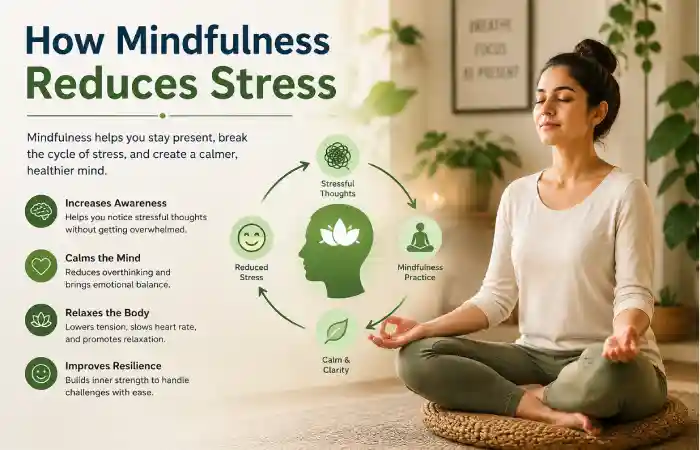
Stress and anxiety often occur together, and mindfulness can help you become more aware of anxious thoughts without immediately reacting to them. For additional strategies, explore mindfulness for anxiety and learn how mindful awareness can be incorporated into your daily routine.
This isn’t to suggest that mindfulness eliminates any stressful situation. It can also involve an acceptance, or at the very least, a shift in your reaction. This is what mindfulness is – being deliberate and gentle enough to bring your focus into the present, whether it’s breathing, sounds, bodily sensations, or whatever you find comes to mind.
The American Psychological Association defines mindfulness as a type of sustained, self-regulated attention that involves attending with focus to the present experience and observing it without judgment. And according to Harvard Health, the literature reviewed by the APA finds the use of mindfulness based interventions as particularly helpful for treating depression, anxiety, andstress.
To provide a simple example of what this looks like, in the course of an everyday situation, say you’re feeling overwhelmed by an upcoming deadline. Rather than continuously bringing up the thought, “what if it all goes wrong?”, you will be aware of the thought as it rises, accept you are anxious (without wishing the anxiety wasn’t there or fighting with it), take a deep, slow breath, and re-apply your attention to what is on your desk in front of you.
Harvard Health further recommends (in their 2026 suggestions) to “allow yourself to redirect your attention from stressful thought to the present sensory experience.”
What the research says
| Area | What current evidence suggests |
| Perceived stress | Mindfulness may reduce perceived stress |
| Anxiety | Evidence suggests potential benefits |
| Sleep | Some studies report improved sleep quality |
| Attention | Mindfulness may improve present-moment attention |
| Physical stress response | Research suggests possible improvements in physiological stress markers |
| Long-term effects | More research is needed for some outcomes |
Stress can also make it difficult to relax at night or maintain a healthy sleep routine. Practicing mindfulness before bedtime may help create a calmer transition into sleep. Read more about mindfulness for better sleep and ways to make relaxation part of your evening routine.
According to the National Center for Complementary and Integrative Health, recent evidence indicates potential use in stress, anxiety, and sleep management. However, they acknowledge that not all mindfulness practices are studied to the same degree nor are their effects all positive.
Daily Stress Relief Techniques
You do not have to sit cross-legged for 30 minutes to practice mindfulness. Start with techniques that fit naturally into your day.
- Mindful breathing
Breath awareness: sit relaxed and take notice of your natural breathing. Pay attention to the sensations while air passing by your nostril or motion of chest and belly. When the mind drifts, kindly brought you attention back.
Start with 2–5 minutes.
- Body scan
Spend time gently focusing your attention on each part of your body as you allow it to drift toward your head starting from your feet. As you go, become aware of anything you notice: areas of tightness, warmth, pressure, or even an ache – you don’t have to fix it.
This technique is great to do before bed or after a difficult day.
- Mindful walking
Instead of walking while scrolling through your phone or thinking about your next task, pay attention to your surroundings.
Notice your feet touching the ground, your breathing, sounds, temperature and movement.
- Mindful eating
Choose one meal or snack and slow down. Notice the food’s texture, smell, temperature and taste.
This turns an ordinary activity into a short mindfulness exercise.
- The 5-4-3-2-1 grounding technique
When stress feels overwhelming, identify:
- 5 things you can see
- 4 things you can touch
- 3 things you can hear
- 2 things you can smell
- 1 thing you can taste
This shifts attention away from repetitive thoughts toward your immediate surroundings.
Mayo Clinic recommends integrating mindfulness into everyday activities rather than treating it as something that must happen only during formal meditation.
Breathing Exercises
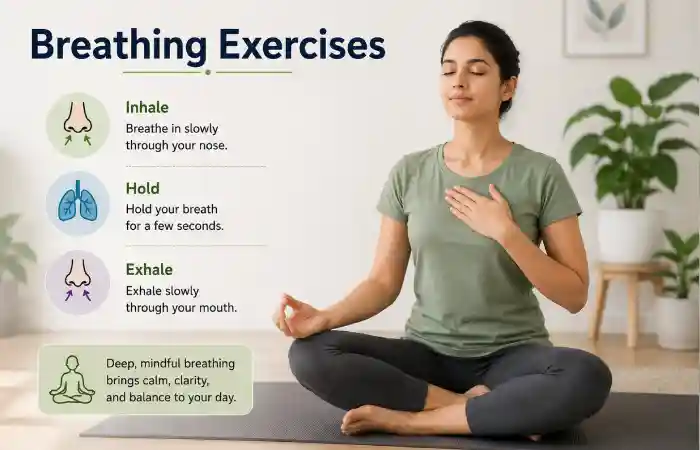
Breathing is another simple way to bring your attention back to the present when stress begins to build. Focusing on slow, controlled breaths can provide an accessible starting point for mindfulness practice. Try these mindfulness breathing techniques to support relaxation and present-moment awareness.
Breathing is one of the easiest places to begin because it is always available.
Simple mindful breathing
- Sit or stand comfortably.
- Relax your shoulders.
- Breathe normally through your nose.
- Notice each inhale and exhale.
- If your attention wanders, gently bring it back.
- Continue for 2–5 minutes.
It doesn’t have to be a long, deep breath. Awareness is key, not ideal breathing. Long deep breathing is a long proven beginner tool for mindfulness. According to Harvard Health just the practice of paying attention to your breath can have a stress relieving affect and be an introduction to larger mindfulness practices.
Building a Stress Management Routine
The biggest mistake beginners make is trying to do too much at once. A sustainable mindfulness routine should be short enough that you can actually maintain it.
Try this simple schedule:
| Time | Practice | Duration |
| Morning | Mindful breathing | 3 minutes |
| Midday | Mindful walking or grounding | 2–5 minutes |
| Evening | Body scan | 5 minutes |
| Before bed | Slow breathing | 2–5 minutes |
The goal is consistency rather than duration.
Work-related pressure can be a significant source of everyday stress. Mindfulness can be practiced during the workday through brief pauses, focused attention, and greater awareness of your reactions. Learn practical ways to use mindfulness at work to manage workplace stress.
As many as six weeks can go into learning meditation or other mindfulness techniques. After a few weeks, you may wish to try gradually extending your practice time. Mayo Clinic points out that practice really does make perfect with meditation, and a wandering mind does not mean a wasted practice session.
Mindfulness and meditation are closely related, but they are not exactly the same. Understanding the distinction can help you choose the approach that best suits your needs and lifestyle. Learn more about mindfulness vs. meditation and how the two practices compare.
FAQs
How much mindfulness per day to reduce stress?
You start with 2–5 minutes per day and slowly increase gradually over time; consistency is the key rather than the duration of practice.
Mindfulness for an immediate stress relief?
You can experience immediate calm after an extremely brief practice, but the outcome is not always what you’ll have initially, and it takes time develop it as a skills.
Is mindfulness the same as meditation?
They are not precisely the same thing – while some meditations focus on present-moment awareness, mindfulness can also be practiced during all your waking activities.
Will mindfulness help relieve anxiety symptoms?
Research results demonstrate that mindful-based techniques can be used to effectively reduce anxiety symptom severity.
Unfortunately, though, these techniques cannot be substituted when mental illness severity warrants professional treatment by a mental health clinician.
What is the most effective mindfulness practice for a beginner?
At the outset the most straightforward way for getting started is to be mindfully breathing! After that you might choose to experiment further with body scans, a mindful walk or grounding.
I am already too afraid to meditiate can i still practice it without meditating?
Absolutely! You can practice mindfulness throughout your day, when walking , eating , showers , brushing your teeth, and many more other normal and simple activity by practicing paying full attention towards your current state of being.
Conclusion
When practice, ideally this is something manageable that doesn’t create another item on your list of stressful to-dos! A brief couple of minutes of focused mindful breathing, body focus, grounding or mindful walking can provide the space and opportunity to step out of your reactive patterns and step into the moment with more awareness. Research to date finds mindfulness to be a helpful tool to manage the stresses and anxieties of modern living but it is important to recognise that it is one part of a larger process and not a panacea.
Afiya Jafar is a fitness and wellness writer who focuses on making health, exercise, and healthy lifestyle information simple and practical. Her work covers workouts, fitness motivation, strength training, nutrition, weight management, stress management, mindfulness, and everyday wellness.
Read Full Bio of Afiya Jafar →
Sameena Begum reviews selected health, wellness, fitness, and digital content for clarity, factual presentation, consistency, and reader usefulness. Her review work helps maintain clear and responsible editorial standards across PhysicalFitt content.
Read Full Bio of Sameena Begum →
Dr. Khizrana Begum is a qualified medical professional with MBBS and MD qualifications and 5+ years of experience in the medical field. She works as a General Physician and Dermatologist, with expertise in general medicine, dermatology, preventive healthcare, and skin health.
Read Full Bio of Dr. Khizrana Begum →