
 Afiya Jafar
Fitness & Wellness Writer
Afiya Jafar is a fitness and wellness writer who focuses on making health, exercise, and healthy lifestyle information simple and practical.
Read Full Bio of Author →
Afiya Jafar
Fitness & Wellness Writer
Afiya Jafar is a fitness and wellness writer who focuses on making health, exercise, and healthy lifestyle information simple and practical.
Read Full Bio of Author →
 Sameena Begum
Health, Fitness & Digital Content Reviewer
Sameena reviews selected health, wellness, fitness, and digital content for clarity, factual presentation, and reader usefulness.
Read Full Bio of Reviewer →
Sameena Begum
Health, Fitness & Digital Content Reviewer
Sameena reviews selected health, wellness, fitness, and digital content for clarity, factual presentation, and reader usefulness.
Read Full Bio of Reviewer →
 Dr. Khizrana Begum
General Physician & Dermatologist
Dr. Khizrana Begum is a General Physician and Dermatologist with MBBS and MD qualifications and 5+ years of experience in the medical field.
Read Full Bio of Medical Reviewer →
Dr. Khizrana Begum
General Physician & Dermatologist
Dr. Khizrana Begum is a General Physician and Dermatologist with MBBS and MD qualifications and 5+ years of experience in the medical field.
Read Full Bio of Medical Reviewer →
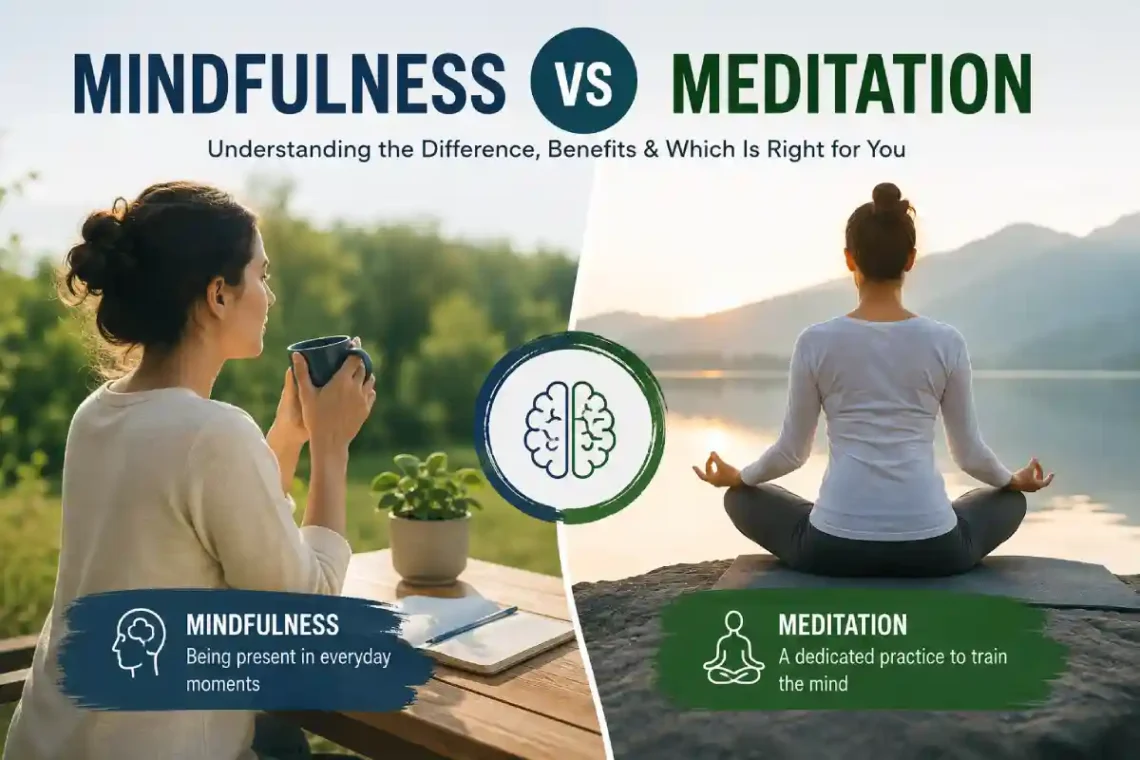
This is probably the most commonly asked question among newcomers seeking solutions for stress reduction, mental well being and self growth. Mindfulness vs. Meditation, while largely overlapping are two different things.
Meditation is a more formal practice in training and developing the brain, whereas mindfulness is the state of being aware of the present moment at any time of day.
Once the two – and both – can be mastered and integrated, they’ll offer a solid routine of mental wellbeing, Whether you want to worry less, think clearer, sleep sounder or increase emotional resilience, these two evidence-based approaches pack one powerful punch.
Mindfulness is a practice of paying attention to the present moment with greater awareness and without immediately judging your thoughts or feelings. Before comparing mindfulness with meditation, it can help to understand what mindfulness is and how it works in everyday life.
❝
This article is a part of
Mindfulness Hub
Mindfulness vs Meditation at a Glance
| Feature | Meditation | Mindfulness |
| Definition | A structured mental training practice | Being fully aware of the present moment |
| Time Required | Usually requires dedicated time | Can be practiced anytime |
| Formal Practice | Required | Not required |
| Goal | Mental training and focus | Awareness and presence |
| Beginner Friendly | May require guidance | Very easy to start |
| Examples | Guided meditation, mantra meditation | Mindful eating, walking, breathing |
What Is the Difference?
The only key difference between mindfulness and meditation is that, mindfulness is a state of being and meditation is a form of action.
Mindfulness is just been aware of what is in your consciousness at that present time as well as external world at that very moment and you are to not judge any of the factors. It could occur while you are eating breakfast, during driving to work, to work, speaking with any one and etc.
Meditation involves actually setting out to train and focus your attention. While you are meditating, you focus on either what your mind thinks of whether as your breath, a certain sound, a certain phrase or even to following certain instructions of someone.
Both mindfulness and meditation can be useful when dealing with everyday pressure. Mindfulness can be practiced throughout the day, while meditation often involves setting aside dedicated time for focused practice. Learn more about mindfulness for stress relief and how mindful practices may support relaxation.
2026 Research Snapshot
| Outcome | Mindfulness Practice | Meditation Practice |
| Stress Reduction | High | Very High |
| Focus Improvement | High | High |
| Anxiety Management | Moderate to High | High |
| Emotional Regulation | High | High |
| Sleep Quality | Moderate | High |
| Workplace Productivity | High | Moderate to High |
Similarities Between Mindfulness and Meditation
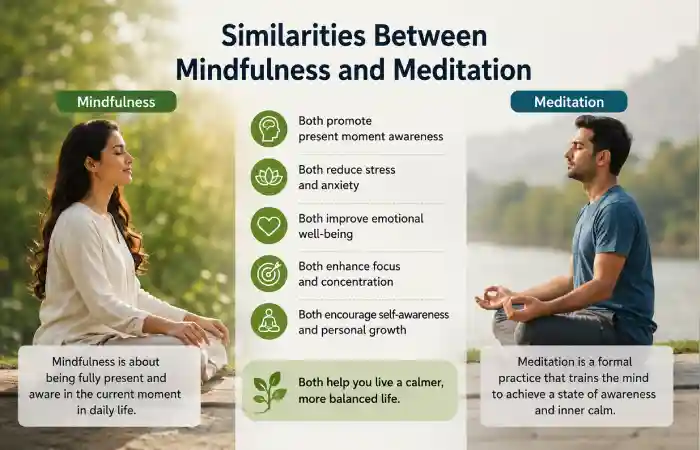
Although they are distinct, mindfulness and meditation share many of the same objectives.
Anxiety is another area where mindfulness and meditation are commonly discussed. Developing awareness of anxious thoughts can help you notice them without automatically reacting to them. Explore mindfulness for anxiety for practical approaches to mindful awareness.
Both techniques reduce stress
The body of literature consistently supporting both mindfulness and meditation that it may decrease perceived stress and increase happiness and the sense of inner calm is significant.
Both enhance focus
Training attention can allow focus to be directed rather than becoming fragmented and thereby provide benefit for student or professional.
Both enhance self-awareness
Mindfulness and meditation train awareness of thoughts, feelings and patterns of behaviour.
Both promote mental wellness
Chronic anxiety may decrease, emotional balance may increase and coping can be enhanced during times of distress.
Both are accessible expensive equipment is not necessary as a peaceful place and minutes each day are all that one might require.
Benefits of Each Practice
Benefits of Mindfulness
Mindfulness is ideal for people who want to bring more awareness into daily life.
Key Benefits
- Improves present-moment awareness
- Enhances emotional intelligence
- Reduces overthinking
- Strengthens workplace productivity
- Encourages healthier habits
- Improves communication skills
Benefits of Meditation
Meditation offers deeper mental training through structured practice.
Key Benefits
- Lowers stress and anxiety
- Improves attention span
- Enhances sleep quality
- Supports emotional regulation
- May lower blood pressure
- Promotes long-term mental resilience
Relaxation is also important when comparing these practices. A calm mindfulness or meditation routine may be useful as part of a healthy evening routine, particularly when a busy mind makes it difficult to wind down. Read more about mindfulness for better sleep and its role in a relaxing bedtime routine.
Comparison of Benefits
| Benefit | Mindfulness | Meditation |
| Daily Awareness | Excellent | Good |
| Deep Relaxation | Moderate | Excellent |
| Stress Relief | High | Very High |
| Better Sleep | Moderate | High |
| Productivity | High | Moderate |
| Emotional Balance | High | High |
Breathing is frequently used as an object of attention during mindfulness and meditation. Focusing on each breath can provide a simple way to bring your attention back to the present moment. Try these mindfulness breathing techniques to explore this approach.
Which One Is Right for You?
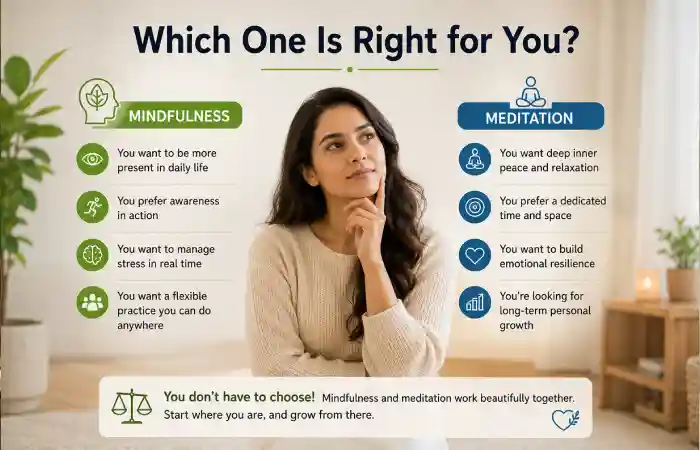
Choosing between mindfulness and meditation depends on your goals and lifestyle.
Choose Mindfulness If:
- You have a busy schedule.
- You struggle to find dedicated practice time.
- You want immediate practical tools.
- You prefer integrating wellness into daily activities.
Choose Meditation If:
- You enjoy structured routines.
- You want deeper mental training.
- You struggle with chronic stress or anxiety.
- You want measurable personal growth over time.
Combining Both for Better Results
A combination of both meditation and mindfulness is often most useful. Meditation exercises and mindfulness applies these to your life.
Simple Daily Routine
| Time | Practice |
| Morning | 10-minute meditation |
| Work Hours | Mindful breathing breaks |
| Lunch | Mindful eating |
| Evening | 5-minute reflection |
| Before Bed | Guided meditation |
These practices can also be adapted to everyday situations rather than being limited to formal sessions. For example, short mindful pauses during a busy working day can help you become more aware of your thoughts, reactions, and attention. Learn practical strategies for mindfulness at work.
This combination helps build awareness, reduce stress, and improve emotional resilience more effectively than relying on only one technique.
Common Mistakes to Avoid
- Expecting instant results
- Judging your thoughts during practice
- Skipping consistency
- Meditating only when stressed
- Trying advanced techniques too early
Troubleshooting Common Challenges
“My mind won’t stop thinking.”
Completely normal. Thoughts don’t have to be stopped, simply observed and noticed, then you gentle return to focusing your attention elsewhere.
“I don’t have time.”
Begin with a one minute breathing meditation or a 5 min meditation practice.
“I don’t feel the results.”
Some may be slow, appearing several weeks into consistent practice.
“I keep forgetting.”
Set reminders or chain your mindful moment to an automatic behavior such as drinking coffee or brushing teeth.
Recommended Tools and Apps (2026)
| App | Best For | Free Version |
| Headspace | Guided meditation | Yes |
| Calm | Sleep and relaxation | Limited |
| Insight Timer | Free meditation library | Yes |
| Balance | Personalized plans | Trial |
| Waking Up | Deep mindfulness training | Trial |
FAQs
Mindfulness and meditation, are they the same?
Mindfulness is an aware way of present-moment experiencing and meditation is a systematic practice designed to develop awareness and concentration.
Can I be mindful without practicing meditation?
Yes. You can be mindful while performing daily tasks as simple as walking, eating or working.
Which one works best for anxiety?
Both practices work well for an anxiety-reduction but in meditation, which is formal, the results are typically seen faster due to its form.
How long each day can I meditate?
People can begin the process as low as 5-10 minutes per day. People can increase them over the period of practice.
Can mindfulness increase productivity?
Yes. Mindfulness helps boost the productivity by improving focus, and also ability to make sound decisions, by minimizing the distractions.
Should I practice these practices by using an app?
No app is strictly required to gain its benefits and people can easily attain its outcomes solely with minimal effort.
Conclusion
As can be seen, when contrasted as mindfulness vs. Meditation there seems no opposition between the two methods and in fact one should be a compliment to the other. Being aware at every moment is not the same as taking time out for meditation, which has been explained to strengthen the senses with dedicated mental exercises that hone the mind’s focus and ability to concentrate.
In fact for the vast majority of people the best way is the one that incorporates both practices, as it has been clearly defined that this way leads to a decrease in mental stress and improvement in concentration, overall mental well being and emotional equilibrium.
Afiya Jafar is a fitness and wellness writer who focuses on making health, exercise, and healthy lifestyle information simple and practical. Her work covers workouts, fitness motivation, strength training, nutrition, weight management, stress management, mindfulness, and everyday wellness.
Read Full Bio of Afiya Jafar →
Sameena Begum reviews selected health, wellness, fitness, and digital content for clarity, factual presentation, consistency, and reader usefulness. Her review work helps maintain clear and responsible editorial standards across PhysicalFitt content.
Read Full Bio of Sameena Begum →
Dr. Khizrana Begum is a qualified medical professional with MBBS and MD qualifications and 5+ years of experience in the medical field. She works as a General Physician and Dermatologist, with expertise in general medicine, dermatology, preventive healthcare, and skin health.
Read Full Bio of Dr. Khizrana Begum →