
 Afiya Jafar
Fitness & Wellness Writer
Afiya Jafar is a fitness and wellness writer who focuses on making health, exercise, and healthy lifestyle information simple and practical.
Read Full Bio of Author →
Afiya Jafar
Fitness & Wellness Writer
Afiya Jafar is a fitness and wellness writer who focuses on making health, exercise, and healthy lifestyle information simple and practical.
Read Full Bio of Author →
 Sameena Begum
Health, Fitness & Digital Content Reviewer
Sameena reviews selected health, wellness, fitness, and digital content for clarity, factual presentation, and reader usefulness.
Read Full Bio of Reviewer →
Sameena Begum
Health, Fitness & Digital Content Reviewer
Sameena reviews selected health, wellness, fitness, and digital content for clarity, factual presentation, and reader usefulness.
Read Full Bio of Reviewer →
 Dr. Khizrana Begum
General Physician & Dermatologist
Dr. Khizrana Begum is a General Physician and Dermatologist with MBBS and MD qualifications and 5+ years of experience in the medical field.
Read Full Bio of Medical Reviewer →
Dr. Khizrana Begum
General Physician & Dermatologist
Dr. Khizrana Begum is a General Physician and Dermatologist with MBBS and MD qualifications and 5+ years of experience in the medical field.
Read Full Bio of Medical Reviewer →
Mindfulness is awareness that you create yourself-being mindful is paying attention to the present moment, rather than getting pulled into thoughts about the past or future or distracted by your surroundings. It seems simple but mastering the ability to step back and observe-without judgment or attachment- your thoughts, emotions, body and the environment can be a useful daily tool. You dont need a peaceful room, a special cushion or a lot of spare time to practice mindfulness.
In short, it’s the practice of turning your focus on whatever is happening in your life today rather than being automatically drawn into fears of tomorrow, regrets of yesterday, or the distractions swirling around you. Sounds simple, but learning to notice your thoughts, feelings, bodily sensations and your environment without first thinking about it or immediately reacting to it, can be a useful skill to practice day to day.
You don’t have to have a designated meditation room, special equipment or hours of free time to begin. Mindfulness can be integrated into your breathing, eating your morning toast, taking a walk, working at your desk, listening to a conversation, preparing to go to bed. According to the latest guidelines from Mayo Clinic mindfulness is defined as the act of present moment, paying attention to your thoughts, feelings, your body, your surrounding world, not to judge.
Mindfulness can be a simple and effective way to manage everyday stress. Practicing mindfulness regularly may help you become more aware of your thoughts, emotions, and physical sensations while responding to stressful situations with greater calm. Learn more about mindfulness for stress relief and how it can become part of a healthy daily routine.
Below we discuss what is mindfulness all about, and what the scientific research has to say about mindfulness as well as some different practices and how to get started with mindfulness. If you are going to attempt integrating mindfulness into real life, here’s your guide.
❝
This article is a part of
Mindfulness Hub
What Is Mindfulness?
Being mindful means paying purposeful attention in the present without judgment. This can be through breath awareness, body sensations, thoughts, emotions, sounds, visuals, smells, tastes or while others is also talking. It helps to think of mindfulness as operating outside the default automatic mode.
You drive to work one day and barely remember the drive home.
You might eat food in front of you while talking on the phone to a friend and then wonder where you plate went at the end because you weren’t aware you have actually eaten it. You could also be a friend or spouse with someone while you are in your head formulating the answer instead of with someone while they are talking to you. Mindfulness generates space between experience and habit-uated response. Not all mind would disappear.
It is indeed still thinking on a mindful endeavor but these are only thoughts.
The way mindfulness works are to notice the thought is a thought, and then come back to awareness on something particular at that particular time. Mayo Clinic’s website reminds us that you don’t have to still your mind to practice mindfulness, Washing dishes can be turned into a mindfulness exercise because as you wash the dishes you notice the water’s warmth, your hands sliding on the plates, the smell of the dish soap, and all of the movement your hands do. The nature of the dish washing did not change but your attention shifted.
Mindfulness and meditation are closely aligned but are two things.
The Science Behind Mindfulness
Ancient traditions of contemplation have been linked to mindfulness, and there has been research on secular modern mindfulness programs in psychology, medicine and behavioral health. For example, the Mindfulness-Based Stress Reduction program developed by Jon Kabat-Zinn in the late 1970s helped promote an influential modern approach to clinical mindfulness, the Greater Good Science Center at UC Berkeley says, to a way of bringing one’s attention to be completely and spontaneously present with one’s thoughts, feelings, body sensations, and environment, as if one of them contained a magical key to life, but with an attitude of softness and opennes, instead of harsh judgment.
It’s important to note that modern science doesn’t say mindfulness works through a process that essentially “empties the brain”. However, when people practice mindfulness regularly, they can train themselves to detect where their attention has drifted and then bring it back on task consciously.
Mindfulness may also be helpful for people dealing with anxious thoughts and excessive worry. By focusing attention on the present moment, mindfulness can help you develop a different relationship with difficult thoughts and emotions. Explore mindfulness for anxiety to learn practical ways to incorporate it into your routine.
That the work of noticing your mind wander and purposefully bringing it back is what it really takes The act of consciously noticing our drifting attention and willfully directing it back to our meditation is fundamental to what the process offers. If our minds wanders say 30 times over a 20-minute mediation, a beginner might perceive the exercise a failure. From a mindfulness perspective, however, each time you recognize attention drifting and bring it back, you’ve engaged the skill.
According to the National Center for Complementary and Integrative Health (NCCIH), evidence suggest that the practices may reduce symptoms of depression, anxiety and improve sleep quality and insomnia and may have moderate evidence regarding pain.
A systematic review and meta-analysis slated for publication in 2025 explored benefits associated with mindfulness-based cognitive therapy for individuals with anxiety or depressive disorders and specifically explored durability over time.
A regular mindfulness practice can also support relaxation before bedtime. Taking a few quiet minutes to slow down, focus on your breathing, and let go of distractions may help prepare your mind for rest. Discover how mindfulness for better sleep can fit into a calming evening routine.
What the evidence does and does not show
| Area | What current evidence suggests |
| Stress | Mindfulness may help reduce perceived stress and improve coping |
| Anxiety | Evidence supports potential improvements in anxiety symptoms |
| Depression | Mindfulness-based approaches may reduce symptoms and may help prevent relapse in appropriate settings |
| Sleep | Mindfulness practices may improve sleep quality and insomnia symptoms |
| Chronic pain | Evidence is promising but mixed, and mindfulness should not be considered a pain cure |
| Focus | Practice may help attention and the ability to redirect a wandering mind |
| Emotional regulation | Awareness can create more space between an emotion and an automatic reaction |
| Physical health | Some research suggests benefits through stress reduction and related behaviors |
| Serious mental health conditions | Mindfulness should complement, not replace, appropriate professional treatment |
The important distinction is between “may help” and “will cure.” High-quality health information should avoid promising guaranteed outcomes.
Benefits of Practicing Mindfulness
One of the biggest advantages of mindfulness is that it can be used for both specific goals and general well-being.
You might practice it because you feel stressed before an important meeting. Someone else might use it to improve concentration while studying. Another person might use a body scan before bed.
One of the easiest ways to practice mindfulness is through focused breathing. Paying attention to each breath can provide a simple anchor when your thoughts become distracted or overwhelming. Try these mindfulness breathing techniques to develop greater awareness and relaxation.
Stress management
Using mindfulness can break the pattern of continuous ruminative thought. While you may, for instance, find yourself looping over a fight with your husband for ten minutes, with mindfulness you would be aware your mind is running around, label “thought.” Back focus yourself toward your breath or what is happening around you.
The Mayo Clinic’s 2026 guidelines list stress reduction as a benefit of mindfulness and include the reminder that it may “fit into your routine even just for a short time.”
Better attention
Mindfulness does not guarantee perfect concentration. Instead, it gives you practice noticing distraction.
That distinction matters.
The goal is not to prevent every distraction. The goal is to recognize when your attention has moved somewhere else and bring it back.
Greater self-awareness
You may begin to recognize patterns such as:
- “I become tense before deadlines.”
- “I start worrying when I am tired.”
- “I reach for my phone whenever I feel bored.”
- “I become defensive when I feel criticized.”
Recognizing these patterns does not automatically solve them, but awareness can be the first step toward choosing a different response.
Emotional balance
Mindfulness can allow you to notice an emotion without just acting on it. This can give you a sliver, but it’s a very real, sliver, of space to pause before firing off an angry email or fleeing from an anxiety-provoking situation.
Improved everyday well-being
Mindfulness can turn normal sensations more vivid. It can make food taste better, conversations more alive and a walk a chance to get back to your environment.
It’s doesn’t have to add one more thing on your to-do list. It can be about how you do the same old things.
How Mindfulness Improves Mental Health
It has become very popular to use mindfulness as part of treatments of the mind.
The NHS says research indicates mindfulness may be useful for anxiety, stress and depression, though may not be as effective for everyone.
Potential uses of mindfulness techniques include finding the capacity to look at a thought, instead of having to believe what it says and follow on with it.
A specific thought:
I am going to fail.
Without mindfulness this thought might quickly morph into anxiety and avoidance and further negative thought.
With mindfulness one may notice:
I am experiencing the thought that I am going to fail.
Psychological distance is established using those words. The thought is still present; it is however, to be observed instead of believed as true.
Mindfulness and anxiety
Anxiety typically causes you to focus on what-ifs; mindfulness focuses you on what-is. That’s not to say that you ignore a real issue, especially if it calls for intervention. In fact, mindfulness may assist you in evaluating the situation, understanding it enough to take proper action.
Many practitioners say that the meditation has served to clarify looping depressive thoughts but recognize that depression is a medical disorder and, as such, may respond well to clinical intervention.
Mindfulness and depression
Many practitioners say that the meditation has served to clarify looping depressive thoughts but recognize that depression is a medical disorder and, as such, may respond well to clinical intervention.
When mindfulness may not feel helpful
Thus, mindfulness should be considered a helpful adjunct and not an alternative to medication or other suitable clinical treatments. It doesn’t always ease the mood. Not everyone experiences mindfulness as relaxing. Per the National Health Service, “Although many of the people who practices mindfulness benefit from the method, a number of others do not.
Mindfulness isn’t limited to meditation sessions at home. It can also be practiced during your working day by taking short pauses, focusing on one task at a time, and becoming more aware of your reactions to workplace pressure. Learn practical strategies for mindfulness at work.
Others may become more stressed, anxious or experience distress if they are trying to focus on themselves too much.
If this happens, stop and seek professional medical or psychological advice.”
Mindfulness for Physical Well-Being
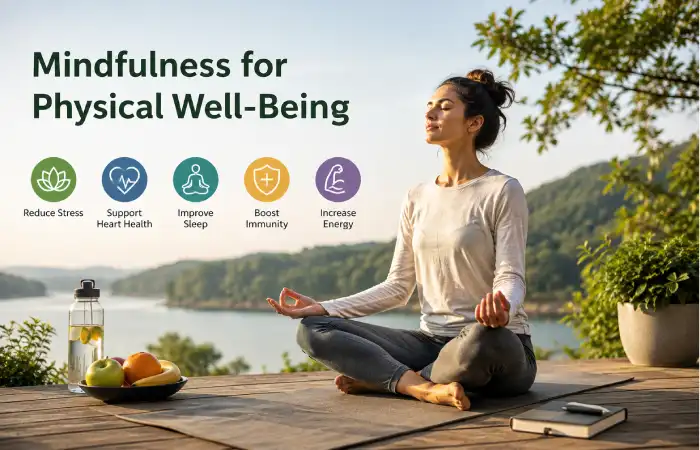
While mindfulness is largely a practice of awareness, it is important that we also be aware of all sensations both physical and mental. Stress has effects on our sleeping, muscles, breathing, heart rate, behavior around food, energy levels during the day, etc. Learning to detect stress early might allow us to reply with actions we now view as being able to manage stress in healthier ways.
Various studies have looked at mindfulness of pain, sleep, blood pressure, Diabetes, and many other chronic health conditions.
Mayo Clinic mentions that people with Multiple chronic health problems might find some benefits from mindfulness but that it is mostly a practice of ” support.”
Mindfulness and pain
Mindfulness does not alter the source of the pain but rather the individuals perception of and response to pain. A summary by NCCIH suggests that there is limited and/or mixed scientific evidence supporting mindfulness for pain with some areas of pain showing a greater benefit than other types of pain such as acute pain.
Mindfulness and sleep
A busy mind can make bedtime difficult.
A brief body scan, breath focus practice, or mindful transition from the day’s activities into sleepy time may reduce fuss and lead to a smoother routine. Mindfulness is not a panacea to cure insomnia; however, there is research that indicate that mindfulness-based programs can enhance sleep quality and reduce symptoms for some insomnia sufferers.
Although mindfulness and meditation are closely connected, they aren’t exactly the same. Understanding how they differ can help you choose practices that work best for your goals and lifestyle. Read more about mindfulness vs. meditation.
Different Types of Mindfulness Practices
There is no single correct way to practice mindfulness.
Mindful breathing
Focus on the natural rhythm of your breathing.
Notice:
- The air entering your nose.
- Your chest or abdomen moving.
- The sensation of breathing out.
- The brief pauses between breaths.
When your attention wanders, return to the breath.
Body scan
A body scan involves slowly directing attention through different parts of the body.
You might begin with your feet and gradually move toward your head. Notice sensations without deciding whether they are good or bad.
Mindful walking
Walk at a comfortable pace and notice the physical experience of movement.
Pay attention to your feet touching the ground, your legs moving, your breathing, sounds around you, and the temperature of the air.
Mindful eating
Choose one meal or snack and slow it down.
Notice its appearance, smell, texture, temperature, and flavor. Put away distractions if possible.
Loving-kindness practice
Loving-kindness meditation involves intentionally developing feelings of goodwill and compassion toward yourself and others.
It can be useful for people who find traditional breath-focused meditation difficult or overly analytical.
Mindful movement
Yoga, tai chi, stretching, and walking can become mindfulness practices when attention is deliberately placed on movement, breathing, and physical sensations.
The NHS also identifies yoga and tai chi as activities that can support awareness of breathing and present-moment experience.
How to Practice Mindfulness Every Day
The easiest way to make mindfulness sustainable is to connect it with activities you already do.
Instead of saying:
“I will meditate for one hour every morning.”
Start with:
“I will take three mindful breaths before I open my laptop.”
Small practices are easier to repeat.
Try the 60-second reset
- Stop what you are doing.
- Relax your shoulders.
- Take a natural breath.
- Notice three things you can see.
- Notice two sounds.
- Notice one physical sensation.
- Return to your activity.
You can repeat this at work, school, home, or while traveling.
Build mindfulness into ordinary routines
| Daily activity | Mindfulness opportunity |
| Brushing teeth | Notice movement, taste and physical sensations |
| Showering | Notice water temperature, sound and smell |
| Drinking coffee | Notice aroma, temperature and flavor |
| Walking | Notice footsteps, breathing and surroundings |
| Eating | Put down your phone and focus on the meal |
| Working | Complete one task before switching whenever possible |
| Studying | Notice distraction and return to the material |
| Commuting | Observe surroundings rather than automatically scrolling |
| Preparing for bed | Slow down and notice physical sensations |
| Talking with someone | Listen without preparing your next response |
Mayo Clinic specifically recommends using everyday activities such as eating and brushing your teeth as opportunities for mindfulness.
Mindfulness Meditation for Beginners
If you have never meditated before, start small.
Mayo Clinic suggests focusing on breathing as a simple starting point and recommends sitting comfortably, choosing a duration, focusing on the breath, and gently returning attention whenever the mind wanders.
A simple five-minute meditation
Minute one: settle
Sit comfortably. Let your body relax as much as possible without forcing anything.
Minute two: notice breathing
Pay attention to your natural breathing. There is no need to change it.
Minute three: observe
Notice thoughts, sounds, sensations, or emotions.
You do not need to solve them.
Minute four: return
When you realize your mind has wandered, gently return to the breath.
Minute five: finish
Notice how you feel before getting up.
There is no score.
If your mind wandered 50 times, you still practiced 50 returns.
Johns Hopkins also recommends starting with small time periods and treating mindfulness as a skill that develops with practice.
Breathing Techniques for Mindfulness
Breathing is one of the most accessible anchors for mindfulness because it is available almost everywhere.
Natural breath awareness
Do not manipulate the breath.
Simply notice the inhale and exhale.
This is often the easiest technique for beginners.
Longer-exhale breathing
If comfortable, gently allow the exhale to last slightly longer than the inhale.
Do not force your breath or continue if you become dizzy or uncomfortable.
Box breathing
Box breathing is commonly structured around equal periods of inhaling, holding, exhaling, and holding.
However, breath-holding techniques are not necessary for mindfulness. If they feel uncomfortable, return to normal breathing.
One-minute breathing practice
Set a timer for one minute.
Focus only on the physical sensation of breathing. When thoughts appear, notice them and return to the breath.
That is enough.
Mindful Living at Home, Work, and School
Mindfulness becomes more useful when it leaves the meditation cushion.
At home
Try one screen-free meal each day.
You can also create a short transition ritual after work. Before entering the next activity, pause for several breaths and consciously recognize that one part of the day has ended.
At work
Multitasking can make attention fragmented.
Try working on one clearly defined task for a short period. When you notice yourself switching tabs, checking messages, or reaching for your phone, simply notice the impulse.
Then decide deliberately whether switching is necessary.
At school
Students can use mindfulness before studying, during breaks, or before an exam.
A short breathing exercise may help create a transition from distraction to focused study.
Mindfulness does not replace studying. It can simply make it easier to return attention to the material.
During conversations
One of the most useful forms of mindfulness is mindful listening.
Instead of planning what you will say next, notice the speaker’s words, tone, facial expression, and your own emotional response.
You may discover that listening carefully changes the quality of the entire conversation.
Mindfulness for Stress and Anxiety
Stress often involves a combination of physical tension, repetitive thoughts, and pressure to respond quickly.
Mindfulness introduces a pause.
For example:
Trigger → automatic reaction → mindfulness pause → deliberate response
That pause does not need to last five minutes.
Sometimes three breaths are enough to recognize:
“I am angry right now.”
That recognition can prevent an immediate reaction.
Harvard Health’s August 2026 guidance emphasizes that many mindfulness exercises can be completed in only a few minutes and describes mindfulness as a practical way to support calm and attention.
A quick anxiety grounding exercise
Look around and identify:
- Five things you can see.
- Four things you can physically feel.
- Three sounds you can hear.
- Two smells you can notice.
- One taste or sensation in your mouth.
The purpose is not to force anxiety away. It is to reconnect attention with the present environment.
If anxiety is severe, persistent, or interfering with daily life, professional support is more appropriate than relying on mindfulness alone.
Mindfulness for Better Sleep
A racing mind can be just as taxing at bedtime as a work assignment. The trick is not to try to fall asleep, but to have a calming routine. Here’s what it entails:
- Limit or Avoid Arousing Activities Before Bedtime
- Get Comfortable Lying or Sitting Down
- Pay Attention to the Body
Your breath-followed by systematically scanning the body to sense where you hold tightness. If you perceive tightness, just notice it without trying to resist it, then continue scanning to the next area of your body and even if stray thoughts enter your mind at any time during these exercises, gently dismiss them and return to a bodily sensation.
Mindfulness might help improve sleep, though anyone suffering from insomnia to an extreme degree should seek appropriate evaluation for their condition rather than treating it with mindfulness alone.
Per NCCIH, there is evidence that mindfulness meditation improves sleep.
Mindfulness and Emotional Regulation
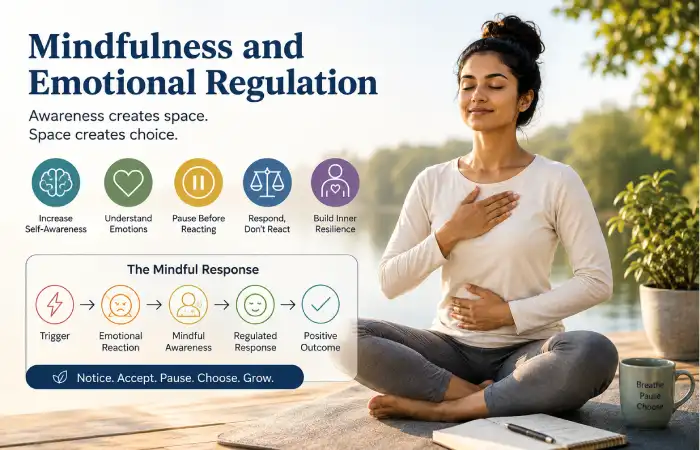
Emotional regulation does not mean suppressing emotions.
Instead, it means developing a greater ability to notice emotions and choose how to respond.
Consider anger.
Without awareness:
Anger → immediate message → regret
With awareness:
Anger → notice body tension → recognize emotion → pause → choose response
Mindfulness can help you identify early physical signs of emotional activation.
You may notice:
- Tight shoulders.
- Faster breathing.
- Clenched jaw.
- Heat in the face.
- Restlessness.
- Repetitive thoughts.
The earlier you notice these signals, the more opportunity you may have to pause.
Mindfulness for Relationships and Communication
Mindful communication starts with attention.
When someone is speaking, listen to understand rather than immediately preparing your defense.
Try:
- Looking at the person instead of your phone.
- Listening to the complete sentence.
- Noticing your emotional reaction.
- Pausing before answering.
- Asking a clarifying question.
- Avoiding assumptions.
- Acknowledging what you heard.
Another way mindfulness may help improve conflict is through facilitating emotional awareness before it becomes an automatic reaction. Mindfulness is not about tolerating rudeness or ceasing to set up essential boundaries. Mindfully setting a boundaries and being present can be used congruently.
Common Mindfulness Myths
Myth: You need to clear your mind.
False. Thoughts are normal.
Mindfulness means being aware of your thoughts instead of getting caught up in them.
Maya Clinic addresses this myth directly as something commonly believed to be true.
Myth: You have to meditate for an hour.
False. Short meditations can be as effective, especially if they’re done regularly.
According to Mayo Clinic, “even a few minutes” of mindfulness practice “ can help.”
Myth: Mindfulness requires being calm.
False. You can practice mindfulness with any emotion – angry,sad,bored,elated or apprehensive.
Myth: Mindfulness means always meditating.
False. Meditation isn’t the only method for experiencing mindfulness; Mindful eating, breathing, listening, walking and more have you covered.
Myth: Mindfulness is therapy.
False. Mindfulness shouldn’t automatically “replace” “medical treatment or professional therapy,” according to Maya Clinic. However, mindfulness is something that can “ complement” treatment.
Myth: Mindfulness takes a special setup.
False.
While having a quiet space might seem necessary -but it”s not,” Mayo Clinic asserts it “possible to gain some mindful benefits ” without any equipment.
Mistakes to Avoid When Practicing Mindfulness
The most common error is attempting to transform instantaneously.
Mindfulness is a talent
Another failure is self-blaming if you notice that your mind has wandered. The truth that your focus can come and go is actually not an indicator that you are terrible at meditating. The simple act of noticing the distraction is an essential function of the practice.
Stay clear of typical issues
Too much try effort- Let go of your effort. Mindfulness is focusing attention as well as isn’t indicated to be a battle with your own head. Starting too long- Five mins consistently may be more realistic compared to a difficult hour-long session that you stop after 3 days.
Expecting relaxation on each occasion- Some periods might feel tranquility
Others may really feel mundane, tense, or frustrating. Making use of mindfulness to repress feelings- You require consciousness, not to disavow your feelings. Trying to find a medical remedy- Consider mindfulness as an enhancement rather than a therapy. Comparing your practice to others- There is no such point as ideal meditating session.
Creating a Personalized Mindfulness Routine
The best routine is one you can actually maintain.
Start by deciding what you want mindfulness to support.
| Goal | Suggested starting practice |
| Stress | 1–5 minutes of breathing |
| Better focus | Mindful work intervals |
| Sleep | Body scan before bed |
| Emotional awareness | Daily feelings check-in |
| More presence | Mindful meals |
| Less phone distraction | Mindful technology breaks |
| Better communication | Mindful listening |
| General well-being | Short daily meditation |
The beginner routine
Morning: One minute of mindful breathing.
Midday: One mindful meal or drink.
Evening: Three minutes of body awareness.
The intermediate routine
Morning: 5–10 minutes of meditation.
Workday: Short mindful pauses between major tasks.
Evening: 5–10 minutes of body scanning or mindful breathing.
The advanced routine
You may eventually prefer longer meditation sessions, structured mindfulness programs, retreats, group classes, or mindfulness-based clinical programs.
Longer does not automatically mean better.
The quality and consistency of practice matter more than trying to reach an arbitrary number of minutes.
Choosing a Mindfulness App or Product
You do not need an app to practice mindfulness. However, guided programs can make starting easier.
If you prefer structured guidance, consider:
| Option | Best for | Potential drawback | Main advantage |
| Headspace | Beginners wanting structured sessions | Subscription model | Guided meditation and sleep content |
| Calm | Sleep and relaxation | Many features require payment | Broad relaxation and sleep library |
| Insight Timer | Large meditation library | Large library can feel overwhelming | Wide range of teachers and practices |
| Free guided audio | Budget-conscious beginners | Quality varies | No subscription required |
| In-person class | People wanting accountability | Less convenient | Teacher and community support |
What to look for in a mindfulness app
Prioritize:
- Clear explanations.
- Qualified instructors.
- Beginner programs.
- Short sessions.
- Sleep options if needed.
- Ability to practice without excessive distractions.
- Transparent subscription terms.
- Privacy information.
- A free trial or free content where available.
Avoid assuming that the most expensive app is automatically the best.
Frequently Asked Questions About Mindfulness
What is mindfulness in simple terms?
Mindfulness refers to paying attention to what is happening in the present moment, with an attitude of openness rather than with immediate judgement or reaction.
What’s the difference between mindfulness and meditation?
Mindfulness is a quality of presence. Meditation is a practice that develops mindfulness, along with various other mental abilities. Mindfulness meditation is a form of meditation.
How much should I do mindfulness for each day?
There is no specific daily duration. Beginner’s might want to start by doing one to five minutes per day, and increase the time if that suits them and feels sustainable.
Can mindfulness help reduce my stress?
Evidence suggests that mindfulness based practices are useful in helping to reduce perceived stress, and in general support effective management of stress. Mayo Cliniclists stress reduction as one possible benefit.
Can mindfulness help me when I’m experiencing anxiety?
Potentially. Advice from health bodies and the evidence at hand indicate that there are benefits that mindfulness based practices provide for some forms of anxiety, although severe anxiety may require professional treatment.
Can mindfulness help me when I have depression?
Certain therapeutic strategies based upon mindfulness may be useful in reducing the symptoms experienced with depression, and these can be integrated into some evidence based treatment approaches, but don’t replace them per se.
Can mindfulness improve sleep?
Some find they experience improvements in sleep quality with regards to some sleep disorders and with insomnia, with research and recommendations from the NCCIH showing benefit.
Do I need to sit cross-legged?
No. Depending on the form of mindfulness, many positions work, including standing, sitting or lying down. Mayo Clinic points out that mindfulness requires being still in a given posture.
Is mindfulness a religion?
While modern mindfulness techniques arose from practices associated with Buddhism, it is a term that is more widely used with reference to secular practice that is taught in various healthcare and education-based organizations and workplaces; the Greater Good Science Center explains this evolution further.
Can I use mindfulness during my working life?
Yes; when transitioning between different tasks, when listening to a colleague, taking a lunch break, or during a short breathing break, these are times you can practice mindfulness.
What happens if practicing mindfulness actually makes me feel worse?
You should cease that method or activity if it’s increasing distress in a noticeable way; there isn’t really a “one-size-fits-all” response and as the NHS suggests, individuals might not find mindfulness beneficial in all cases.
Is there evidence for the benefits of mindfulness?
Yes, there is now a great deal of research on the subject, although the degree of support of the findings by the scientific community does depend on the area being studied; evidence to support mindfulness-based outcomes is currently “fairly strong” in relation tostress and anxiety, as well asdepression and sleep,although research is still somewhat weaker in other contexts, for instance physical health.
Can mindfulness replace other treatments I might be receiving (e.g. Therapy or medication)?
No. Mindfulness practices are a useful complementary form of therapy, but shouldn’t ever automatically be taken as a sole substitution for other forms of treatment.
Final Thoughts
Mindfulness isn’t necessarily a perpetually blank or calm mind, nor a life of being perfectly poised each minute. It’s a trainable skill for noticing what is and choosing to redirect yourself back.
Begin small. Take one mindful breath. Eat one meal that you weren’t distracted by your phone.
Take one five minute walk with no earbuds.
Listen fully to someone without planning your response while they’re speaking. Acknowledge a stressful thought without assuming it’s true. Small amounts like these turn mindfulness into a more everyday practice instead of just another item to cross off the list. An approach that’s often the most successful is the simplest:pick one action that is achievable, do it consistently, and evaluate your success not by your stray thoughts, but your ability to notice andreturn,Mindfulness develops strength not when we try to practice it flawlessly, but rather when we employ it easily within our lives.
Afiya Jafar is a fitness and wellness writer who focuses on making health, exercise, and healthy lifestyle information simple and practical. Her work covers workouts, fitness motivation, strength training, nutrition, weight management, stress management, mindfulness, and everyday wellness.
Read Full Bio of Afiya Jafar →
Sameena Begum reviews selected health, wellness, fitness, and digital content for clarity, factual presentation, consistency, and reader usefulness. Her review work helps maintain clear and responsible editorial standards across PhysicalFitt content.
Read Full Bio of Sameena Begum →
Dr. Khizrana Begum is a qualified medical professional with MBBS and MD qualifications and 5+ years of experience in the medical field. She works as a General Physician and Dermatologist, with expertise in general medicine, dermatology, preventive healthcare, and skin health.
Read Full Bio of Dr. Khizrana Begum →