

 Afiya Jafar
Fitness & Wellness Writer
Afiya Jafar is a fitness and wellness writer who focuses on making health, exercise, and healthy lifestyle information simple and practical.
Read Full Bio of Author →
Afiya Jafar
Fitness & Wellness Writer
Afiya Jafar is a fitness and wellness writer who focuses on making health, exercise, and healthy lifestyle information simple and practical.
Read Full Bio of Author →
 Sameena Begum
Health, Fitness & Digital Content Reviewer
Sameena reviews selected health, wellness, fitness, and digital content for clarity, factual presentation, and reader usefulness.
Read Full Bio of Reviewer →
Sameena Begum
Health, Fitness & Digital Content Reviewer
Sameena reviews selected health, wellness, fitness, and digital content for clarity, factual presentation, and reader usefulness.
Read Full Bio of Reviewer →
 Dr. Khizrana Begum
General Physician & Dermatologist
Dr. Khizrana Begum is a General Physician and Dermatologist with MBBS and MD qualifications and 5+ years of experience in the medical field.
Read Full Bio of Medical Reviewer →
Dr. Khizrana Begum
General Physician & Dermatologist
Dr. Khizrana Begum is a General Physician and Dermatologist with MBBS and MD qualifications and 5+ years of experience in the medical field.
Read Full Bio of Medical Reviewer →
An inability to get to sleep doesn’t always mean you’re not tired- sometimes your body wants sleep when your mind is busy, reliving today’s events or playing out future scenarios that can’t be controlled. Mindfulness for better sleep works to move you away from these distractions and into a focus on the here and now, easing your mind and body into relaxation over time. A body of evidence suggests mindfulness meditation can help with sleep, though it’s important to state it’s not a cure for chronic insomnia.
As shown by a 2019 systematic review of 18 trials that included 1654 individuals, the use of mindfulness practices can lead to sleep improvements over other therapies that included a psycho-education component.
However, at the core of the practice is accepting you can’t force yourself to sleep, and using mindful techniques for relaxation that will encourage and initiate sleep.
Mindfulness is a practice that encourages you to focus on the present moment and become more aware of your thoughts and feelings. If you are new to the practice, start with this guide to mindfulness and how it works.
❝
This article is a part of
Mindfulness Hub
Why Sleep Problems Happen
Sleep issues stem from numerous factors: stress, worrying, erratic schedules, excessive coffee, prolonged screen time, poor bedroom conditions, illness, pain and several types of sleep disorders.
A particularly tricky issue is mind-wandering. Although your body is tired, your mind is still coming up with new plans, revisiting the past, expressing worries and doing other similar things. This sets up a problematic cycle:
Worry -> High levels of alertness -> inability to sleep -> further Worry
Mindfulness helps break out of the circle by demonstrating how you can recognize these “mind-wandering scenarios” without dwelling on them, reacting to them or fighting them. Instead of, for example:
“I’m a horrible sleeper because I cannot sleep yet.”
you are simply asked to recognize:
“Worry is arising about tomorrow’s meeting”
and then turn your mind calmly to either your body sensations (what are you feeling physically at that moment) or your breathing (slowly counting inhalations and exhalations). This reduces the desire that sleep happen. However mindfulness should not replace professional judgment for prolonged insomnia symptoms.
Mindfulness Before Bed

You don’t need a complex meditation apparatus. Even a short, disciplined session may suffice to start you on the way. Try This 10- Minute Mindfulness Practice – Prior to Bedtime: Sit down or lie in a place of peace. Close your eyes or gently fix your attention to a point on the ceiling.
Stress is one of the factors that can make it harder to relax and fall asleep at night. Developing mindful habits may help you manage everyday pressure and create a calmer state of mind before bedtime. Learn more about mindfulness for stress relief and how it can support relaxation.
Focus on your breath in your belly or chest.
When your mind is distracted, simply don’t think, but be aware of what you assume while, then bring your attention back to the breath in your belly. Allow your jaw, shoulders, legs and hands to loosen up. Proceed the 10-minute mindfulness practice prior to dozing off to continue working toward improved focus all through the day. End with an organized sleep schedule.
The purpose of mindfulness meditation is not really to cease your mental output, but to be conscious that thoughts arise-and also that you have the capacity to control your attention from straying.harvard health indicates that “focusing on your breath can lead you to a state of pure awareness where you’re able to watch your thoughts drift through your mind, and eventually release them.”
Try a Body Scan
If breathing meditation feels difficult, try a body scan.
Move your attention slowly from your feet toward your head. Notice sensations such as warmth, pressure, tension or heaviness without trying to change them.
A body scan is also recommended as a relaxation technique for people struggling to fall asleep.
Relaxation and Breathing Exercises
Mindfulness and controlled breathing work well together because breathing gives your attention something simple to return to.
Anxiety and racing thoughts can also interfere with restful sleep. Mindfulness may help you become more aware of anxious thoughts without allowing them to dominate your attention. Explore mindfulness for anxiety for practical ways to incorporate mindful awareness into your daily routine.
Simple Bedtime Breathing
Try this:
- Inhale slowly through your nose.
- Allow your abdomen to expand naturally.
- Exhale gently.
- Pause briefly.
- Repeat without forcing the breath.
Continue for several minutes.
Count to 10, breath by breath cycle, then go back to 1 if that is helpful.
The key here is to breath steadily in a relaxed way, rather than trying to take “unnaturally” deep breaths that become awkward.
Sleep Foundation mentions monitored breathing as a form of relaxation that you could try if you can’t sleep.
Progressive Muscle Relaxation
Alternatively try progressive muscle relaxation.
First tighten a muscle or a group of muscles for about ten seconds, then relax completely before moving onto the next one, finishing with your face and jaw.
This is helpful if your body feels tensed up physically before you go to bed.
Creating a Nighttime Routine
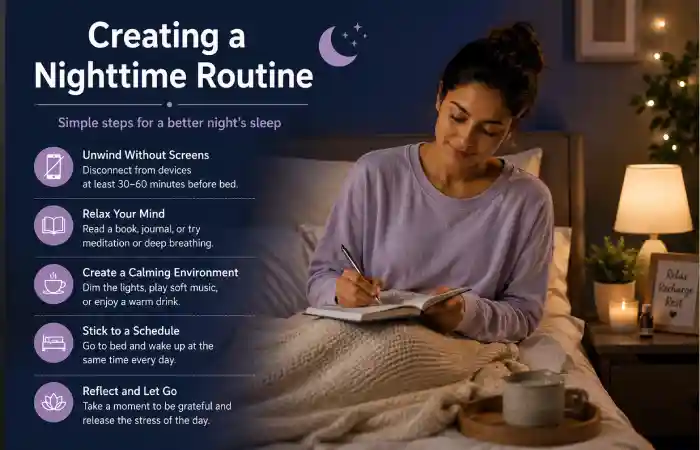
Mindfulness works better when it becomes part of a predictable routine rather than something you only try during a bad night.
Breathing exercises can be especially useful as part of a relaxing bedtime routine. Slowly bringing your attention to your breathing can help you shift your focus away from distractions and prepare for rest. Try these mindfulness breathing techniques to encourage a calmer evening routine.
A practical routine could look like this:
| Time | Activity |
| 60 minutes before bed | Reduce stimulating activities |
| 30 minutes before bed | Dim lights and put away unnecessary screens |
| 20 minutes before bed | Shower, read or do gentle stretching |
| 10 minutes before bed | Mindfulness or breathing |
| Bedtime | Lights out and sleep |
A Simple 15-Minute Mindfulness Routine
For beginners, try:
5 minutes: slow breathing
5 minutes: body scan
5 minutes: quiet awareness of thoughts and sensations
You don’t need special equipment.
Work-related responsibilities and a busy schedule can sometimes make it difficult to switch off at the end of the day. Practicing mindfulness during working hours may help you develop greater awareness and create a healthier transition from work to rest. Learn more about mindfulness at work.
A meditation app or guided audio can be useful if you find it difficult to practice alone, but it is optional.
Common Sleep Mistakes
Even a good mindfulness practice can be undermined by habits that keep your brain stimulated.
Trying Too Hard to Sleep
One of the biggest mistakes is treating sleep like a task that must be completed.
The more you think, “I need to sleep now,” the more frustrated and alert you may become.
Instead, make relaxation the goal.
Checking the Clock
Repeatedly checking the time can increase anxiety about how many hours remain before morning.
If possible, turn the clock away from your direct view.
Using Your Phone in Bed
The act of scrolling through feeds and messages, and viewing exciting material, can interfere with turning off before sleep. Electronics should be switched off as part of a relaxing bedtime routine according to The Sleep Foundation.
Hoping Mindfulness for Instant Sleep
Mindfulness is a skill.
It may feel awkward at first while you become aware of how active and scattered your brain is. That does not mean it isn’t working.
Emphasize consistency rather than expecting quick results.
If You Lie Awake Feeling Increasing Agitated
Staying in bed while awake might only further increase the correlation between your bed and anxiety.
It’s suggested by The Sleep Foundation that you get out of bed and do a low-stress activity before going back once you are more tired, in approximately twenty minutes.
Mindfulness and meditation are often used together, particularly when creating a relaxing routine. However, the two practices have some important differences. Understanding mindfulness vs. meditation can help you choose practices that suit your sleep and relaxation goals.
Mindfulness vs. Other Sleep Approaches
| Approach | Best use | Main purpose |
| Mindfulness | Racing thoughts and bedtime stress | Reduces mental reactivity and promotes awareness |
| Breathing exercises | Tension and difficulty winding down | Encourages physical relaxation |
| Sleep hygiene | Building healthy sleep habits | Removes environmental and behavioral barriers |
| Body scan | Busy or restless mind | Shifts attention toward physical sensations |
| CBT-I | Persistent insomnia | Treats chronic insomnia using behavioral and cognitive strategies |
The Bottom Line
Mindfulness sleep helps not to make you fall asleep, but a smooth transition from alertness to sleepiness. Simple methods of meditation based on breathing, body scanning and the state of wakefulness are helpful to take a break from excessive thoughts or trouble sleeping in the evening.
Combining mindfulness meditation with regular evening rituals, a comfortable sleep environment and healthy sleep practices contribute significantly to the achievement of success. If you still encounter problems with falling asleep, it would not be useful to practice mindfulness without other treatment based on evidence.
Afiya Jafar is a fitness and wellness writer who focuses on making health, exercise, and healthy lifestyle information simple and practical. Her work covers workouts, fitness motivation, strength training, nutrition, weight management, stress management, mindfulness, and everyday wellness.
Read Full Bio of Afiya Jafar →
Sameena Begum reviews selected health, wellness, fitness, and digital content for clarity, factual presentation, consistency, and reader usefulness. Her review work helps maintain clear and responsible editorial standards across PhysicalFitt content.
Read Full Bio of Sameena Begum →
Dr. Khizrana Begum is a qualified medical professional with MBBS and MD qualifications and 5+ years of experience in the medical field. She works as a General Physician and Dermatologist, with expertise in general medicine, dermatology, preventive healthcare, and skin health.
Read Full Bio of Dr. Khizrana Begum →